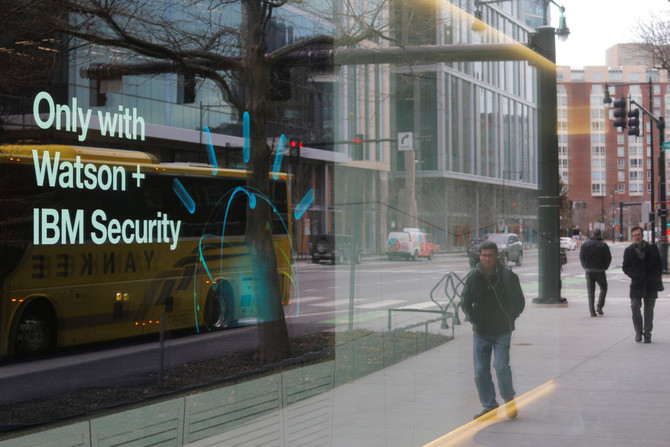
IBM returns to growth after 6 years, warns higher tax rate to hit profits

Total revenue increased 3.6 percent to $22.54 billion, beating analysts’ average estimate of $22.06 billion. (Reuters)
Updated 19 January 2018
Follow

IBM returns to growth after 6 years, warns higher tax rate to hit profits

BENGALURU: International Business Machines Corp’s revenue rose for the first time in 23 quarters, beating analysts’ estimates, but the company warned that a higher tax rate this year would eat into its profit.
IBM’s shares, which have rallied 10 percent so far this year on hopes of a strong turnaround in the company’s fortunes, fell more than 3 percent in extended trading on Thursday.
The company forecast stable margins and revenue growth for 2018, buoyed by growth in its newer businesses such as cloud computing and security services.
However, IBM forecast an operating profit of at least $13.80 per share for 2018, compared with $13.80 in 2017 and market expectations of $13.92, according to Thomson Reuters.
“According to Street expectations, we’re already very low for earnings, ... but still, you would have liked to have seen, with the little better revenue trajectory and some positive comments, that would have played in to a nicer number,” Pivotal Research analyst Lou Miscioscia said.
IBM forecast a 2018 operating tax rate of 16 percent, plus or minus 2 percentage points, compared with a rate of 12 percent in 2017.
“Tax will be a headwind in 2018,” IBM veteran and new Chief Financial Officer James Kavanaugh said on a conference call.
Kavanaugh said IBM would continue to “maintain a high level of investment” in 2018 as it boosts its capabilities on its high-margin “strategic imperatives” such as cloud, mobile, cybersecurity and data analytics.
That focus, started by Chief Executive Ginni Rometty, has helped IBM counter its faltering legacy hardware and software businesses and slow its revenue declines in recent quarters.
The company’s revenue finally rose in the latest fourth quarter, the first year-over-year increase since the first quarter of 2012, just after Rometty became CEO.
Revenue from IBM’s cloud business jumped 30 percent in the latest quarter. Revenue from all “strategic imperatives” rose 17 percent.
Total revenue increased 3.6 percent to $22.54 billion, beating analysts’ average estimate of $22.06 billion.
IBM swung to a loss of $1.05 billion from a year-ago profit of $4.50 billion, due to a $5.5 billion tax reform-related charge. Its adjusted profit of $5.18 per share beat estimates by a penny.
The company’s adjusted gross margins of 49.5 percent fell short of market expectations of 50.8 percent.


Saudi Arabia leads outcome-based education to prepare future-ready generations: Harvard Business Review

A Harvard sign is seen at the Harvard University campus in Boston, Massachusetts, on May 27, 2025. (AFP)
Updated 10 February 2026
Follow

Saudi Arabia leads outcome-based education to prepare future-ready generations: Harvard Business Review

  • The Riyadh-based school group developed a strategy that links every classroom activity to measurable student competencies, aiming to graduate learners equipped for the digital economy and real-world contexts

RIYADH: Saudi Arabia’s education system is undergoing a sweeping transformation aligned with Vision 2030, shifting from traditional, input-focused methods to outcome-based education designed to equip students with future-ready skills, Harvard Business Review Arabic reported.

The transformation is being adopted and spearheaded by institutions such as Al-Nobala Private Schools, which introduced the Kingdom’s first national “learning outcomes framework,” aimed at preparing a generation of leaders and innovators for an AI-driven future, the report said.

Al-Nobala has leveraged international expertise to localize advanced learning methodologies.

The Riyadh-based school group developed a strategy that links every classroom activity to measurable student competencies, aiming to graduate learners equipped for the digital economy and real-world contexts. The school’s group approach combines traditional values with 21st-century skills such as critical thinking, communication, innovation and digital fluency.

According to the report, the shift addresses the growing gap between outdated models built for low-tech, resource-constrained environments and today’s dynamic world, where learners must navigate real-time information, virtual platforms, and smart technologies.

“This is not just about teaching content, it’s about creating impact,” the report noted, citing how Al-Nobala’s model prepares students to thrive in an AI-driven world while aligning with national priorities.

The report noted that Saudi Arabia’s Ministry of Education has paved the way for this shift by transitioning from a centralized controller to a strategic enabler, allowing schools such as Al-Nobala to tailor their curriculum to meet evolving market and societal needs. This is part of the long-term goal to place the Kingdom among the top 20 global education systems.

Al-Nobala’s work, the report stated, has succeeded in serving the broader national effort to link education outcomes directly to labor market demands, helping to fulfill the Vision 2030 pillar of building a vibrant society with a thriving economy driven by knowledge and innovation.

Last February, Yousef bin Abdullah Al-Benyan, Saudi Arabia’s minister of education, said that the Kingdom was making “an unprecedented investment in education,” with spending aligned to the needs of growth and development. He said that in 2025, education received the second-largest share of the state budget, totaling $53.5 billion.