LONDON: Emirates has secured the future of the Airbus A380 — at least for now — with an order for 36 of the superjumbos, it emerged on Thursday.
But only 20 are firm orders and the European aircraft maker will likely get “significantly” less than the list price of $16 billion, analysts told Arab News.
Tim Coombs, airlines specialist at Aviation Economics, said Airbus “had been quite clear that the production line would have closed without an order from Emirates.”
That in itself would have markedly increased the Gulf carrier’s bargaining position.
When asked if the discount could have been struck at or below 40 percent, Chris Tarry, airlines analyst at CTAIRA, told Arab News: “I wouldn’t disabuse you of that.”
Discounts for orders from Airbus and Boeing are not uncommon, but the size of concessions are rarely disclosed.
Tarry said: “I am sure Emirates was able to secure a particularly attractive price for the additional aircraft.”
A dearth of orders had cast doubts on the future of the A380 program with Chief Operating Officer John Leahy saying a few days ago that production would have ceased without a further commitment from Emirates. The airline is by far Airbus’s largest customer for A380s, with 101 deliveries in the past 10 years.
With the latest deal, the A380 could continue now for “at least another 10 years,” said Leahy in an Airbus statement on Thursday.
A major issue for the future of the four-engined A380 has been that twin-engined aircraft have been getting bigger and flying further. Instead of airlines flying to hubs such as Dubai, there is a greater choice of jets to carry travelers direct to their destinations, said Coombs.
Chris Bryant, Berlin-based columnist for Bloomberg, wrote on the news organization’s website that the A380 had always seemed the ideal solution to the problem of increasingly congested airports.
“Yet, in reality, airlines are increasingly shunning the big hubs and flying point-to-point instead, thanks in part to a new generation of fuel-efficient jets,” said Bryant.
The latest Emirates/A380 contract comes in the form of a memorandum of understanding that allows a buyer to pull out under certain conditions, and is often not legally binding.
Some of the new A380s, which will begin to be delivered from 2020, will be replacements for the oldest of the wide-bodied aircraft, Emirates said in a statement.
It is not known if these new orders will encompass an upgraded version of the superjumbo — dubbed the A380plus — which adds fuel-saving winglets and room for 80 more passengers.
“I’m personally convinced more orders will follow Emirates’ example and that this great aircraft will be built well into the 2030s,” said Leahy.
Already by far the biggest A380 customer, Emirates has repeatedly stalled on a deal, putting the aircraft’s future in doubt after Airbus failed to win new orders for two years.
There were gasps at the Dubai Air Show in November when Emirates unveiled a provisional $15.1 billion order for 40 of Boeing’s mid-sized wide-body 787-10 jetliners instead of announcing an expected deal with Airbus for more A380s.
Airbus had warned in 2016 that 10 years after entering service, its A380 production line would have dwindled to 12 a year in 2018, and eight in 2019.
After Thursday’s deal, continued production is secured for the time being, but analysts cautioned that further big orders were unlikely. Tarry commented: “Should we expect lots more orders in the near term? Certainly not,” he said.
Emirates Chairman Sheikh Ahmed bin Saeed Al-Maktoum said: “Some of the new A380s we’ve just ordered will be used as fleet replacements. This order will provide stability to the A380 production line.”
He added: “We will continue to work closely with Airbus to further enhance the aircraft and onboard product, so as to offer our passengers the best possible experience. The beauty of this aircraft is that the technology and real estate on board gives us plenty of room to do something different with the interiors.”
Emirates said the A380 is an essential part of the solution to sustainable growth, alleviating traffic congestion at busy airports by transporting more passengers with fewer flights. The carrier was said to be the best way to capture growing world air traffic, which doubles every 15 years. The A380 flies 8,200 nautical miles (15,200 kilometers) non-stop and can accommodate 575 passengers in four classes.
Leahy said: “This aircraft has contributed enormously to Emirates’ growth and success since 2008 and we are delighted that it will continue to do so.”


Emirates throws A380 a lifeline with $16bn order at eleventh hour
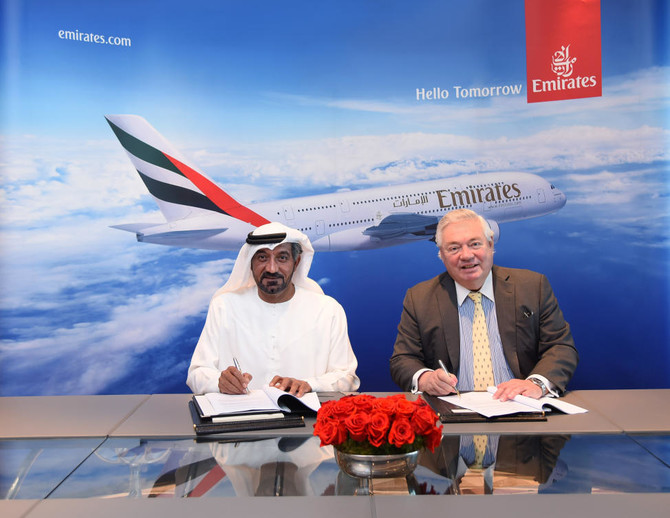
Emirates throws A380 a lifeline with $16bn order at eleventh hour


How AI and financial literacy are redefining the Saudi workforce
- Preparing people capable of navigating money and machines with confidence
ALKHOBAR: Saudi Arabia’s workforce is entering a transformative phase where digital fluency meets financial empowerment.
As Vision 2030 drives economic diversification, experts emphasize that the Kingdom’s most valuable asset is not just technology—but people capable of navigating both money and machines with confidence.
For Shereen Tawfiq, co-founder and CEO of Balinca, financial literacy is far from a soft skill. It is a cornerstone of national growth. Her company trains individuals and organizations through gamified simulations that teach financial logic, risk assessment, and strategic decision-making—skills she calls “the true language of empowerment.”

“Our projection builds on the untapped potential of Saudi women as entrepreneurs and investors,” she said. “If even 10–15 percent of women-led SMEs evolve into growth ventures over the next five years, this could inject $50–$70 billion into GDP through new job creation, capital flows, and innovation.”
Tawfiq, one of the first Saudi women to work in banking and later an adviser to the Ministry of Economy and Planning on private sector development, helped design early frameworks for the Kingdom’s venture-capital ecosystem—a transformation she describes as “a national case study in ambition.”
“Back in 2015, I proposed a 15-year roadmap to build the PE and VC market,” she recalled. “The minister told me, ‘you’re not ambitious enough, make it happen in five.’” Within years, Saudi Arabia had a thriving investment ecosystem supporting startups and non-oil growth.
Opinion
This section contains relevant reference points, placed in (Opinion field)
At Balinca, Tawfiq replaces theory with immersion. Participants make business decisions in interactive simulations and immediately see their financial impact.
“Balinca teaches finance by hacking the brain, not just feeding information,” she said. “Our simulations create what we call a ‘business gut feeling’—an intuitive grasp of finance that traditional training or even AI platforms can’t replicate.”
While AI can personalize lessons, she believes behavioral learning still requires human experience.

“AI can democratize access,” she said, “but judgment, ethics, and financial reasoning still depend on people. We train learners to use AI as a co-pilot, not a crutch.”
Her work aligns with a broader national agenda. The Financial Sector Development Program and Al Tamayyuz Academy are part of Vision 2030’s effort to elevate financial acumen across industries. “In Saudi Arabia, financial literacy is a national project,” she said. “When every sector thinks like a business, the nation gains stability.”
Jonathan Holmes, managing director for Korn Ferry Middle East, sees Saudi Arabia’s digital transformation producing a new generation of leaders—agile, data-literate, and unafraid of disruption.
“What we’re seeing in the Saudi market is that AI is tied directly to the nation’s economic growth story,” Holmes told Arab News. “Unlike in many Western markets where AI is viewed as a threat, here it’s seen as a catalyst for progress.”

Holmes noted that Vision 2030 and the national AI strategy are producing “younger, more dynamic, and more tech-fluent” executives who lead with speed and adaptability. Korn Ferry’s CEO Tracker Report highlighted a notable rise in first-time CEO appointments in Saudi Arabia’s listed firms, signaling deliberate generational renewal.
Korn Ferry research identifies six traits for AI-ready leadership: sustaining vision, decisive action, scaling for impact, continuous learning, addressing fear, and pushing beyond early success.
“Leading in an AI-driven world is ultimately about leading people,” Holmes said. “The most effective leaders create clarity amid ambiguity and show that AI’s true power lies in partnership, not replacement.”
He believes Saudi Arabia’s young workforce is uniquely positioned to model that balance. “The organizations that succeed are those that anchor AI initiatives to business outcomes, invest in upskiling, and move quickly from pilots to enterprise-wide adoption,” he added.
DID YOU KNOW?
• Saudi women-led SMEs could add $50–$70 billion to GDP over five years if 10–15% evolve into growth ventures.
• AI in Saudi Arabia is seen as a catalyst for progress, unlike in many Western markets where it is often viewed as a threat.
• Saudi Arabia is adopting skills-based models, matching employees to projects rather than fixed roles, making flexibility the new currency of success.
The convergence of Tawfiq’s financial empowerment approach and Holmes’s AI leadership vision points to one central truth: the Kingdom’s greatest strategic advantage lies in human capital that can think analytically and act ethically.
“Financial literacy builds confidence and credibility,” Tawfiq said. “It transforms participants from operators into leaders.” Holmes echoes this sentiment: “Technical skills matter, but the ability to learn, unlearn, and scale impact is what defines true readiness.”

As organizations adopt skills-based models that match employees to projects rather than fixed job titles, flexibility is becoming the new currency of success. Saudi Arabia’s workforce revolution is as much cultural as it is technological, proving that progress moves fastest when inclusion and innovation advance together.
Holmes sees this as the Kingdom’s defining opportunity. “Saudi Arabia can lead global workforce transformation by showing how technology and people thrive together,” he said.
Tawfiq applies the same principle to finance. “Financial confidence grows from dialogue,” she said. “The more women talk about money, valuations, and investment, the more they’ll see themselves as decision-makers shaping the economy.”
Together, their visions outline a future where leaders are inclusive, data-literate, and AI-confident—a model that may soon define the global standard for workforce transformation under Vision 2030.


