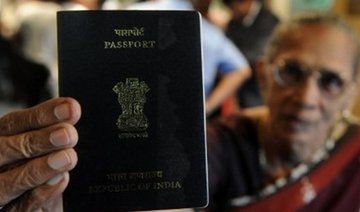
NEW DELHI: Indian government’s recent decision to issue orange passports to people who require emigration checks has been widely criticized by concerned citizens who have described the new rules as discriminatory.
The Indian Foreign Ministry said on Friday that those who need emigration clearance for travel to a group of 18 countries, mostly in the Gulf region, would be issued with orange passports and those who do not would receive blue ones.
People who have graduated high school, or are among the 2 percent of Indians who pay income tax, do not require emigration checks. But the vast majority of unskilled workers do.
“You are making a mockery of the people who are illiterate and come from the marginalized section of society,” said Professor Irudaya Rajan S. of Kerala’s Center for Development Studies (CDS). “It is an institutionalization of discrimination on the basis of education.”
According to Pew Research Center, 1 in 20 migrant workers worldwide are Indian-born. As of 2015, 15.6 million people born in India were living in other countries. India has been among the world’s top countries of origin for migrants since the UN started tracking those figures in 1990. A World Bank estimate says that India received about $69 billion in remittances in 2015 amounting to roughly three percent of the country’s gross domestic product.
Data provided by the Indian Embassy in Doha reveals that between 2004 and 2017, around 3,154 Indian workers died in Qatar, with more than 200 workers dying each year from 2007 onwards.
“How will changing the color of the passport stop exploitation?” asked Rajan. “It’s not the right move. In the name of protection, you are exposing people to risk both inside and outside India. (This) is not going to help stop human trafficking and exploitation.”
Government sources say the scheme is supposed to prevent the exploitation of Indian workers abroad, although there has been no clear explanation as to how.
The government has claimed that the new passport scheme will make it easier for immigration officers to identify workers who require vetting before being allowed to travel to various countries. As the Washington Post reported, “The theory is this would also make human trafficking more difficult as border officials would immediately know which people need the extra permission to travel.”
But Rajan said, “It is sheer discrimination on the basis of the socio-economic status of the workers. The government argues that it wants to protect Indians who are vulnerable through this decision. The orange passport will make them much more vulnerable, as they are more easily identifiable.”
Pranay Kotasthane, a geopolitical analyst at the Bangalore-based think tank The Takshashila Institution, questioned the need for emigration clearance in the first place, and added that the “priority of the government should be to prevent exploitation of women and Indian workers abroad. There is no way the change in the color of the passport is going to do that.”
He told Arab News that “by changing the color of the passport, you are just systematizing more discrimination – one Indian gets one color of passport and another gets the other one. It’s not solving the problem. In fact this should be used as an opportunity by India to completely get rid of the emigration system that we have used since 1983.”
Rakesh Sinha, a member of Rashtriya Swayamsevak Sangh (RSS), the paternal organization of the ruling Bharatiya Janata Party (BJP), defends the government’s decision, saying that “the move will act as a deterrent against human trafficking.”
However, leader of the opposition, Congress Party President Rahul Gandhi, said the move was “completely unacceptable” and that the government is “treating India’s migrant workers like second-class citizens.”
“This action demonstrates BJP’s discriminatory mind-set,” Gandhi added.