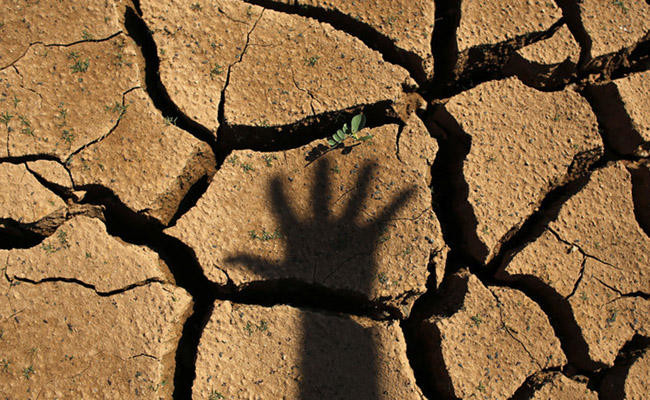
Global business leaders and policymakers are more worried about environmental issues than any other risk factor in 2018, according to a report by the World Economic Forum (WEF).
The report, which is published each January ahead of the WEF’s annual meeting in Davos, Switzerland, said that the world is “struggling to keep up with the pace of change.” For the second year running, environmental shocks are the main concern for global experts and decision makers.
The report “highlights numerous areas where we are pushing systems to the brink, from extinction-level rates of biodiversity loss to mounting concerns about the possibility of new wars,” the WEF said.
Experts were asked to rank 30 global risks in terms of impact and likelihood. All five environmental risks — extreme weather; biodiversity loss and ecosystem collapse; major natural disasters; man-made environmental disasters; and failure of climate-change mitigation and adaptation — were responders’ biggest concerns. Extreme weather events — what the WEF called “billion dollar disasters” — were seen as the single most prominent risk.
In the Middle East, however, other risks were seen as more threatening. The report highlighted fiscal crisis as the biggest threat to stability, followed by energy price shocks, unemployment, terrorist attacks and inter-state conflict. The environment did not feature in the top five risks for regional leaders.
Environmental issues are sure to feature prominently at this year’s meeting in Davos, with the presence of US President Donald Trump, a renowned skeptic on climate change, guaranteed to generate debate on the matter.
World leaders are also generally more pessimistic about the state of global affairs. Of 1,000 surveyed by the WEF, some 59 percent said that risks would increase in 2018, with only 7 percent believing that the world would be less risky.
A deteriorating geopolitical landscape is partly to blame for the pessimistic outlook in 2018, with 93 percent of respondents saying they expect political or economic confrontations between major powers to worsen and nearly 80 percent expecting an increase in risks associated with war involving major powers, the report added.
“There are numerous other potential flashpoints around the world, not least in the Middle East, where an increasing number of destabilizing forces might lead to the eruption of new military conflicts in addition to those in Syria and Yemen,” the report said.
Global economic growth is forecast to be strong in 2018, reducing the risk from economic factors. Some experts were worried that the improvement in global GDP growth rates may lead to complacency about persistent structural risks in the global economic and financial systems.
Even so, inequality is ranked high among the underlying risk drivers, and the most frequently cited interconnection of risks is that between adverse consequences of technological advances and high structural unemployment or under-employment, the report said.
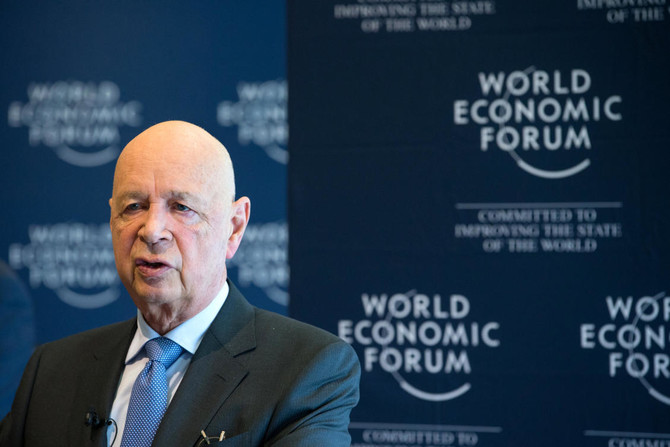
Klaus Schwab, the WEF’s founder and executive chairman, said: “A widening economic recovery presents us with an opportunity that we cannot afford to squander, to tackle the fractures that we have allowed to weaken the world’s institutions, societies and environment. We must take seriously the risk of a global systems breakdown. Together we have the resources and the new scientific and technological knowledge to prevent this. Above all, the challenge is to find the will and momentum to work together for a shared future.”
Cyber threats are growing in prominence, with large-scale cyberattacks now ranked third in terms of likelihood, while rising cyber-dependency is ranked as the second most significant driver shaping the global risks landscape over the next 10 years, the report concluded.
John Drzik, president of global risk and digital at Marsh & McLennan insurance group, which sponsors the report, said: “Geopolitical friction is contributing to a surge in the scale and sophistication of cyber-attacks. At the same time cyber exposure is growing as firms are becoming more dependent on technology.”


![]()
![]()
Environment the biggest worry for global leaders in gloomy report from WEF
Environment the biggest worry for global leaders in gloomy report from WEF
Latest updates


© 2026 SAUDI RESEARCH & PUBLISHING COMPANY, All Rights Reserved And subject to Terms of Use Agreement.