UN hopes imports will help stave off famine in Yemen as diphtheria spreads

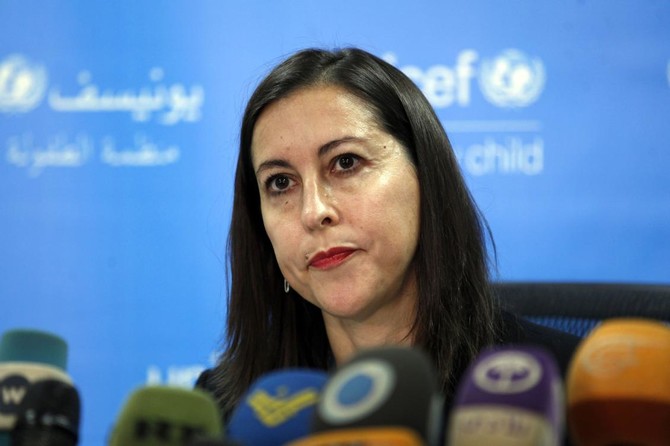
UNICEF's representative in Yemen, Meritxell Relano, looks on during a press conference in the Yemeni capital Sana'a, on January 16, 2018. (AFP)
Updated 17 January 2018
Follow

UN hopes imports will help stave off famine in Yemen as diphtheria spreads

GENEVA: UN aid agencies called on Tuesday for the Yemeni port of Hodeidah to remain open beyond Friday, the date set by a Saudi-led military coalition, to permit continued delivery of life-saving goods.
Yemen is the world’s worst humanitarian crisis, where 8.3 million people are entirely dependent on external food aid and 400,000 children suffer from severe acute malnutrition, a potentially lethal condition, they said.
The Arab coalition, under international pressure, eased a three-week blockade which was imposed on Yemeni ports and airports in November in response to a ballistic missile fired by the Houthi movement toward the Saudi capital Riyadh.
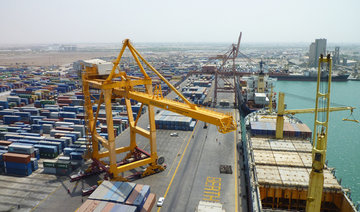
Four mobile cranes arrived in the important Houthi-controlled Hodeidah port, the UN said on Monday, after the coalition agreed to let them into Yemen, where nearly three years of war have pushed it to the verge of famine.
“The port in theory is going be open to the 19th of this month. Then we don’t know if the coalition will close or (leave) it open,” Meritxell Relano, UN Children’s Fund (UNICEF) Representative in Yemen, told a news briefing in Geneva.
“Obviously the feeling is that they extend this period so that the commercial goods can come in, but especially the fuel,” she said, speaking from the capital Sanaa.
Before the conflict, Hodeidah port handled around 70 percent of Yemen’s imports, including food and humanitarian supplies.
Fuel is vital to power water and sanitation stations to provide clean water and help avoid diseases, she said.
More than 11 million Yemeni children — virtually all — need humanitarian assitance, Relano said. UNICEF figures show 25,000 Yemeni babies die at birth or before the age of one month.
“Yemen is in the grips of the world’s biggest hunger crisis,” World Food Programme (WFP) spokeswoman Bettina Luescher said. “This is a nightmare that is happening right now.”
“We appeal to parties on (the) ground in order to stave off famine that we can continue regularly to get food in, to get medicines in, to get fuel in, be it from the humanitarian or the commercial side,” she said.

Luescher, asked about prospects for the Hodeidah port lifeline to remain open, replied: “Obviously since the cranes were imported and are operational, we are hopeful and optimistic that our work can continue.”
A diphtheria outbreak in Yemen is “spreading quickly,” with 678 cases and 48 associated deaths in four months, Fadela Chaib of the World Health Organization said.
The number of cases has doubled since Dec 22, when the WHO reported 333 people affected by the highly-contagious disease, with 35 deaths. Ibb and Hodeidah are the worst-hit of the 19 affected governorates, Chaib said.
“We can stop the outbreak by providing antibiotics and also vaccinating,” she said. Some 2.5 million doses have been imported for a planned immunization campaign, she said.

First responders enter devastated Aleppo neighborhood after days of deadly fighting

Updated 12 January 2026
Follow

First responders enter devastated Aleppo neighborhood after days of deadly fighting

  • The US-backed SDF, which have played a key role in combating the Daesh group in large swaths of eastern Syria, are the largest force yet to be absorbed into Syria’s national army

ALEPPO, Syria: First responders on Sunday entered a contested neighborhood in Syria’ s northern city of Aleppo after days of deadly clashes between government forces and Kurdish-led forces. Syrian state media said the military was deployed in large numbers.
The clashes broke out Tuesday in the predominantly Kurdish neighborhoods of Sheikh Maqsoud, Achrafieh and Bani Zaid after the government and the Syrian Democratic Forces, the main Kurdish-led force in the country, failed to make progress on how to merge the SDF into the national army. Security forces captured Achrafieh and Bani Zaid.
The fighting between the two sides was the most intense since the fall of then-President Bashar Assad to insurgents in December 2024. At least 23 people were killed in five days of clashes and more than 140,000 were displaced amid shelling and drone strikes.
The US-backed SDF, which have played a key role in combating the Daesh group in large swaths of eastern Syria, are the largest force yet to be absorbed into Syria’s national army. Some of the factions that make up the army, however, were previously Turkish-backed insurgent groups that have a long history of clashing with Kurdish forces.
The Kurdish fighters have now evacuated from the Sheikh Maqsoud neighborhood to northeastern Syria, which is under the control of the SDF. However, they said in a statement they will continue to fight now that the wounded and civilians have been evacuated, in what they called a “partial ceasefire.”
The neighborhood appeared calm Sunday. The United Nations said it was trying to dispatch more convoys to the neighborhoods with food, fuel, blankets and other urgent supplies.
Government security forces brought journalists to tour the devastated area, showing them the damaged Khalid Al-Fajer Hospital and a military position belonging to the SDF’s security forces that government forces had targeted.
The SDF statement accused the government of targeting the hospital “dozens of times” before patients were evacuated. Damascus accused the Kurdish-led group of using the hospital and other civilian facilities as military positions.
On one street, Syrian Red Crescent first responders spoke to a resident surrounded by charred cars and badly damaged residential buildings.
Some residents told The Associated Press that SDF forces did not allow their cars through checkpoints to leave.
“We lived a night of horror. I still cannot believe that I am right here standing on my own two feet,” said Ahmad Shaikho. “So far the situation has been calm. There hasn’t been any gunfire.”
Syrian Civil Defense first responders have been disarming improvised mines that they say were left by the Kurdish forces as booby traps.
Residents who fled are not being allowed back into the neighborhood until all the mines are cleared. Some were reminded of the displacement during Syria’s long civil war.
“I want to go back to my home, I beg you,” said Hoda Alnasiri.