ISLAMABAD: Pakistan’s prominent religious scholars have delivered a fatwa in which they unanimously declared all forms of terrorism and suicide attacks un-Islamic.
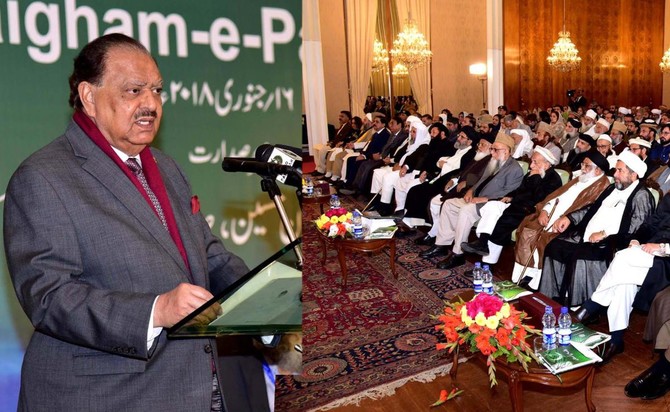
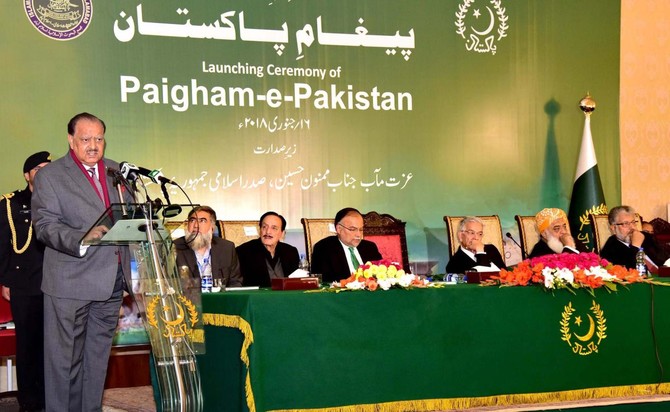
Their fatwa (decree) was summed up in a document called “Paigham-e-Pakistan” — or “Message from Pakistan” — which was released at a ceremony they attended at the Presidency in the presence of the leading stalwarts of the ruling Pakistan Muslim League (Nawaz) party.
Expressing his confidence in the decree, President Mamnoon Hussain told the audience that the document would be pivotal in countering sectarianism, terrorism, and extremism. He said that the consensus among religious scholars to issue the decree was a monumental step toward progress, adding it would not only present a positive image of the country but also highlight Islam as a religion of peace.
A copy of the 49-page document obtained by Arab News is signed by 1,829 clerics from all Islamic schools of thought in the country. Pakistan’s Foreign Minister Khawaja Asif urged the citizens to accept the decree and support state institutions in their war against terrorism.
Asif said that the government would not allow Pakistani soil to be used for militant training and recruitment or launching attacks against other countries.
“The fatwa, which condemns terrorism and extremism, has also been endorsed by Pakistan’s Ministries of Interior, Foreign Affairs, Education and Religious Affairs,” said President House spokesperson Farooq Adil, adding that it “is also our comprehensive state narrative against terrorism.”
Adil told Arab News that the decree document was drafted on the request of the state. The task was given to the International Islamic University, which not only has religious experts but also communicates with other religious scholars, sects, and civil society. After numerous meetings and deliberations over a span of several months, the decree was unanimously drafted and agreed.
Sharing its salient features, Adil said the fatwa was based on the Constitution of Pakistan, which “is an Islamic constitution that is built upon the Qur’an and the Sunnah.”
Some of the major points of the decree state that the “Constitutions of Pakistan is an Islamic and Democratic document and it is a social contract between all (federating) units of Pakistan, which enjoys the support of (Islamic) scholars of all schools of thought.”
The document adds that “in accordance with the requirements of the Constitution of the Islamic Republic, there is nothing in Pakistan which is contrary to the Qur’an and the Sunnah and no individual or group has the right to start any sort of armed struggle against the state of Pakistan and its institutions in the presence of this constitution.”
The document also condemns the groups who use force in the name of implementing Shariah, saying their acts are repugnant to the basic teachings of Islam. “Moreover, revolt against the Constitution of Pakistan and imposing one’s own ideology on others with force is contrary to the injunctions of Shariah and is thus riot on earth. This is also a national crime according to the constitution and laws of the Islamic Republic. In order to put an end to such destructive activities, comprehensive administrative, educational, ideological and defense measures will be taken.”
Paigham-e-Pakistan also maintains that “there is a need for modern establishment of Pakistani society in line with the requirements of the Constitution of Pakistan, which eradicates the tendencies of hate, narrow-mindedness and intolerance.”
“We have seen many fatwas in the past, but this is a comprehensive one and has covered all issues in an effective manner,” said Qari Mohammed Hanif Jalandhri, secretary-general of the largest federation of Islamic seminaries, Wafaqul Madaris Al-Arabia, while speaking with Arab News.
The decree may not be enough to stop terrorists acting as “soldiers of Islam,” but it would prevent misinterpretation of the religion, said Dr. Yaseen Zafar of the Salafi Madrasa Board.
“We wanted to send out a clear message that all religious scholars are against extremism and terrorism. Hopefully, this will also deoxygenate militant networks and gradually make them irrelevant,” Zafar told Arab News.
Former Chairman of the Madrasa Education Board of Pakistan Dr. Amir Tauseen agreed that it was important to issue a fatwa with consensus. However, he added that what was more important was its implementation.


![]()
![]()
Pakistani religious scholars pass fatwa against terrorism
Pakistani religious scholars pass fatwa against terrorism
Latest updates


Recommended


© 2026 SAUDI RESEARCH & PUBLISHING COMPANY, All Rights Reserved And subject to Terms of Use Agreement.