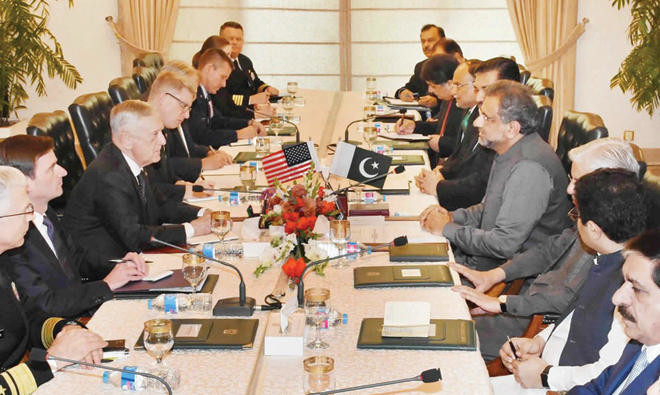
ISLAMABAD: Defense Secretary Jim Mattis pressed top Pakistani leaders Monday to “redouble” efforts to go after insurgents operating in safe havens, the Pentagon said, underscoring a long frustration with Islamabad over Taliban-linked militants that freely cross the border to conduct attacks against the US and allies in Afghanistan.
Both sides released comments saying that the US and Pakistan are want to continue to work together and that Islamabad plays a key role in the struggle for peace in Afghanistan.
In brief comments before their meeting, Pakistan Prime Minister Shahid Khaqan Abbasi said his country is committed to the war on terror and shares the same common objectives as the US.
“Engagement is there,” he said, adding that they “need to move forward with (the) issues at hand.”
Mattis did not speak while reporters were present. A Pentagon statement said that during the meetings Mattis discussed Pakistan’s role in the peace process and “reiterated that Pakistan must redouble its efforts to confront militants and terrorists operating within the country.”
A statement from Abbasi’s office said the prime minister talked about recent counterterrorism operations and said Pakistan “would continue to conduct intelligence based operations all over the country.” And it said Abbasi appreciates “the US resolve not to allow the use of Afghan soil against Pakistan.”
Earlier, Mattis told reporters traveling with him that he wants to work with Pakistan to address the problems, adding that the US is committed to a pragmatic relationship that expands cooperation while also “reinforcing President Trump’s call for action against terrorist safe havens.”
“We have heard from Pakistan leaders that they do not support terrorism. So I expect to see that sort of action reflected in their policies,” Mattis said before his trip to Islamabad.
Mattis met with Abbasi and army chief Gen. Qamar Javed Bajwa, as well as a number of senior Pakistani leaders and military officials and US Ambassador David Hale.
Mattis’ statement reflects persistent US assertions that Islamabad is still not doing enough to battle the Taliban and allied Haqqani network insurgents within its borders.
Since the start of the war in Afghanistan, militants in Pakistan have crossed the mountainous and ill-defined border to wage attacks, then return to safe havens in Pakistan, where they have had a long-standing relationship with the ISI, Islamabad’s intelligence agency.
In a blunt assessment early last week, Gen. John Nicholson, the top US commander in Afghanistan, said there have been no changes in Pakistan’s support for militant networks.
He said Pakistani leaders went to Kabul and met with Afghan President Ashraf Ghani.
“They identified certain steps that they were going to take. We’ve not yet seen those steps play out,” Nicholson told reporters in a recent briefing.
The US, he said, has been very direct about what it expects Pakistan to do in the fight against the Taliban.
“We’re hoping to see those changes,” he said. “We’re hoping to work together with the Pakistanis going forward to eliminate terrorists who are crossing” between Pakistan and Afghanistan.
Following Mattis’ visit, Pakistan’s prime minister’s office released a statement saying there are no safe heavens in Pakistan and that the nation was committed to eradicating terrorism once and for all.
The White House, meanwhile, has previously condemned Pakistan’s release late last month of a US-wanted militant as a “step in the wrong direction” and warned that it could harm Islamabad’s relations with the US and its reputation around the world.
In August, the US said it would hold up $255 million in military assistance for Pakistan until it cracks down on extremists threatening Afghanistan.
Imtiaz Gul, an Islamabad security analyst, said US officials always come to Islamabad with their “own wish list.”
“I am sure the US defense secretary is also carrying a wish list with him but I don’t think Pakistan will accept any dictation as it has already demonstrated its seriousness in fighting terrorism, and Washington in recent weeks has appreciated and acknowledged Pakistan’s sacrifices in war on terror,” he said.
Gul said relations between Pakistan and the US have gone from bad to worse since the Trump administration announced Afghan strategy in which Pakistan was degraded and India was elevated.
“Pakistan is genuinely concerned,” he said.
President Donald Trump’s tough words about Pakistan as he unveiled the updated US strategy for the war in Afghanistan, infuriated Islamabad and triggered anti-US protests there that Pakistani police had to use tear gas to disperse
Mattis’ trip to Pakistan comes at the end of a short trip to the region, including stops in Egypt, Jordan and Kuwait.


![]()
Mattis seeks more cooperation with Pakistan on terror fight
Mattis seeks more cooperation with Pakistan on terror fight

Latest updates


© 2026 SAUDI RESEARCH & PUBLISHING COMPANY, All Rights Reserved And subject to Terms of Use Agreement.