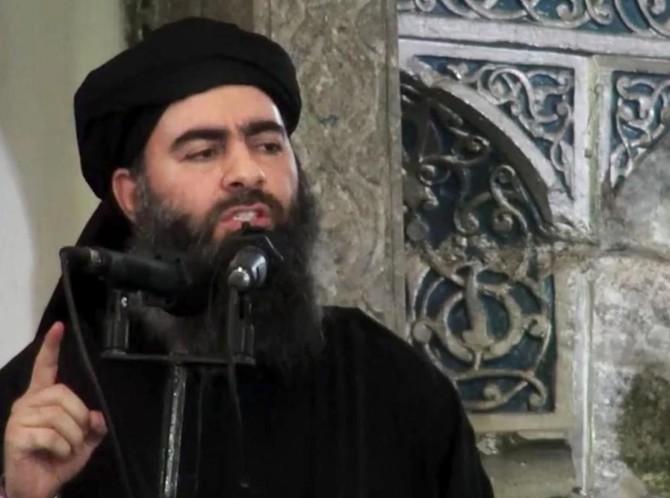
Abu Bakr Al-Baghdadi: The world’s most wanted remains at large

Abu Bakr Al-Baghdadi, the leader of Daesh remains at large, months after his caliphate collapsed in 2017. (AP)
Updated 16 January 2018
Follow

Abu Bakr Al-Baghdadi: The world’s most wanted remains at large

Abu Bakr Al-Baghdadi, the leader of Daesh remains at large, months after his “caliphate” collapsed in 2017.
But the most wanted man has been traced to a specific place at least three times in the past 18 months, according to British daily The Guardian.
Intelligence agencies in Iraq and Europe believe for most of the past year and a half, Baghdadi has been based in a village south of Baaj — traveling within a small range between Abu Kamal, on the Iraq-Syria border, and Shirkat, south of Mosul.
Late last year, he was traced to a village south of Baaj, through the brief use of a communications device.
The connection was picked up by a signals intelligence network that has penetrated web and phone use in Daesh-held areas. However, it was too brief to pin point his exact location.
However the threat of his return remains. Signs of Daesh regrouping could mean the return of the group’s leader.
A US military assessment suggests he is probably hiding in the Euphrates river valley, along the border with Syria.
Meanwhile regional officials say he has returned to land between the Tharthar basin and the desert, closer to where the troubles began.


In major policy shift on Syria, UN Security Council lifts sanctions on Hayat Tahrir Al-Sham

Updated 4 sec ago
Follow

In major policy shift on Syria, UN Security Council lifts sanctions on Hayat Tahrir Al-Sham

  • Move reflects evolving Syrian political landscape in the post-Assad era, ending a global freeze on assets, travel ban and arms embargo

NEW YORK CITY: The UN Security Council on Friday removed Al-Nusra Front, the militant group that evolved into Hayat Tahrir Al-Sham, from its so-called Daesh and Al-Qaeda Sanctions List.

The move signals a major shift in international policy toward Syria’s evolving political landscape in the post-Assad era, and ends a global freeze on assets, travel ban and arms embargo that have been imposed on the group since 2014.

Al-Nusra Front and Hayat Tahrir Al-Sham were led by Ahmad Al-Sharaa, formerly Abu Mohammed Al-Julani, who is now Syria’s president and was a leading figure in the offensive that toppled the Assad regime.

The consensus decision by the Security Council’s sanctions committee was announced by the UK, which holds the presidency of the Security Council this month and was acting in the absence of the chair of the committee. It followed a request by the new Syrian authorities to delist “Al-Nusrah Front for the People of the Levant.”

The decision means measures that were applied to Hayat Tahrir Al-Sham under Security Council Resolution 2734, adopted in 2024, no longer apply. As a result, UN member states are notrequired to freeze the group’s funds, restrict the movement of its representatives, or block the supply or transfer of arms and related materiel.

Al-Nusra Front was added to the sanctions list for its ties to Al-Qaeda and involvement in the financing and execution of militant activities during the war in Syria. The UN initially continued to treat the group’s successor organization, Hayat Tahrir Al-Sham, as a listed alias.

Al-Sharaa has said the group severed all prior transnational jihadist links and is now solely focused on local Syrian matters.