

Philippine volcano ‘fireworks’ draw tourists as residents flee

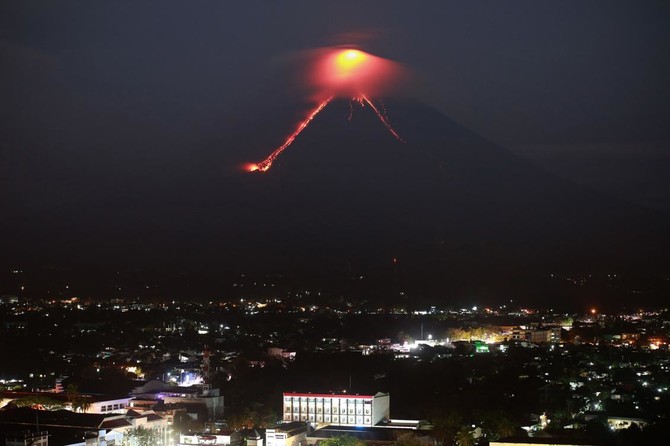
Above, lava from Mayon volcano is seen as it erupts in Legazpi City on January 15. Mayon, a near-perfect cone that also draws thousands of tourists during its periods of quiet, rises 2,460 meters above Legazpi. (AFP)
Updated 16 January 2018
Follow

Philippine volcano ‘fireworks’ draw tourists as residents flee

LEGAZPI CITY, Philippines: Spectacular lava “fireworks” shooting from its crater are drawing tourists to the Philippines’ most active volcano, authorities said Tuesday as scientists warned of a potential dangerous eruption within days.
Lava spurting from Mayon volcano lit up the sky overnight Monday in what scientists said was a sign of increasing activity that prompted official calls for evacuation of areas under threat from a major eruption.
But even as thousands of residents flee, tourists are flocking to the area, some 330 kilometers southeast of Manila to watch and photograph the spectacle, Danny Garcia, a spokesman for Albay province said.
“It’s a spectacle to watch. It’s beauty and fury in one, especially at night. But it’s a natural phenomenon so we don’t know when an (explosive) eruption will happen,” Garcia added.
Mayon, a near-perfect cone that also draws thousands of tourists during its periods of quiet, rises 2,460 meters above Legazpi, a city of about 200,000 people surrounded by a largely agricultural region.

The state volcanology institute described the natural pyrotechnics as “short-duration lava fountaining,” an escalation from the slow lava flow from the crater a day earlier.
“If lava has enough gas and material, fragments will be flown up into the air, like the fountain you light up on New Year’s Eve,” Renato Solidum, head of the Philippine Institute of Volcanology and Seismology (Phivolcs), said.
“There is more force involved when the lava would exit so it’s more intense than just the lava oozing out.”
Ash also rose two kilometers into the sky in the past 24 hours, enveloping surrounding areas in a grey carpet as more residents left their homes for safety.
About 30,000 people in and around Legazpi have fled their homes, the provincial government said on Tuesday, more than double the official count on Monday.
Local governments are tapping emergency funds and working to ensure clean water supply, officials said.
However hotels reported getting more tourist bookings while people flocked to viewing decks to watch the volcano from a distance, the provincial government said although it gave no specific figures.
The Philippines is part of the Pacific “Ring of Fire” of islands that were formed by volcanic activity, and is perennially under threat from 22 active volcanoes.
The most powerful explosion in recent years was the 1991 eruption of Mount Pinatubo, about 100 kilometers northwest of Manila, which killed more than 800 people.
Scientists said it was highly unlikely Mayon would have a similar eruption.
“It erupts quite often, and volcanoes that erupt frequently tend to have smaller eruptions than those that erupt less frequently,” David Rothery, a geosciences professor at The Open University in Britain, said.



Over 1,400 Indonesians left Cambodian scam groups in five days: embassy

Updated 2 sec ago
Follow

Over 1,400 Indonesians left Cambodian scam groups in five days: embassy

  • Scammers working from hubs across Southeast Asia lure Internet users globally into fake romances and cryptocurrency investments
  • Some foreign nationals have evacuated suspected scam compounds across Cambodia this month
PHNOM PENH: More than 1,400 Indonesians have left cyberscam networks in Cambodia in the last five days, Jakarta said on Wednesday, after Phnom Penh pledged a fresh crackdown on the illicit trade.
Scammers working from hubs across Southeast Asia, some willingly and others trafficked, lure Internet users globally into fake romances and cryptocurrency investments, netting tens of billions of dollars each year.
Some foreign nationals have evacuated suspected scam compounds across Cambodia this month as the government pledged to “eliminate” problems related to the online fraud industry, which the United Nations says employs at least 100,000 people in Cambodia alone.
Between January 16-20, 1,440 Indonesians left sites operated by online scam syndicates around Cambodia and went to the Indonesian embassy in Phnom Penh for help, the mission said in a statement.
The “largest wave of arrivals” occurred on Monday when 520 Indonesians came to the embassy, it said.
Recent Cambodian law enforcement measures against scam operators meant more citizens would likely continue showing up at the embassy, it added.
“The main problem for them is that they do not possess passports and they are staying in Cambodia without valid immigration permits,” according to the embassy.
It urged Indonesians leaving scam sites to report to the embassy, which could assist them with securing travel documents and overstay fine waivers in order to return home.
Indonesia said this week that its embassy in Phnom Penh handled more than 5,000 consular service cases for citizens in Cambodia last year — more than 80 percent of which were related to Indonesians who “admitted to being involved with online scam syndicates.”
Cambodia arrested and deported Chinese-born tycoon Chen Zhi, accused of running Internet scam operations from Cambodia, to China this month.
Chen, a former adviser to Cambodia’s leaders, was indicted by US authorities in October.
Analysts say Chen’s extradition has left some of those running Internet scams from Cambodia fearing legal consequences — after the criminal enterprises ballooned for years — with some operators opting to release people or evacuate their compounds.