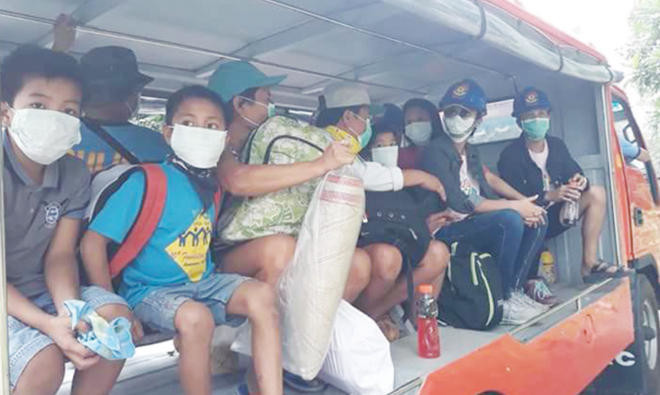
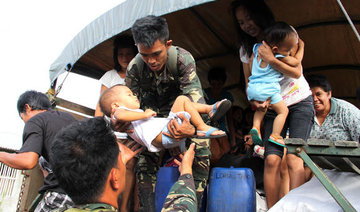
MANILA: More than 2,000 people have been evacuated as the Philippines’ most active volcano continued to spew ash on Sunday.
The Philippine Institute of Volcanology and Seismology (Phivolcs) said it has recorded three phreatic or steam-driven eruptions at Mayon volcano in less than 24 hours.
The first explosion was reported late Saturday afternoon when the volcano unleashed a grayish steam and ash plume about 2,500 meters high which drifted to the southwest portion.
After the eruption, authorities ordered the immediate evacuation of residents near the volcano.
Based on seismic records, the volcano’s activity started around 4:21 p.m. Saturday and lasted around one hour and 47 minutes.
At 12:30 a.m. Sunday, Phivolcs raised the alert on Mayon volcano to level 2, citing signs of rising magma that “could lead to more phreatic eruptions or eventually to hazardous magmatic eruptions.”
Another phreatic eruption was recorded at 8:49 a.m. Sunday, lasting about five minutes.
“The event produced a grayish steam and ash plume that was largely obscured by summit clouds,” the Phivolcs said. Sulfurous odor was detected and rumbling sounds were heard by residents living within the immediate vicinity of the volcano.
The third eruption was recorded at 11:43 a.m. and lasted about 15 minutes.
Since the first eruption, rockfall events have been intermittently recorded and are continuing as of reporting time. Faint crater glow was also first observed at 10:16 p.m. Saturday.
The public had been advised to be vigilant and desist from entering the 6km-radius Permanent Danger Zone (PDZ) to minimize risks from sudden explosions, rockfall and landslides.
People affected by the ashfall were likewise advised to cover their nose and mouth with damp, clean cloth or dust mask.
Civil aviation authorities were also told to advise pilots to avoid flying close to the volcano’s summit as ash from any sudden eruption can be hazardous to aircraft.
Meanwhile, Chief Inspector Arthur Gomez, spokesperson of the Albay Provincial Police Office, said more than 2,000 residents have been evacuated and are now temporarily seeking shelter in three elementary schools.
Gomez said 475 families or 1,576 people are now staying at the Guinobatan Elementary Central School; 98 families or 343 people at Cabangan Elementary School; and 92 families or 368 people at Anoling Elementary School.
Antonia Bornas, Phivolcs’ volcano Monitoring and Eruption Prediction Division said in a radio interview there is the possibility of raising Mayon’s alert level to 3, citing inflationary changes or a slight swelling of its edifice.
Raising the volcano’s alert level would mean extending the danger zone up to 8km and the need to evacuate residents in the cities of cities of Ligao, Sto. Domingo, Tabaco City in Malilipot and Legazpi.
Famous for its near-perfect cone shape, Mayon volcano is a major landmark in Albay province south of the Philippines’ capital of Manila. It is also the most active volcano in the country, with at least 50 eruptions since 1616.
Mayon’s most destructive eruption was in 1814, which claimed about 1,200 lives and destroyed the historical Cagsawa church.

2,000 evacuated as Mayon danger grows
Foreign truckers ‘in God’s hands’ in militant-hit Mali
KIDIRA: Amath Mboup, a young Senegalese, is haunted by the charred and decomposing bodies of fellow truckers killed by jihadists lying along the highway to the Malian city of Kayes.
Since September, fighters from the Al-Qaeda-linked Group for the Support of Islam and Muslims, known by its Arabic acronym JNIM, have sought to cripple landlocked Mali’s economy and undermine its junta.
They have been blocking and sometimes attacking fuel tankers entering Mali and placing total blockades on certain strategic routes leading to the capital Bamako.
Hundreds of tankers from Abidjan, Ivory Coast’s economic capital, and the Senegalese capital Dakar have been set ablaze.
Dozens of drivers have been killed or kidnapped, particularly on the Kayes-Bamako road in the west of the country, near the border with Senegal.
After waiting two days for routine checks in the Senegalese border town of Kidira, one of the main crossing points between Senegal and Mali, Mboup — who is in his thirties — was preparing to travel onwards to Bamako, his truck loaded with goods.
Alone in the truck, where amulets hang to ward off bad luck, Mboup was apprehensive as he is every time he takes this route.
- ‘Everyone is afraid’ -
“Everyone is afraid to take this road because it’s too risky: You know you’re leaving, but you don’t know if you’ll come back alive,” he told AFP, his face dusty and pale with fatigue.
Malick Bodian, another Senegalese driver, told AFP he is always putting his life “in God’s hands.”
“Your mind is never at peace when you travel this road. You think you could be attacked at any moment,” he said.
Many of the truckers interviewed by AFP said there was no question of quitting their jobs.
“We don’t have a choice. It’s the only job I know how to do to feed my family,” said Mboup, a married father of two.
Behind him, dozens of trucks, engines rumbling, were lined up for several kilometers waiting to leave Senegal for the bumpy Malian roads and all their potential dangers.
Fuel tankers were not among the trucks, however. Last November, JNIM claimed in a propaganda video that all tanker drivers would henceforth be considered “military targets.”
The drivers in line were Senegalese, Malian, Ivorian and Burkinabe and many said they had encountered militants on their journeys.
“They often appear out of nowhere in the forest on motorcycles and are usually wearing turbans and heavily armed,” Malian driver Moussa Traore said.
“When you see them, you’re the one who slows down. Sometimes they stop you to ask for your documents, other times not,” he said.
- Obstacle course -
Mali imports most of its requirements, including fuel, fish, fruit and vegetables, by road from Senegal, Mauritania or Ivory Coast. More than 70 percent of its imports transit through Dakar port.
JNIM is waging a form of “economic jihad” in western Mali, aiming to destabilize the region by “targeting vital logistics routes,” according to a 2025 report by the Timbuktu Institute think tank.
Traveling on certain roads in Mali such as the one to Kayes has become an obstacle course.
“The flow of trucks that used to pass through Kidira is no longer the same,” said Modou Kayere, an official with the West African Truck Drivers Union, which represents some 15 countries.
In late November, Senegalese authorities reported that nearly 2,500 shipping containers filled with goods destined for Mali were blocked at Dakar port due to the security situation.
According to most of the drivers interviewed by AFP, vehicles carrying goods are rarely attacked by militants, unlike fuel tankers.
But the risk is real and the drivers are trying to adapt.
They have decided to stop driving at night and some have even set up alert networks on WhatsApp to warn their peers of danger on the road.
Since September, fighters from the Al-Qaeda-linked Group for the Support of Islam and Muslims, known by its Arabic acronym JNIM, have sought to cripple landlocked Mali’s economy and undermine its junta.
They have been blocking and sometimes attacking fuel tankers entering Mali and placing total blockades on certain strategic routes leading to the capital Bamako.
Hundreds of tankers from Abidjan, Ivory Coast’s economic capital, and the Senegalese capital Dakar have been set ablaze.
Dozens of drivers have been killed or kidnapped, particularly on the Kayes-Bamako road in the west of the country, near the border with Senegal.
After waiting two days for routine checks in the Senegalese border town of Kidira, one of the main crossing points between Senegal and Mali, Mboup — who is in his thirties — was preparing to travel onwards to Bamako, his truck loaded with goods.
Alone in the truck, where amulets hang to ward off bad luck, Mboup was apprehensive as he is every time he takes this route.
- ‘Everyone is afraid’ -
“Everyone is afraid to take this road because it’s too risky: You know you’re leaving, but you don’t know if you’ll come back alive,” he told AFP, his face dusty and pale with fatigue.
Malick Bodian, another Senegalese driver, told AFP he is always putting his life “in God’s hands.”
“Your mind is never at peace when you travel this road. You think you could be attacked at any moment,” he said.
Many of the truckers interviewed by AFP said there was no question of quitting their jobs.
“We don’t have a choice. It’s the only job I know how to do to feed my family,” said Mboup, a married father of two.
Behind him, dozens of trucks, engines rumbling, were lined up for several kilometers waiting to leave Senegal for the bumpy Malian roads and all their potential dangers.
Fuel tankers were not among the trucks, however. Last November, JNIM claimed in a propaganda video that all tanker drivers would henceforth be considered “military targets.”
The drivers in line were Senegalese, Malian, Ivorian and Burkinabe and many said they had encountered militants on their journeys.
“They often appear out of nowhere in the forest on motorcycles and are usually wearing turbans and heavily armed,” Malian driver Moussa Traore said.
“When you see them, you’re the one who slows down. Sometimes they stop you to ask for your documents, other times not,” he said.
- Obstacle course -
Mali imports most of its requirements, including fuel, fish, fruit and vegetables, by road from Senegal, Mauritania or Ivory Coast. More than 70 percent of its imports transit through Dakar port.
JNIM is waging a form of “economic jihad” in western Mali, aiming to destabilize the region by “targeting vital logistics routes,” according to a 2025 report by the Timbuktu Institute think tank.
Traveling on certain roads in Mali such as the one to Kayes has become an obstacle course.
“The flow of trucks that used to pass through Kidira is no longer the same,” said Modou Kayere, an official with the West African Truck Drivers Union, which represents some 15 countries.
In late November, Senegalese authorities reported that nearly 2,500 shipping containers filled with goods destined for Mali were blocked at Dakar port due to the security situation.
According to most of the drivers interviewed by AFP, vehicles carrying goods are rarely attacked by militants, unlike fuel tankers.
But the risk is real and the drivers are trying to adapt.
They have decided to stop driving at night and some have even set up alert networks on WhatsApp to warn their peers of danger on the road.
© 2026 SAUDI RESEARCH & PUBLISHING COMPANY, All Rights Reserved And subject to Terms of Use Agreement.