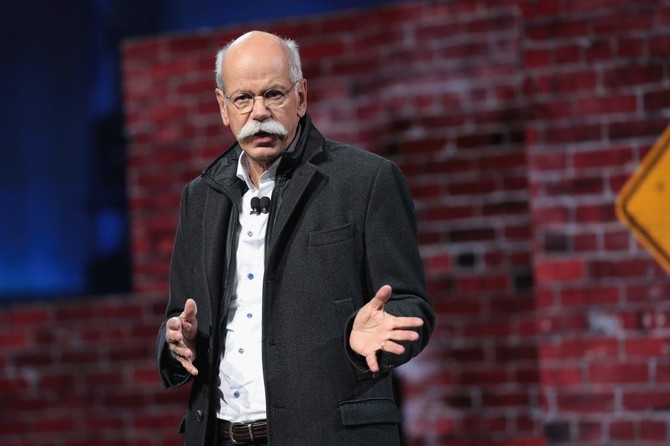
DETROIT: The chief executive of Daimler said Monday at the Detroit auto show that his company cannot currently guarantee it can meet tougher European CO2 emissions standards taking effect in several years.
Dieter Zetsche, CEO of the maker of Mercedes-Benz luxury vehicles, told reporters he “can’t guarantee” to meet tightening emission standards in 2021.
“It’s a huge challenge for everyone,” he said later in an interview. “We will make it. That’s our intention. But I can’t guarantee it.”
A regulation adopted in 2014 requires vehicle manufacturers selling vehicles in the EU to reach, with some exceptions, a level of 95 grams of CO2 emitted per kilometer by early 2021, compared to 130 grams in 2015.
Manufacturers that fail will be fined €95 per car and gram of excess CO2. This could potentially lead to fines in the tens or hundreds of millions of euros.
Fellow automotive CEO Sergio Marchionne of Fiat Chrysler said he understood Daimler’s predicament, and his company was also looking at how to meet the tougher standards — with non-compliance not an option.
“We’ve gone through this. It ain’t pretty,” he said, regarding the cost of fines.
“Having said this, we have no intention of pulling vehicles, because we think we can meet the standards.”
German manufacturers, whose large engines emit more CO2 than smaller models, are struggling to achieve the goals, according to experts.
So far, they have relied on diesel to reduce emissions. But diesel engine cars have fallen out of favor with consumers and sales have dropped, exacerbated by the Volkswagen diesel emissions cheating scandal.
“It’s dragged all of us into the very uncomfortable state where we are now on the defensive continuously about the utilization of diesel in the market,” Marchionne said.
To help comply with the new standards, manufacturers are developing a range of electric vehicles, with no certainty about the real-world demand from consumers.


![]()
Daimler struggling with European emissions standards
Daimler struggling with European emissions standards
Latest updates


Recommended


© 2026 SAUDI RESEARCH & PUBLISHING COMPANY, All Rights Reserved And subject to Terms of Use Agreement.