BRUSSELS: EU ministers agreed on Monday on new rules for approving cars for sale in order to prevent a repeat of the Volkswagen (VW) emissions scandal and giving the European Commission the power to fine cheating manufacturers directly.
The rules, which still have to be discussed with the European Parliament before becoming law, are a response to the 2015 dieselgate scandal when German carmaker VW was found to have used software to cheat US diesel emission tests.
Under the present system, national bodies such as Germany’s KBA authority have the power to clear new vehicles for the whole EU and can also revoke licenses.
The new rules will allow other national authorities to review such decisions and also give the commission the power to carry out spot checks and fine manufacturers up to €30,000 ($33,562) per vehicle if they are found to be cheating.
In the run-up to Monday’s ministerial meeting in Brussels, European diplomats had said Germany was reluctant to hand more market surveillance powers to Brussels despite the fallout from the VW scandal.
Matthias Machnig, German junior economy minister, told fellow ministers at the meeting his country was in favor of strengthening oversight but added he wanted assurances on how to avoid a conflict between different agencies.
Since the VW scandal, investigations of various other carmakers revealed on-road nitrogen oxide emissions as high as 15 times the regulatory limits, as well as the use of devices to mask real vehicle emissions.
“No week goes by without new revelations, new investigations,” EU Commissioner Elzbieta Bienkowska told ministers. “It will never finish if we do not have a more robust system in Europe.”
Corporate lending picks up
Corporate lending in the euro zone, a key gauge for measuring the health of economic recovery, accelerated slightly in April to hit a near eight-year high, Economic Central Bank (ECB) data showed on Monday.
Growth in loans to non-financial corporations picked up to 2.4 percent in April from 2.3 percent in March, its highest level since June 2009.
The ECB closely monitors lending in the 19 countries that share the euro because it believes that businesses are more likely to spend, hire and invest if cash is more readily available, powering the economy toward recovery and inflation toward the central bank’s target of just below 2 percent.
Credit almost dried up completely during the financial crisis and so the ECB took a number of measures to kick-start lending: Cutting interest rates to historic lows, offering low-interest loans to banks and pumping more than €1.8 trillion so far into the financial system through bond-buying.
The measures worked and credit has indeed picked up noticeably.
The April data showed that lending to households also increased slightly to 2.6 percent, powered by faster growth in borrowing for both mortgages and general consumption.
“The credit market looks positive again in April... it shows that businesses are looking more confidently into the future,” said Joerg Zeuner, chief economist of Germany’s KfW bank.
The April data are also being closely watched because the ECB slowed down its mass bond-buying measures last month.


![]()
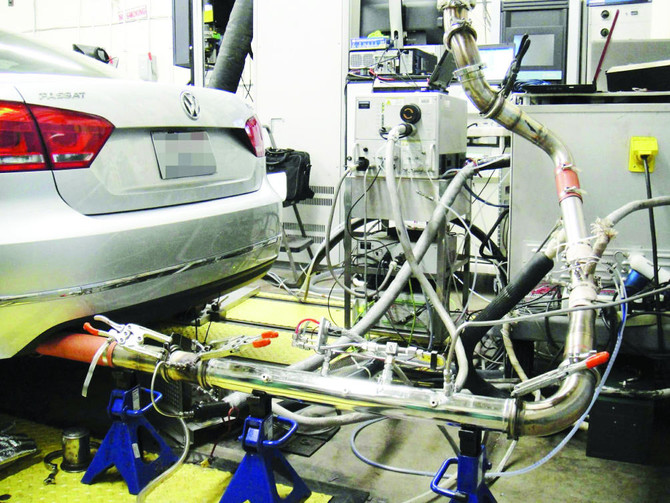
EU ministers agree car approval rules after ‘Dieselgate’
EU ministers agree car approval rules after ‘Dieselgate’
Latest updates


© 2026 SAUDI RESEARCH & PUBLISHING COMPANY, All Rights Reserved And subject to Terms of Use Agreement.