Ethiopia to free opposition leader and others jailed for involvement in unrest

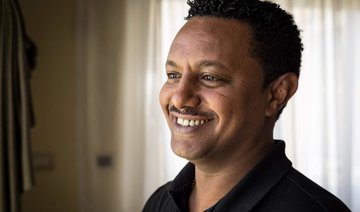
In a surprise move, Ethiopia’s Prime Minister Hailemariam Desalegn, announced plans to drop charges against political prisoners and close a notorious prison camp in what he calls an effort to “widen the democratic space for all.” (AP Photo)
Updated 15 January 2018
Follow

Ethiopia to free opposition leader and others jailed for involvement in unrest

ADDIS ABABA: Ethiopian authorities have dropped charges against a senior opposition leader and hundreds of others who had been jailed for involvement in unrest that gripped the country in 2015 and 2016, the country’s attorney general said on Monday.
Hundreds have been killed in violence in the Horn of Africa country since protests first erupted in its central Oromiya province over allegations of land grabs.
Several dissident politicians have since been jailed having been charged with involvement in terrorism and collusion with the secessionist Oromo Liberation Front, which the government has branded a terrorist group.
Facing mounting unrest, Prime Minister Hailemariam Desalegn announced earlier this month that jailed politicians would be released and those facing trial would have their cases dismissed in a bid to foster reconciliation.
On Monday, Attorney General Getachew Ambaye told journalists that 528 people had so far been selected for clemency, including Merera Gudina — leader of the opposition group Oromo Federalist Congress who was arrested in late 2015.
Getachew said criteria for their selection involved taking into account proof that the suspects did not take part in actions that led to killings and severe injury, damaging infrastructure, and “conspiracy to dismantle the constitutional order by force.”
“All 528 will be released within two months,” he said.
Merera was arrested after a trip to Brussels to meet members of the European Parliament, and formally charged with attempting to “dismantle or disrupt social, economic and political activity.”
He was also accused of backing a secessionist group Addis Ababa labels a terrorist movement, as well as flouting guidelines on a state of emergency that was imposed for nine months during his trip to Belgium.
Nearly 700 people died in one bout of unrest during months of protests in 2015 and 2016, according to a parliament-mandated investigation.
Rallies over land rights broadened into demonstrations over political restrictions and perceived rights abuses, before spreading into the northern Amhara region and — to a smaller extent — in its SNNP province in the south.
In recent months, a spate of ethnic clashes have also taken place. Dozens of people were killed in several bouts of violence between ethnic Oromos and Somalis in the Oromiya region last year.
Hailemariam made his announcement after the ruling EPRDF coalition concluded a weeks-long meeting meant to thrash out policies to address grievances.
The unrest had triggered growing friction within the party. Some high-ranking members had subsequently submitted their resignation, while officials have openly squabbled with each other over the cause of clashes.
Getachew said more pardons and releases are set to follow.
Ethiopia, sandwiched between volatile Somalia and Sudan, is often accused by rights groups of using security concerns as an excuse to stifle dissent and media freedoms. It denies the charge. (Reporting by Aaron Maasho; Editing by)


UK pays Guantanamo detainee ‘substantial’ compensation over US torture questions

Updated 5 sec ago
Follow

UK pays Guantanamo detainee ‘substantial’ compensation over US torture questions

  • Abu Zubaydah has been held at Guantanamo Bay without charge for 20 years
  • British security services knew he was subjected to ‘enhanced interrogation’ but failed to raise concerns for 4 years

LONDON: A Saudi-born Palestinian being held without trial by the US has received a “substantial” compensation payment from the UK government, the BBC reported.

Abu Zubaydah has been imprisoned at Guantanamo Bay in Cuba for almost 20 years following his capture in Pakistan in 2002, and was subjected to “enhanced interrogation” techniques by the CIA.

He was accused of being a senior member of Al-Qaeda in the aftermath of the Sept. 11 terror attacks on the US. The allegations were later dropped but he remains in detention.

The compensation follows revelations that UK security services submitted questions to the US to be put to Abu Zubaydah by their US counterparts despite knowledge of his mistreatment.

He alleged that MI5 and MI6 had been “complicit” in torture, leading to a legal case and the subsequent compensation.

Dominic Grieve, the UK’s former attorney general, chaired a panel reviewing Abu Zubaydah’s case.

He described the compensation as “very unusual” but said the treatment of Abu Zubaydah had been “plainly” wrong, the BBC reported.

Grieve added that the security services had evidence that the “Americans were behaving in a way that should have given us cause for real concern,” and that “we (UK authorities) should have raised it with the US and, if necessary, closed down co-operation, but we failed to do that for a considerable period of time.”

Abu Zubaydah’s international legal counsel, Prof. Helen Duffy, said: “The compensation is important, it’s significant, but it’s insufficient.”

She added that more needs to be done to secure his release, stating: “These violations of his rights are not historic, they are ongoing.”

Duffy said Abu Zubaydah would continue to fight for his freedom, adding: “I am hopeful that the payment of the substantial sums will enable him to do that and to support himself when he’s in the outside world.”

He is one of 15 people still being held at Guantanamo, many without charge. Following his initial detention, he arrived at the prison camp having been the first person to be taken to a so-called CIA “black site.”

He spent time at six such locations, including in Lithuania and Poland, outside of US legal jurisdiction. 

Internal MI6 messages revealed that the “enhanced interrogation” techniques he was subjected to would have “broken” the resolve of an estimated 98 percent of US special forces members had they been subjected to them.

CIA officers later decided he would be permanently cut off from the outside world, with then-President George W. Bush publicly saying Abu Zubaydah had been “plotting and planning murder.”

However, the US has since withdrawn the allegations and no longer says he was a member of Al-Qaeda.

A report by the US Senate Select Committee on Intelligence said Abu Zubaydah had been waterboarded at least 83 times, was locked in a coffin-like box for extended periods, and had been regularly assaulted. Much of his treatment would be considered torture under UK law.

Despite knowledge of his treatment, it was four years before British security services raised concerns with their American counterparts, and their submission of questions within that period had “created a market” for the torture of detainees, Duffy said.

A 2018 report by the UK Parliament’s Intelligence and Security Committee was deeply critical of the behavior of MI5 and MI6 in relation to Abu Zubaydah. 

It also criticized conduct relating to Guantanamo detainee Khalid Sheikh Mohammed, widely regarded as a key architect of the Sept. 11 attacks, warning that the precedent set by Abu Zubaydah’s legal action could be used by Mohammed to bring a separate case against the UK.

MI5 and MI6 failed to comment on Abu Zubaydah’s case. Neither the UK government nor Mohammed’s legal team would comment on a possible case over his treatment.