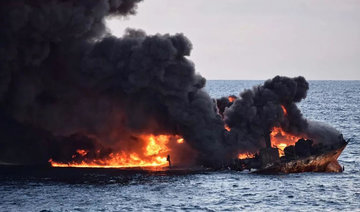
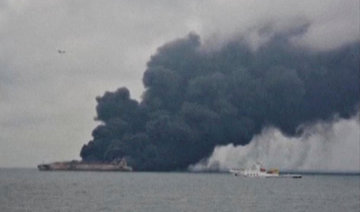
TOKYO/BEIJING: Black smoke was billowing from the East China Sea site where a burning Iranian oil tanker sank, Japanese authorities said on Monday, as worries grow about damage to the marine ecosystem from the worst oil ship disaster in decades.
The blazing vessel, which was carrying 136,000 tons — almost one million barrels — of condensate, an ultra-light, highly flammable crude oil, sank on Sunday evening after several explosions weakened the hull.
The tanker Sanchi had been adrift and ablaze after crashing into the freighter CF Crystal on Jan. 6. Strong winds had pushed it away from the Chinese coast, where the incident happened, and into Japan’s exclusive economic zone (EEZ).
China’s State Oceanic Administration said on Sunday that because the explosions had ruptured the hull of the ship, a large amount of oil in surrounding waters was on fire.
The sinking marks the biggest tanker spill since 1991, when 260,000 tons of oil leaked off the Angolan coast.
Japan’s coast guard has sent two patrol boats and an airplane to the area to search for missing crew members and assess the latest situation, a spokesman for the Japan Coast Guard said on Monday over the phone.
The Japanese authorities lost track of the tanker as of 0840 GMT on Sunday, the spokesman said. The ship’s last confirmed location was about 315 km (195 miles) west of Sokkozaki on the island of Amami Oshima.
Amami Oshima is one of the northern islands in the Ryukyu island chain that includes Okinawa.
A Chinese salvage team on Saturday recovered two bodies from the tanker, China’s state news agency Xinhua reported. Another body, presumed to be one of the Sanchi’s sailors, was found on Jan. 8 and brought to Shanghai for identification.
The salvage team recovered the Sanchi’s voyage data recorder, or “black box” from the bridge of the tanker, Xinhua also said on Saturday. But the team was forced to leave the ship after just half an hour because the wind shifted and “thick toxic smoke” had complicated the operation.
Iranian officials said on Sunday the remaining 29 crew members and passengers of the tanker were presumed dead. The crew consisted of 30 Iranians and two Bangladeshis.
Sinking vs burning
Experts worry the ship’s sinking is potentially more damaging to the marine ecosystem than letting the condensate oil burn off. The sinking will likely expel the remaining condensate and the tanker’s bunker fuel, or the heavy fuel oil that powers a ship’s engines, contaminating the surrounding waters.
Bunker fuel is the dirtiest kind of oil, extremely toxic when spilled, though less explosive. Condensate is poisonous to marine organisms.
A harmful plume of condensate would likely be in the water, out of sight of observers on the surface, said Rick Steiner, a US marine scientist based in Anchorage, Alaska, who has experience of oil spills.
“As with all major oil spills, time is of the essence. This is particularly so with condensate spills, as the substance is so toxic and volatile,” Steiner said in an emailed statement.
The East China Sea is known for its rich, although already polluted, marine ecosystem, with whales, porpoises, seabirds and fish, he said.
Fuel oil is relatively easy to contain because volumes are lower and its viscosity means it’s easier to extract from water, but even small volumes can harm marine life.
A Suezmax tanker can hold a maximum of 5,000 tons of bunker fuel. The Sanchi may have been carrying about 1,000 tons by the time it hit the grain freighter CF Crystal, according to bunker fuel traders’ estimates.