BEIJING: A Iranian oil tanker burst into flames from end to end and sank Sunday, eight days after a collision with a cargo ship off China, state media said.
A Tehran official said even before news of the sinking that there was no hope of saving some 30 missing crewmen. But Chinese officials played down fears of a major environmental disaster.
The Sanchi, carrying 136,000 tons of light crude oil from Iran, had been in flames since colliding with the CF Crystal, a Hong Kong-registered bulk freighter, on January 6.
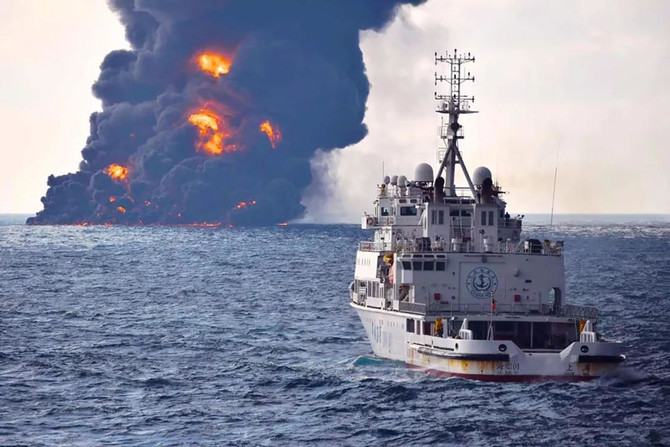
Around midday Sunday the ship “suddenly ignited,” with the entire vessel burning fiercely and a pall of smoke around 800-1,000 meters high, China’s transport ministry said, releasing dramatic pictures showing the entire vessel obscured by thick black smoke.
The ship later sank, the official news agency Xinhua cited the State Oceanic Administration as saying.
“There is no hope of finding survivors among the members of the crew,” Mohammad Rastad, spokesman for the Iranian rescue team dispatched to Shanghai, told Iran’s state broadcaster in Tehran before the tanker went down.
Rastad said information from members of the Crystal crew suggested all the personnel on the Sanchi were killed in the first hour of the accident “due to the explosion and the release of gas.”
“Despite our efforts, it has not been possible to extinguish the fire and recover the bodies due to repeated explosions and gas leaks,” he said.
The Sanchi, which was headed to South Korea to deliver its cargo, had a crew of 32 — 30 Iranians and two Bangladeshis. Only three bodies have so far been recovered.
Chinese rescuers Saturday also recovered the tanker’s “black box,” the transport ministry said without specifying exactly what had been retrieved.
A reporter with China’s state television CCTV aboard a plane from the State Oceanic Administration reported seeing wreckage from the Sanchi and oil on fire, and spilt fuel covering a 10 square kilometer area.
“The oil spill situation is very serious,” CCTV quoted the reporter as saying on social media.
But the television earlier also cited Zhang Yong, a senior engineer with the State Oceanic Administration, as playing down fears of a spill.
“Because this is light crude oil spill, relatively speaking it has a much smaller impact than other oil spills, because this kind of oil is especially volatile — most of it has entered the atmosphere, so it’s had less impact on the ocean...,” Zhang was quoted as saying.
“This area should be considered the open sea, very far from places where people live, so the human impact should be minimal.”
Rescue efforts had been particularly difficult because at 89 degrees Celsius, the vessel’s compartments were too hot for workers to withstand for long, CCTV quoted He Wang, an expert from Chinese oil company Huade Petrochemical, as saying.

Iranian oil tanker ablaze off China coast has sunk: state media
Lebanon close to completing disarmament of Hezbollah south of Litani River, says PM
BEIRUT: Lebanon is close to completing the disarmament of Hezbollah south of the Litani River, Prime Minister Nawaf Salam said on Saturday, as the country races to fulfil a key demand of its ceasefire with Israel before a year-end deadline.
The US-backed ceasefire, agreed in November 2024, ended more than a year of fighting between Israel and Hezbollah and required the disarmament of the Iran-aligned militant group, starting in areas south of the river adjacent to Israel.
Lebanese authorities, led by President Joseph Aoun and Salam,
tasked
the US-backed Lebanese army on August 5 with devising a plan to establish a state monopoly on arms by the end of the year.
“Prime Minister Salam affirmed that the first phase of the weapons consolidation plan related to the area south of the Litani River is only days away from completion,” a statement from his office said.
“The state is ready to move on to the second phase — namely (confiscating weapons) north of the Litani River — based on the plan prepared by the Lebanese army pursuant to a mandate from the government,” Salam added.
The statement came after Salam held talks with Simon Karam, Lebanon’s top civilian negotiator on a committee overseeing the Hezbollah-Israel truce.
Since the ceasefire, the sides have regularly accused each other of violations, with Israel questioning the Lebanese army’s efforts to disarm Hezbollah. Israeli warplanes have increasingly targeted Hezbollah in southern Lebanon and even in the capital.
Hezbollah, a Shiite Muslim group, has tried to resist the pressure — from its mainly Christian and Sunni Muslim opponents in Lebanon as well as from the US and Saudi Arabia — to disarm, saying it would be a mistake while Israel continues its air strikes on the country.
Israel has publicly urged Lebanese authorities to fulfil the conditions of the truce, saying it will act “as necessary” if Lebanon fails to take steps against Hezbollah.
The US-backed ceasefire, agreed in November 2024, ended more than a year of fighting between Israel and Hezbollah and required the disarmament of the Iran-aligned militant group, starting in areas south of the river adjacent to Israel.
Lebanese authorities, led by President Joseph Aoun and Salam,
tasked
the US-backed Lebanese army on August 5 with devising a plan to establish a state monopoly on arms by the end of the year.
“Prime Minister Salam affirmed that the first phase of the weapons consolidation plan related to the area south of the Litani River is only days away from completion,” a statement from his office said.
“The state is ready to move on to the second phase — namely (confiscating weapons) north of the Litani River — based on the plan prepared by the Lebanese army pursuant to a mandate from the government,” Salam added.
The statement came after Salam held talks with Simon Karam, Lebanon’s top civilian negotiator on a committee overseeing the Hezbollah-Israel truce.
Since the ceasefire, the sides have regularly accused each other of violations, with Israel questioning the Lebanese army’s efforts to disarm Hezbollah. Israeli warplanes have increasingly targeted Hezbollah in southern Lebanon and even in the capital.
Hezbollah, a Shiite Muslim group, has tried to resist the pressure — from its mainly Christian and Sunni Muslim opponents in Lebanon as well as from the US and Saudi Arabia — to disarm, saying it would be a mistake while Israel continues its air strikes on the country.
Israel has publicly urged Lebanese authorities to fulfil the conditions of the truce, saying it will act “as necessary” if Lebanon fails to take steps against Hezbollah.
© 2025 SAUDI RESEARCH & PUBLISHING COMPANY, All Rights Reserved And subject to Terms of Use Agreement.


