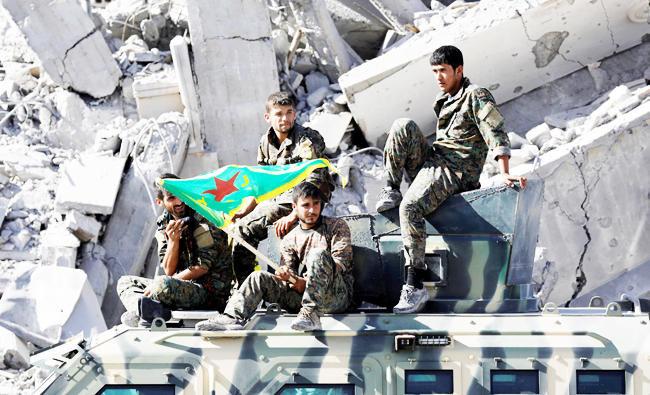
ANKARA: Turkey reacted with undisguised anger on Sunday to plans by the US-led coalition against Daesh to establish a 30,000-strong Kurdish-led border security force in northern Syria.
At least half of the new force will be retrained fighters from the Syrian Democratic Forces (SDF), which are dominated by the Kurdish People’s Protection Units (YPG). They are the coalition’s main allies in Syria — but Turkey considers the YPG to be the Syrian branch of the outlawed PKK, and therefore a terrorist group.
“Rather than end its support to the PYD-YPG, these steps taken to legitimize a terror organization and to make it permanent in the region are worrying,” said Ibrahim Kalin, spokesman for Turkish President Recep Tayyip Erdogan.
“Accepting this state of affairs is absolutely not possible. We reserve all our rights of intervention against terror.”
With the offensive against Daesh winding down, the coalition and its allies are shifting their focus to border security, coalition spokesman Col. Ryan Dillon said.
“There is a goal of a final force of about 30,000. There are approximately 230 individuals training right now in the border security force. That’s an inaugural class.”
The new force will secure checkpoints and guard against improvised explosive devices. Kurdish members are expected to serve on Syria’s northern border with Turkey, with Arab forces deployed along the border with Iraq and the Euphrates River valley.
The new move was further evidence that US and Turkish policies and objectives in Syria were continuing to diverge, Serhat Guvenc, a professor of international relations at Istanbul Kadir Has University, told Arab News.
“It was crystal clear that the US would not change its decision to collaborate with the SDF in the short and medium term,” he said.
“When the future of the Syrian conflict is being discussed at the negotiating table, the military gains on the ground will swing the balance.”
The US aim was to consolidate the SDF’s gains and increase its bargaining power before the Russian-sponsored Sochi peace congress at the end of this month, he said.
Mete Sohtaoglu, a Middle East researcher in Istanbul, said the coalition had taken action before to transform the YPG into a regular army.
“They have already restructured this armed force in various regions of Syria,” he told Arab News.
“In the framework of peace plans for Syria, all armed groups, including the YPG, were set to be incorporated into one single army.”
The border force was part of a broader initiative by the US to establish a “parallel state” within Syria, Sohtaoglu said, and he expected a Turkish military response in Afrin, Manbij, Tel Abyad and Kobani.
“If this US support is reflected politically and diplomatically, Turkey will begin a comprehensive and wide-ranging military operation in the north of Syria by taking the most important decision in its history,” he said.
Because of the latest US move, Russia was likely to support, or at least turn a blind eye to, Turkish military intervention in Afrin, said Giray Sadik, an international security expert and associate professor at Ankara Yildirim Beyazit University.
“It may also further boost the cooperation within the Russia-Iran-Turkey axis against the US presence in Syria,” he said.


![]()
Turkish anger over new Kurdish-led border security force in Syria
Turkish anger over new Kurdish-led border security force in Syria
Latest updates


© 2026 SAUDI RESEARCH & PUBLISHING COMPANY, All Rights Reserved And subject to Terms of Use Agreement.