Syrian Kurds say Russia has promised they can attend Sochi talks

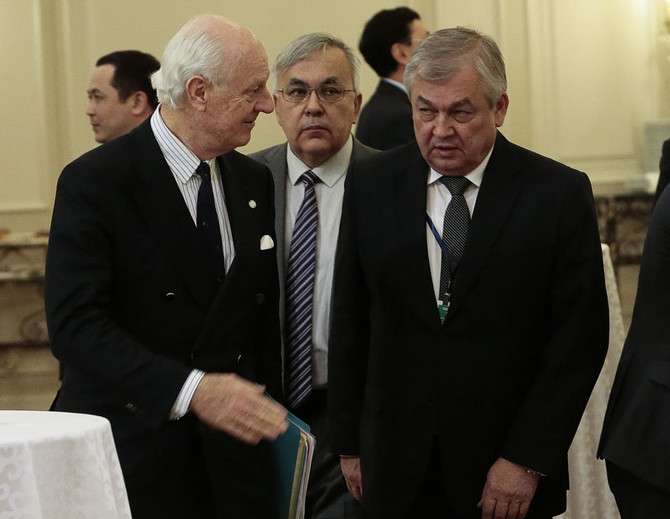
UN Special Envoy for Syria Staffan de Mistura (L) speaks with Russia's chief negotiator for Syria, Aleksandr Lavrentyev (R), during the session of Syria peace talks in Astana on Dec. 22, 2017. (AFP)
Updated 27 December 2017
Follow

Syrian Kurds say Russia has promised they can attend Sochi talks

BEIRUT: Russia has promised that the autonomous region controlled by Kurds in northern Syria will be represented at peace talks it is hosting next month, the commander of the main Syrian Kurdish militia was cited as saying on Wednesday.
Moscow has said 155 representatives of the autonomous region will participate, Sipan Hemo, the commander of the YPG, was quoted as saying by official Syrian Kurdish social media channels on Wednesday.
Kurdish groups have not taken part in any round of Syrian peace talks so far despite their control of more than a quarter of Syria. Turkey opposes their involvement in talks.
Moscow backs Syrian President Bashar Assad in Syria’s six-year-old civil war while Turkey opposes him.
But Ankara views the YPG as a terrorist group affiliated to the Kurdish PKK, which has waged an insurgency in Turkey for decades.
Russia, Iran and Turkey announced the Jan. 29-30 dates for the talks in the Black Sea resort of Sochi date after a round of peace talks in Kazakhstan last week, but did not say who would participate.
About 40 Syrian rebel groups, including factions that have taken part in other rounds of peace talks, said on Monday they would refuse to attend the Sochi Congress.
Russia is the most powerful supporter of Assad. Its jets have helped him bring the rebellion against his rule near to an end.
UN Syria envoy Staffan de Mistura has said that the success of the congress should be assessed by its ability to contribute to and support the UN-led Geneva talks on ending the war.


Qatar joins US-led Pax Silica Alliance to secure semiconductor and critical mineral supply chains

Updated 7 sec ago
Follow

Qatar joins US-led Pax Silica Alliance to secure semiconductor and critical mineral supply chains

  • Doha says participation in alliance will enhance its international partnerships in fields of semiconductors, computing, cybersecurity and digital technologies.
  • Qatar is the second Middle Eastern country to join the US-led economic-security coalition, after Israel

LONDON: Qatar joined the US-led Pax Silica Alliance on Monday in a move described as a strategic step to enhance cooperation in advanced technologies and supply-chain security.

The alliance was launched last month in Washington with the aim of securing global supply chains for semiconductors, artificial intelligence technology, critical minerals and digital infrastructure.

Doha said participation in the alliance will enhance its international partnerships in the fields of semiconductors, computing, cybersecurity and digital technologies, helping to boost the country’s technological capabilities and economic diversification efforts, the Qatar News Agency reported.

Ahmed Al-Sayed, Qatar’s minister of state for foreign trade affairs, and Jacob Helberg, the US under secretary of state for economic affairs, signed the Pax Silica declaration during a ceremony in Doha.

Al-Sayed said the world was undergoing a significant transformation driven by AI, rising energy and mineral demands, and rapid technological advancements.

He described the declaration as “a new milestone in the Qatar-US partnership, founded on trust, shared interests, and a unified vision for advancing stability and prosperity.”

He added: “Qatar recognizes that the currency of geopolitical power has changed. Sovereignty is no longer just about protecting borders, it is about securing the supply chains of the artificial intelligence era.”

Qatar is the second Middle Eastern country to join the alliance; Israel signed up in December. Japan, South Korea, Singapore, the UK and Australia have also joined the bloc.

“In a region often defined by its fractures, Pax Silica marks a historic opportunity for the region to shift from political rivalry to economic interoperability,” Helberg said.