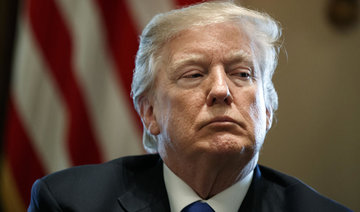
JEDDAH: Tough new sanctions imposed by US President Donald Trump on 14 Iranian individuals and organizations are a political blow and a warning to the regime in Tehran, a leading analyst told Arab News on Saturday.
Among those targeted are the powerful politician Ayatollah Sadeq Larijani, the head of Iran’s judiciary and a close ally of Iran’s Supreme Leader Ayatollah Ali Khamenei. Groups facing sanctions include the cyber unit of the Islamic Revolutionary Guard Corps (IRGC).
The US move is a significant move and “a critical victory for human rights defenders and the Iranian people,” said Majid Rafizadeh, a Harvard-educated Iranian-American political scientist.
The sanctions on the IRGC cyber unit were also a step toward peace and stability by combating the Iranian regime’s attempts to hack other governments’ systems and organizations, he said.
Announcing the new action on Friday, Trump said he would continue the suspension of US sanctions on Iran under the 2015 nuclear deal — but only for 120 days. In the intervening time, he has demanded a separate agreement to restrict Iran’s ballistic missile program, which is not explicitly covered by the nuclear deal, and to make the 10-year curb on Iran’s nuclear program permanent. If he sees no progress on such an agreement, the president will withdraw from the nuclear deal.
Trump was sending a message that the Iranian regime “will be monitored not only for its nuclear defiance, development, research and proliferation, but also for its human rights violations,” Rafizadeh said.
Trump, who has sharply criticized the deal reached under Barack Obama’s presidency, had chafed at once again having to waive sanctions on a country he sees as a threat in the Middle East.
“Despite my strong inclination, I have not yet withdrawn the United States from the Iran nuclear deal,” he said on Friday. The options were to fix “the deal’s disastrous flaws, or the United States will withdraw. This is a last chance.”
Contrary to the view of his critics, Rafizadeh said, Trump had used diplomacy to address the loopholes in the nuclear deal. “This will give the administration a more robust platform to persuade the EU nations to fix the nuclear agreement or to abandon it.
“If other parties do not take necessary and adequate action to address the shortcomings of the nuclear agreement, Trump has buttressed his position and laid out the groundwork to reimpose sanctions, as well as withdrawing from the deal.”
Trump is also giving the US Congress additional time to work on legislation to fix loopholes in the deal, such as requiring Iran to allow its military sites be inspected for nuclear development, research, weaponization and proliferation, Rafizadeh said.
“Iran is not adhering to the spirit of the nuclear deal due to its heightened interventionist and expansionist policies in the Arab world and to its human rights violations domestically.”
Rafizadeh said the deal had empowered the IRGC and its militias in the region through sanctions relief. This, he said, had further radicalized, militarized and destabilized the region. “Iran continues to ratchet up its antagonistic policy toward Arab nations, the US, and the West.”
Iran’s Foreign Ministry said sanctions on Larijani were “hostile action” that “crossed all red lines of conduct in the international community and a violation of international law, and will surely be answered by a serious reaction of the Islamic Republic.”
Foreign Minister Mohammad Javad Zarif said the nuclear deal was “not renegotiable” and Trump’s move “amounts to desperate attempts to undermine a solid multilateral agreement.”
James Jeffrey, distinguished fellow at the Washington Institute for Near East Policy and former US ambassador to Iraq, told Arab News: “Ignore the rhetoric. Zarif is simply reflecting the truth about Iran’s refusal to change the nuclear deal, and all other parties including Europeans agree. But what Trump and his advisers, in background talks with me, seem to be looking for is an agreement with France, Germany and the UK to deal with the problems Trump cites — long-range missiles, inspection flaws and Iranian enrichment breakout after 10 years, without necessarily new negotiations.
“These are real problems that, for example, French President Emmanuel Macron has cited, and do not necessarily require modifying the agreement which, as Zarif says, understandably Iran rejects.
“Missiles and sanctions related to them are not part of the agreement, but a separate Security Council resolution that Iran did not formally agree to.
“Inspection problems involve a mix of the International Atomic Energy Agency not using powers the agreement gives it, and inspection procedures and deals outside of the agreement.
“Unchecked enrichment after 10 years is a serious problem, but could be dealt with through European/US carrots and sticks and cooperation by a future Iranian government, without changing the agreement.”
Speaking by phone to Arab News, Aaron David Miller, vice president for New Initiatives at the Woodrow Wilson International Center for Scholars and a former senior US peace negotiator, said that the Trump administration will face "great odds" convincing European signatories of the JCPOA to agree to change the "internal architecture' of the agreement.
Miller also maintained that despite the strong rhetoric from the Trump administration, he does not see its policy on Iran as fundamentally different from that of his predecessor, Barack Obama.
Nevertheless, when asked whether he had expected the JCPOA to compel Iran to moderate its behavior in the region or whether he expected it to be emboldened, Miller said the JCPOA was not meant to be "transformational. It was transactional."


![]()

Trump’s new sanctions ‘a blow and a warning to Iranian regime’
Trump’s new sanctions ‘a blow and a warning to Iranian regime’


Latest updates




© 2026 SAUDI RESEARCH & PUBLISHING COMPANY, All Rights Reserved And subject to Terms of Use Agreement.