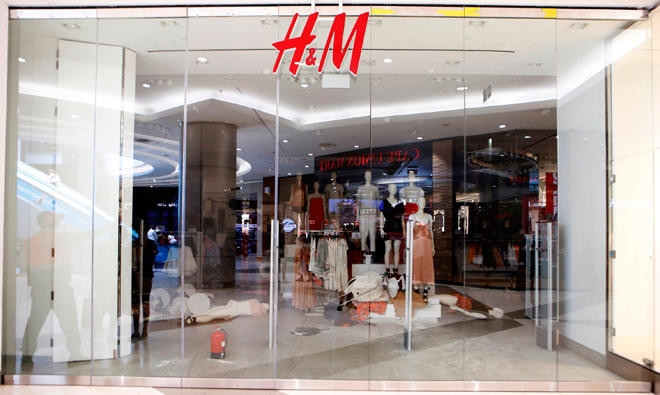
JOHANNESBURG: South African police Saturday intervened to clear protesters trashing outlets of Swedish clothing giant Hennes and Mauritz in Johannesburg over a controversial advertisement of a black child.
A photo on the company’s online website of a black boy wearing a green hoodie with the inscription “coolest monkey in the jungle” had triggered outrage on social media and among observers worldwide.
The company has pulled the photograph but the Economic Freedom Fighters (EFF) — a radical group set up by the expelled head of the youth wing of the ruling African National Congress — organized protests at several H&M outlets in and around Johannesburg.
Video footage showed activists trashing displays, kicking over and pulling down clothes rails as well as pushing over mannequins.
“Several incidents of protests at H&M stores around the province have been reported,” South African police (SAPS) said in a tweet.
“At the East Rand Mall the protesters managed to enter the shop & stole several items. #SAPS members had to intervene and dispersed the group of protesters by firing rubber bullets.”
Floyd Shivambu from EFF said: ‘That @hm nonsense of a clothing store is now facing consequences for its racism. All rational people should agree that the store should not be allowed to continue operating in South Africa.”
H&M is not the only major company to be hit by an advertisement scandal in recent years.
Spanish clothing brand Zara in 2014 removed striped pyjamas with a yellow star after facing outrage over its resemblance to clothes worn by Jewish prisoners in concentration camps.
And in October last year, personal care brand Dove apologized after it was accused of racism for airing a commercial showing a black woman turning into a white woman after removing her top.

Protests in Johannesburg over ‘racist’ ad
Israel to seek new security deal with the US, FT reports
Israel is preparing for talks with the Trump administration on a new 10-year security deal, seeking to extend US military support even as Israeli leaders signal they are planning for a future with reduced American cash grants, the Financial Times reported on Tuesday.
Gil Pinchas, speaking to the FT before stepping down as chief financial adviser to Israel’s military and defense ministry, said Israel would seek to prioritize joint military and defense projects over cash handouts in talks that he expected to take place in the coming weeks.
The US State Department did not immediately respond to a Reuters request for comment outside regular business hours.
“The partnership is more important than just the net financial issue in this context ... there are a lot of things that are equal to money,” Pinchas told the FT. “The view of this needs to be wider.”
Pinchas said pure financial support — or “free money” — worth $3.3 billion a year, which Israel can use to purchase US weapons, was “one component of the MOU (that) could decrease gradually.”
In 2016, the US and Israeli governments signed a memorandum of understanding for the 10 years through September 2028 that provides $38 billion in military aid, $33 billion in grants to buy military equipment and $5 billion for missile defense systems.
Earlier this month, Israeli Prime Minister Benjamin Netanyahu
said he hoped to “taper off” Israeli dependence on US military aid in the next decade.
Gil Pinchas, speaking to the FT before stepping down as chief financial adviser to Israel’s military and defense ministry, said Israel would seek to prioritize joint military and defense projects over cash handouts in talks that he expected to take place in the coming weeks.
The US State Department did not immediately respond to a Reuters request for comment outside regular business hours.
“The partnership is more important than just the net financial issue in this context ... there are a lot of things that are equal to money,” Pinchas told the FT. “The view of this needs to be wider.”
Pinchas said pure financial support — or “free money” — worth $3.3 billion a year, which Israel can use to purchase US weapons, was “one component of the MOU (that) could decrease gradually.”
In 2016, the US and Israeli governments signed a memorandum of understanding for the 10 years through September 2028 that provides $38 billion in military aid, $33 billion in grants to buy military equipment and $5 billion for missile defense systems.
Earlier this month, Israeli Prime Minister Benjamin Netanyahu
said he hoped to “taper off” Israeli dependence on US military aid in the next decade.
© 2026 SAUDI RESEARCH & PUBLISHING COMPANY, All Rights Reserved And subject to Terms of Use Agreement.