JOHANNESBURG: Tens of thousands of protesters marched through South African cities on Friday demanding President Jacob Zuma’s resignation, as a second ratings agency downgraded the country’s debt to junk status.
Zuma’s sacking of respected finance minister Pravin Gordhan last week has fanned public anger, divisions within the ruling ANC party and a sharp decline in investor confidence in the country.
“Recent political events, including a major cabinet reshuffle, will weaken standards of governance and public finances,” the Fitch ratings agency predicted as it announced the downgrade.
The Standard & Poor’s agency had also downgraded South African sovereign debt to junk status after Zuma’s dramatic ministerial shake-up.
Zuma, who came to power in 2009, has been battered by a series of corruption scandals during his time in office, while the country has suffered record unemployment, slowing growth and stubborn racial inequality.
His removal of Gordhan unleashed a fresh bout of criticism, as many ordinary South Africans and international investors saw the former minister as a bulwark against corruption.
In the biggest political protests for several years, large crowds gathered in the capital Pretoria, the economic hub Johannesburg and coastal cities of Durban and Cape Town.
Several thousand people attended the Johannesburg protest organized by the opposition Democratic Alliance party, which hopes to make gains in 2019 elections under its leader Mmusi Maimane, 36.
“We want Zuma to fall. He is too corrupt. Real people are struggling. I voted for Nelson Mandela, but Maimane has a lot of integrity and he’s young,” protester Vanessa Michael, 54, from East Rand, told AFP.
Mabefw Malega, a 38-year-old undertaker who had traveled three hours from Limpopo province to march said “people just want Zuma gone.”
One young woman in a wheelchair held a banner that said “I love my country, not my government.”
Johannesburg was thronged with the DA’s signature blue while Luthuli House, the nerve center of the ruling African National Congress (ANC), was surrounded by its veteran anti-apartheid fighters, dressed in camouflage, in a show of loyalty to Zuma.
The ANC led the decades-long struggle against apartheid, and carried Nelson Mandela to power in the 1994 elections that ended white-minority rule.
But the party has lost popularity in recent years and slipped to 55 percent of the vote in last year’s local elections — its worst ever result.
Zuma this week appeared to have quelled a rebellion within the ANC despite senior party figures, including Deputy President Cyril Ramaphosa, speaking out against Gordhan’s sacking.
The cabinet overhaul — which was announced in a midnight statement — cleared out many of Zuma’s critics and placed loyalists in key positions.
“Tensions within the ANC will mean that political energy will be absorbed by efforts to maintain party unity and fend off leadership challenges,” Fitch said in its statement.
“The agency believes that the cabinet reshuffle will further undermine the investment climate.”
Junk status was likely to increase the cost of the government’s debt and shrink public funds available for welfare, health, education and housing.
South Africa’s trade union federation Cosatu this week joined many anti-apartheid veterans, civil action groups and business leaders calling for the president to resign.
“We must move forward with the South Africa of our dreams — not South Africa that will enrich a few cronies,” Solly Mapaila, of the South African Communist Party, told the rally in Pretoria.
Zuma, 74, is due to step down as head of the ANC in December, and as president ahead of the 2019 general election.
He is seen as favoring his ex-wife, former African Union chief Nkosazana Dlamini-Zuma, to succeed him.
Zuma has been accused of being in the sway of the wealthy Gupta business family, allegedly granting them influence over government appointments, contracts and state-owned businesses.
Friday’s marches were mainly peaceful, though police used stun grenades to disperse rival groups of protesters outside the Guptas’ main residence in Johannesburg.
Outside Cape Town, retired archbishop Desmond Tutu, who is in frail health, made an appearance to support the protests.
Parliament will vote on a motion of no confidence in the president on April 18, though he has easily survived previous such votes against him.


![]()
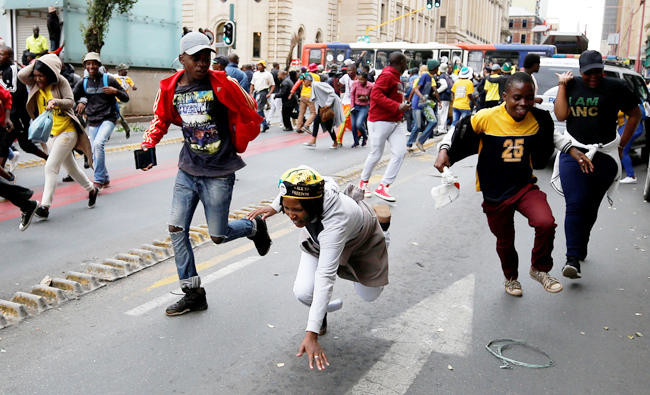
Anti-Zuma protests in S.Africa as economic woes mount
Anti-Zuma protests in S.Africa as economic woes mount
Latest updates


© 2026 SAUDI RESEARCH & PUBLISHING COMPANY, All Rights Reserved And subject to Terms of Use Agreement.