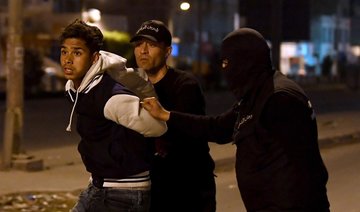
TUNIS: Tunisian authorities arrested another 150 people including local opposition leaders over unrest against price and tax rises that prompted troop deployments to restive towns, and activists called for renewed rallies at the weekend.
Protests, some violent, flared across Tunisia on Monday, when one protester was killed, before ebbing on Thursday. Protesters have burned dozens of state buildings, prompting the government to send the army into several cities and towns.
Activists and opposition politicians appealed for fresh demonstrations in the capital, Tunis, on Friday and on Sunday, the seventh anniversary of the toppling of authoritarian president Zine El-Abidine Ben Ali.
On Thursday, unrest was limited to sporadic clashes in the northern city of Siliana, in Sidi Bouzid in central Tunisia and Douz in the south of the North African country.
“The protests have declined and there was no damage, but last night the police arrested 150 people involved in rioting in the past few days, bringing the total number of detainees to 778,” Interior Ministry spokesman Khelifa Chibani said. Sixteen extremists were among those detained, he said.
Three local leaders of the Popular Front, the main opposition bloc, were detained in Gafsa for allegedly setting fire to a government building, a judicial source said.
The Popular Front said its leaders had been targeted in a political campaign that was “reproducing the methods of the oppressive Ben Ali regime.” Party members had also been arrested in Mahdia and Karbariya, it said.
The protests draw on anger over price and tax increases included in this year’s budget that took effect on Jan. 1. The government has blamed the opposition and “troublemakers” for stoking unrest, a charge the opposition has denied. The government has vowed not to back down on the austerity measures, taken to satisfy foreign lenders.
Prices have increased for fuel and some consumer goods, while taxes on cars, phone calls, the Internet, hotel accommodation and other items have also gone up.
Tunisia appears to have little scope to back away austerity. The International Monetary Funds says Tunisia is committed to “decisive action” to reform its economy before the IMF reviews the payment of its next loan tranche.
Last year, the Washington-based IMF agreed a four-year loan program worth about $2.8 billion with Tunisia, but tied to economic reforms.
The 2018 budget also raises customs taxes on some imports, and the Tunis government is trying to cut the public sector wage bill through voluntary redundancies.
While Tunisia is held up by some as the only democratic success story among countries swept up in the Arab Spring, it has had nine governments since Ben Ali’s overthrow, none of which have been able to resolve deep-rooted economic problems.


![]()

Opposition leaders among 150 detained in Tunisia
Opposition leaders among 150 detained in Tunisia

Latest updates


© 2026 SAUDI RESEARCH & PUBLISHING COMPANY, All Rights Reserved And subject to Terms of Use Agreement.