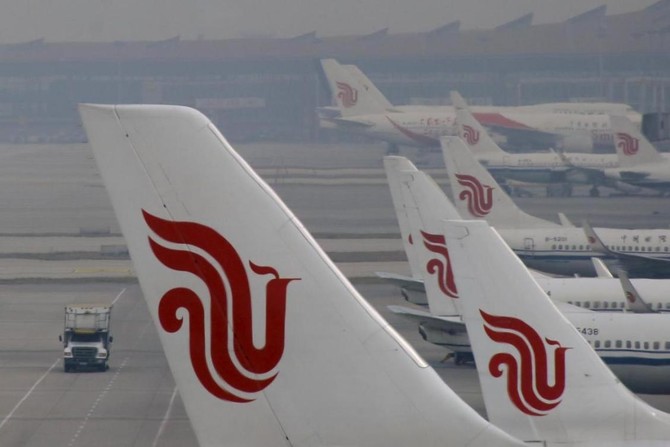
SHANGHAI: China will make it easier for state and private enterprises to invest in its fast growing civil aviation industry from Jan. 19, but retain the state’s grip over key airlines and airports in sensitive regions.
China is the world’s fastest growing aviation market and is forecast to surpass the United States as the world’s biggest from 2022, says the International Air Transport Association.
The Civil Aviation Administration of China (CAAC) said on its website on Friday that new rules would allow state and private firms to independently or jointly make investments from January 19, to drive the industry’s healthy development.
There would be limits, though, and certain entities needed to remain controlled by state-owned shareholders. These included the country’s three largest airlines, Air China, China Eastern Airlines and China Southern Airlines, and some airports in certain hub cities and western Xinjiang and Tibet regions.
It said that airlines could not own more than a 25 percent stake in international and regional airports, while airports in turn could not control more than 25 percent of companies involved in the sale, storage and transport of aviation fuel.
The Chinese government has promised to open up more sectors to private investment as part of efforts to make its companies more globally competitive.
The CAAC said it first started looking at allowing more private investment in aviation in 2005. In recent years it has routinely sought public opinion to fine-tune investment rules.
In 2016, it proposed to reduce the number of state-owned cargo airports and scrap restrictions on the types of investors in other airports, and also allow private firms to make certain aviation investments without requiring CAAC approval.

China to ease investment access to aviation industry
Saudi Arabia leads outcome-based education to prepare future-ready generations: Harvard Business Review
- The Riyadh-based school group developed a strategy that links every classroom activity to measurable student competencies, aiming to graduate learners equipped for the digital economy and real-world contexts
RIYADH: Saudi Arabia’s education system is undergoing a sweeping transformation aligned with Vision 2030, shifting from traditional, input-focused methods to outcome-based education designed to equip students with future-ready skills, Harvard Business Review Arabic reported.
The transformation is being adopted and spearheaded by institutions such as Al-Nobala Private Schools, which introduced the Kingdom’s first national “learning outcomes framework,” aimed at preparing a generation of leaders and innovators for an AI-driven future, the report said.
Al-Nobala has leveraged international expertise to localize advanced learning methodologies.
The Riyadh-based school group developed a strategy that links every classroom activity to measurable student competencies, aiming to graduate learners equipped for the digital economy and real-world contexts. The school’s group approach combines traditional values with 21st-century skills such as critical thinking, communication, innovation and digital fluency.
According to the report, the shift addresses the growing gap between outdated models built for low-tech, resource-constrained environments and today’s dynamic world, where learners must navigate real-time information, virtual platforms, and smart technologies.
“This is not just about teaching content, it’s about creating impact,” the report noted, citing how Al-Nobala’s model prepares students to thrive in an AI-driven world while aligning with national priorities.
The report noted that Saudi Arabia’s Ministry of Education has paved the way for this shift by transitioning from a centralized controller to a strategic enabler, allowing schools such as Al-Nobala to tailor their curriculum to meet evolving market and societal needs. This is part of the long-term goal to place the Kingdom among the top 20 global education systems.
Al-Nobala’s work, the report stated, has succeeded in serving the broader national effort to link education outcomes directly to labor market demands, helping to fulfill the Vision 2030 pillar of building a vibrant society with a thriving economy driven by knowledge and innovation.
Last February, Yousef bin Abdullah Al-Benyan, Saudi Arabia’s minister of education, said that the Kingdom was making “an unprecedented investment in education,” with spending aligned to the needs of growth and development. He said that in 2025, education received the second-largest share of the state budget, totaling $53.5 billion.