

Europe sees ‘no alternative’ to Iran nuclear deal as Trump decision looms

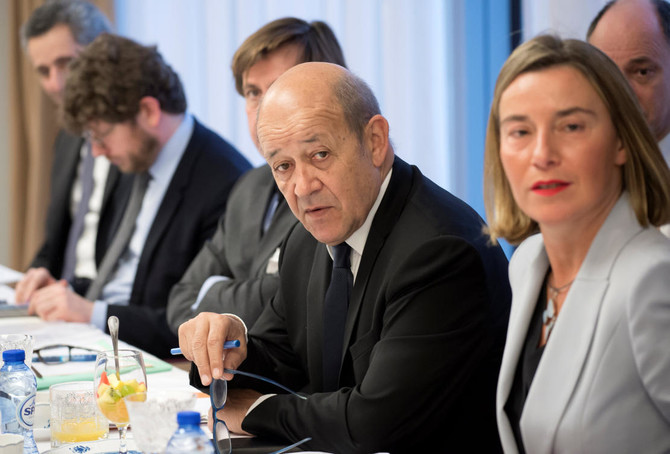
Foreign ministers of the three European powers and EU foreign policy chief Federica Mogherini (R) made their plea after a meeting in Brussels. (Reuters)
Updated 11 January 2018
Follow

Europe sees ‘no alternative’ to Iran nuclear deal as Trump decision looms

LONDON: European leaders vowed to stand by the Iran nuclear deal on Thursday as US President Donald Trump weighs bringing back sanctions against Tehran.
Speaking after ministers from Britain, France, Germany and Iran met in Brussels, the EU’s diplomatic leader Federica Mogherini insisted that the pact had effectively deterred Iran’s nuclear ambitions.
“It is delivering on its main goal which means keeping the Iranian nuclear program in check and under close surveillance,” she said.
Despite the show of optimism for the 2015 deal, which lifted sanctions against Iran in return for curbs on the country’s nuclear program, the US president has threatened to follow through with a campaign promise to shred the agreement.
A Friday deadline looms for Trump to renew his support for the sanctions waiver. Top advisers have appealed to the president to adhere to the pact.
Senior officials told AP and AFP they expected Trump to extend relief from the nuclear-related sanctions on Iran on Friday. He is also expected to impose fresh measures against Iran over human rights abuses and support for foreign extremist groups.
Behnam Ben Taleblu, a senior Iran analyst at the Foundation for Defense of Democracies in Washington, said that while it was likely Trump would remain in the nuclear agreement, it was possible that Washington would pursue different avenues to squeeze Tehran.
“Ultimately the president will waive the nuclear sanctions to remain party to the core tenants of the nuclear deal but that doesn’t preclude the US from ramping up this non nuclear pressure,” Ben Taleblu said.
“The Europeans have wrongly interpreted American enforcement of the deal as an attempt to unravel it.”

Following the meetings in Brussels on Thursday with Iran’s Foreign Minister Javad Zarif, European leaders made thinly veiled appeals to Trump to respect the deal. 
“The unity of the international community is essential to preserve a deal that is working,” Mogherini said.
Marc Martinez, an independent country risk analyst based in Dubai, said Trump’s public misgivings about the nuclear pact serve Washington’s interests.
“The uncertainty surrounding the US position is already hurting badly the revival of the Iranian economy,” he said.
However, Trump was unlikely to scrap the deal altogether because the impact on US diplomatic credibility would be “unfathomable,” Martinez told Arab News.
The US decision about whether to reinstate sanctions comes amid large protests against the Iranian regime.
On Wednesday night, the White House issued a statement insisting the “Iranian dictatorship” was “wasting resources on military adventurism.”
Critics of the deal in the Arab Gulf and the West say that it does nothing to address Iran’s ballistic missile program and aggressive foreign policies in Middle East conflicts such as Yemen and Syria.
The Europeans say these issues should be kept separate from the nuclear deal, but Mogherini claimed these concerns were raised with Zarif.
She said the leaders also brought up the anti-government protests that killed more than 20 people when security forces responded with violence.
The EU has condemned the “unacceptable loss of human lives” in the protests and stressed that peaceful protest and freedom of expression are “fundamental rights.”
But the main focus on Thursday was to display a united front in support of the nuclear deal despite Iran’s behavior.
France’s Foreign Minister Jean-Yves Le Drian said there was “no alternative” to the “essential” deal.
British Foreign Secretary Boris Johnson agreed, saying the 2015 pact is “a crucial agreement that makes the world safer.”
UN inspectors have said on nine occasions that Iran is complying with the deal, most recently in November.
Iran has warned that if the US walks away from the agreement, it is ready to give an “appropriate and heavy response.”
“Iran’s continued compliance conditioned on full compliance by the US,” Zarif said on Twitter after the meeting.
He said there was a “strong consensus in Brussels today” that Iran was complying with the deal and that “any move that undermines (the agreement) is unacceptable.”
US Congress is working on a way to punish Iran for the ballistic missile program and its interference in Arab countries like Yemen and Syria.
Johnson added that to build global support for the deal it was important that “Iran should be able to show that it is a good neighbor in the region” and show what it can do to help solve the Yemen crisis.
German Foreign Minister Sigmar Gabriel indicated that Iran had agreed to open talks about regional issues, starting with Yemen.
Officials from the world powers involved in the deal meet every three to four months to assess how it is being implemented.
The pact is monitored by the International Atomic Energy Agency and is underpinned on the US side by a presidential waiver of nuclear-related sanctions on Iran’s central bank.


Trump urges Iranian Kurds to attack Iran as war widens

Updated 06 March 2026
Follow

Trump urges Iranian Kurds to attack Iran as war widens

  • Azerbaijan preparing unspecified retaliatory measures on Thursday
  • The seven-day war has now seen Iran target Israel, the Gulf states, Cyprus, Turkiye and Azerbaijan, and spread to the Indian Ocean off Sri Lanka

DUBAI/WASHINGTON: US President Donald Trump encouraged Iranian Kurdish forces in Iraq to launch attacks against Iran as the Middle East conflict widened, with Azerbaijan warning it would retaliate for being targeted by Iranian missiles.
Israel on Friday said it had ​started a “broad-scale” wave of attacks against infrastructure targets in Tehran, as Gulf cities came under renewed bombardment by Iran.
The seven-day war has now seen Iran target Israel, the Gulf states, Cyprus, Turkiye and Azerbaijan, and spread to the Indian Ocean off Sri Lanka where a US submarine sank an Iranian naval ship.
On the possibility of the Iranian Kurdish forces entering Iran, Trump told Reuters on Thursday: “I think it’s wonderful that they want to do that, I’d be all for it.”
Two Iranian drone attacks targeted an Iranian opposition camp in Iraqi Kurdistan on Thursday, security sources said.
Iranian Kurdish militias have consulted with the United States in recent days about whether, and how, to attack Iran’s security forces in the western part of the country, according to three sources with knowledge of the matter.
The Iranian Kurdish coalition of groups based on the Iran-Iraq border in ‌the semi-autonomous region ‌of Iraqi Kurdistan has been training to mount such an attack in hopes of weakening the country’s ​military, ‌as ⁠the United ​States ⁠and Israel pound Iranian targets with bombs and missiles. Trump, speaking with Reuters in a telephone interview, also said the United States must have a role in deciding who will be the next leader of Iran after airstrikes killed Supreme Leader Ayatollah Ali Khamenei last week.
“We’re going to have to choose that person along with Iran. We’re going to have to choose that person,” he said.
US Defense Secretary Pete Hegseth said on Thursday that the US was not expanding its military objectives in Iran, despite what Trump said about choosing the country’s next leader.
“There’s no expansion in our objectives. We know exactly what we’re trying to achieve,” he said. The attack on Iran is a major political gamble for the Republican president, with opinion polls showing little support and ⁠Americans concerned about the rise in gasoline prices caused by disruption to energy supplies. Trump dismissed that ‌concern. Shares on Wall Street fell on Thursday, weighed by surging oil prices, as the ‌economic impact of the campaign intensified, with countries around the world cut off from a ​fifth of global supplies of oil and liquefied natural gas and ‌air transport still facing chaos and global logistics increasingly snarled.

Azerbaijan prepares to retaliate
Azerbaijan was preparing unspecified retaliatory measures on Thursday after it said ‌four Iranian drones crossed its border and injured four people in the Nakhchivan exclave.
“We will not tolerate this unprovoked act of terror and aggression against Azerbaijan,” President Ilham Aliyev told a meeting of his Security Council.
Iran, which has a significant Azeri minority, denied it targeted its neighbor.
Lebanon’s Iran-backed Hezbollah militia warned Israeli residents to evacuate towns within 5 km (3 miles) of the border between the countries in a message posted on its Telegram channel in Hebrew early on Friday.
“Your military’s ‌aggression against Lebanese sovereignty and safe citizens, the destruction of civilian infrastructure and the expulsion campaign it is carrying out will not go unchallenged,” Hezbollah said.

Us munitions full
Hegseth and Admiral Brad Cooper, who leads ⁠US forces in the Middle East, ⁠said during a briefing about operations that the US has enough munitions to continue its bombardment indefinitely.
“Iran is hoping that we cannot sustain this, which is a really bad miscalculation,” Hegseth told reporters at Central Command headquarters in Florida. “Our munitions are full up and our will is ironclad.”
The Pentagon earlier this week said the military campaign, known as Operation Epic Fury, is focused on destroying Iran’s offensive missiles, missile production and navy, while not allowing Tehran to have a nuclear weapon.
Cooper said the US had now hit at least 30 Iranian ships, including a large drone carrier that he said was the size of a World War Two aircraft carrier.
He added that B-2 bombers had in the past few hours dropped dozens of 2,000 penetrator bombs targeting deeply buried ballistic missile launchers, and that bombings were also targeting Iran’s missile production facilities.
Iran’s ballistic missile attacks had decreased by 90 percent since the first day of the war, while drone attacks had decreased by 83 percent in that time frame, he said. In Iran, at least 1,230 people have been killed, according to the Iranian Red Crescent Society, including 175 schoolgirls and staff killed at a primary ​school in Minab in the country’s south on the first day ​of the war. Another 77 have been killed in Lebanon, its Health Ministry says. Thousands fled southern Beirut on Thursday after Israel warned residents to leave.