Houthi prisoner admits: ‘Hezbollah expert came to train us’

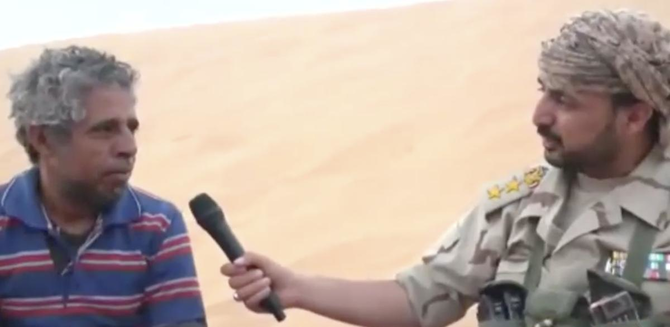
A screen grab from the video shown on Al-Hadath released by the Yemeni National Army of a Houthi prisoner. (Screenshot)
Updated 12 January 2018
Follow

Houthi prisoner admits: ‘Hezbollah expert came to train us’

LONDON: The Yemeni National Army released a video on Thursday of a Houthi militia prisoner in the Al-Jawf region who confessed to receiving training along with dozens of others at the hands of Lebanese Hezbollah soldiers.
He confirmed on the tape distributed by Al-Hadath that he was given training by an artillery and rocket expert along with 39 Houthi soldiers. After this, the group were posted on the Al-Jawf, Sa’da and Hajjah fronts in areas that border Saudi Arabia.
He also revealed that theoretical training took place in the Yemeni capital of Sana’a whilst practical training took place in another area. He said that the expert, only known as “Sajid”, used to come to train them weekly and added that he was Lebanese and had fought in Iraq.
On January 8, the Houthi leader in charge of the Al-Hays and Al-Khokha fronts in Yemen surrendered himself to UAE forces. He also expressed his readiness to work with Arab coalition forces led by Saudi Arabia.


Dozen people entered Egypt from Gaza on first day of Rafah opening: source

Updated 10 min 39 sec ago
Follow

Dozen people entered Egypt from Gaza on first day of Rafah opening: source

  • The reopening, demanded by the UN and aid groups, is a key part of the second phase of Trump’s truce plan for Gaza, where humanitarian conditions remain dire after two years of war

RAFAH: A handful of injured Palestinians and their companions entered Egypt from Gaza on Monday, the first day of a limited reopening of the Rafah border crossing, a source on the Egyptian side of the border told AFP.
“Five injured people and seven companions” crossed the border, the source said on Tuesday.
The reopening, demanded by the United Nations and aid groups, is a key part of the second phase of US President Donald Trump’s truce plan for Gaza, where humanitarian conditions remain dire after two years of war.
The number of patients allowed to enter Egypt through the crossing was limited to 50 on Monday, each accompanied by two companions, according to three officials at the Egyptian border.
An Egyptian health official told AFP on Monday that three ambulances had arrived with Palestinian patients who were screened upon arrival to determine which hospital to be taken to.
AlQahera News, citing Egypt’s health ministry, reported that 150 hospitals and 300 ambulances had been prepared to receive Palestinian patients.
It said 12,000 doctors and 30 rapid deployment teams had been allocated to work with those transferred.
The director of Gaza City’s Al-Shifa Hospital, Mohammed Abu Salmiya, said there were 20,000 patients in the territory in urgent need of treatment, including 4,500 children.
There was no official announcement of the number of people who returned to Gaza via the crossing.
AFP images on Monday showed empty buses crossing back to Egypt after transporting Palestinians to Gaza earlier in the day.
The partial resumption of operations at the crossing comes after Israeli forces seized control of the gateway to Egypt in May 2024 during the war with Hamas.
Gaza’s civil defense reported dozens killed in a wave of Israeli strikes over the weekend, in what the military said was retaliation for Palestinian fighters exiting a tunnel in Rafah city.
Ali Shaath, the head of a Palestinian technocratic committee established to oversee the day-to-day governance of Gaza, said Rafah’s reopening offered a “window of hope” for the territory.