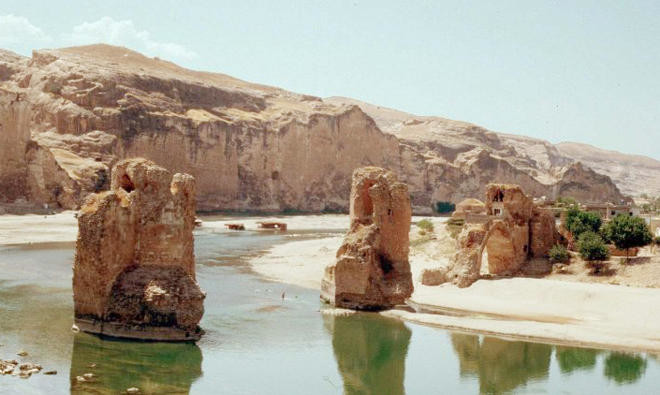
Iran-Turkey water policy leaves Iraq dry

Iraq’s southern provinces have been suffering a serious shortage of water.
Updated 12 January 2018
Follow

Iran-Turkey water policy leaves Iraq dry

BAGHDAD: Iraq has been negotiating with Turkey and Iran to minimize the effects of the two countries’ water policies on its territories, Iraqi Deputy Minister of Water Resources Mahdi Rasheed told Arab News on Wednesday.
Rasheed said that the talks were aimed at finding common solutions to an expected water crisis in the summer.
Iraq mainly relies on the Tigris and Euphrates rivers and rainwater to provide its fresh water needs. Both rivers originate from outside Iraq, and Turkey, Iran and Syria have controlled the release of water into Iraq for decades.
A decline in rainfall during the past two months, increasing rates of evaporation caused by high temperatures and a lack of water imports from Turkey and Iran, mean Iraq’s southern provinces have been suffering a serious shortage of water.
The crisis is expected to worsen after the completion of the Alesso dam and Turkey’s announcement of its intention to fill the dam’s reservoirs in March.
Iraq last week filed a formal request to Turkey to postpone the filling of the Alesso dam from March to June to help Iraq “overcome the period of water scarcity.”
“The water shortage crisis still exists. If Turkey insists on filling the reservoirs of the (Allesso) dam in March, we will certainly be hurt,” Rasheed said. “We will have to rely on our water reservoirs to secure the demands of agriculture and drinking water. As a ministry we are thinking about the future; it is not logical to empty our (water) reservoir.”
Iraq is seeking to benefit from the season of melting of snow, which begins in March, to replenish its water reservoirs. Iraqi officials involved in the talks with Turkey have presented an alternative plan for the Turkish side to fill the reservoirs without depriving Iraq of water during March to June.
According to the suggested Iraqi plan, the filling period of the Turkish dam would last for a maximum of four years and minimum of seven months, depending on rainfall.
“The Turkish side understands our problem,” said Rasheed, who heads the Iraqi delegation negotiating with the Kurdish side on the joint water issues.
“We recognize their right to fill the dam but we have a problem. We agree that the dam will help us to control the water release and organize water policy, but the problem is their (the Turkish) plan to fill it (the dam),” he said.
“We are still waiting for their response to our request and we expect that they will answer us next week.”
Rasheed said that Iraq is facing similar problems with Iran, which has cut the water imports of the Tigris river from 40 percent to 15 percent due to the projects and dams that Iran has established on the river during the past years.
The almost-completed Daryan dam, which Iran is building on the Tigris river, 28 km away from the Iraqi-Iranian border, and the 47 km-long tunnel it has dug near it to divert the river into Iran, is the biggest concern for Iraqi officials.
“Iran is trying to divert the course of the (Tigris) river. In this case even the (amount) that we receive now will be cut and will not reach us,” Rasheed said.


Abbas reiterates opposition to displacement of Palestinians

Russian President Vladimir Putin with Palestinian President Mahmoud Abbas at the Senate Palace of the Kremlin in Moscow. (AP)
Updated 23 January 2026
Follow

Abbas reiterates opposition to displacement of Palestinians

  • During Moscow talks, president calls for immediate halt to Israeli acts of terror
  • Historically, Russia has supported and stood by the Palestinian people at political and diplomatic levels

MOSCOW: The Palestinian National Authority’s President Mahmoud Abbas has reiterated his opposition to all attempts to displace Palestinian people from their land.

Speaking with Russian President Vladimir Putin at the presidential palace in Moscow, Abbas was reported by the Kremlin’s official website as saying that “the Palestinian people are holding on to their land, and we categorically oppose attempts by the Americans and Israelis to expatriate Palestinians beyond Palestinian territory.” 
He said the Palestinian people “will not abandon their land, whatever the cost.” Abbas stressed the need to fully implement US President Donald Trump’s peace plan, leading to the withdrawal of occupation forces and the launch of the reconstruction process.
He emphasized that the Palestinian Authority would assume a central role in administering the Gaza Strip, and that the enclave and the West Bank constituted two parts of a single territorial unit, with a unified and undifferentiated system of civilian institutions.
He stressed the need for an immediate halt to “Israeli settler colonialism and Israeli acts of terror in the West Bank, including Jerusalem, along with the release of withheld Palestinian funds and the cessation of all measures that undermined the Palestinian Authority and the two-state solution.”
He reaffirmed his commitment to continue the struggle for the realization of the Palestinian people’s right to self-determination and of their right to a fully sovereign, independent state based on the borders of June 4, 1967, with East Jerusalem as its capital, while living in security and peace with neighbors.
He told Putin: “What we need is peace, and we hope that with your help and support, we can achieve it — a peace built on the basis of international legal resolutions, decisions of the United Nations, and the principles established following the wars of 1967 and 1973.
“East Jerusalem remains the capital of Palestine, and we know that Russia has always supported — indeed, was the first to support — Palestine, maintaining a firm stance in support of our people.”
Abbas thanked his Russian counterpart for Moscow’s support and commended the bilateral “bonds of friendship” between both countries. He added: “We are friends of Russia and the Russian people. For over 50 years our nations have been bound by a strong friendship that has developed over the decades and continues on the correct path. Russia is a great friend and a nation upon which we rely in many spheres.
“Historically, Russia has supported and stood by the Palestinian people at political and diplomatic levels. Your economic and financial support is both significant in scale and crucial in importance.”
Abbas emphasized moving forward with the implementation of a comprehensive national reform program aimed at consolidating the rule of law, strengthening the principles of good governance, transparency, and accountability, and ensuring the separation of powers.
Putin affirmed Moscow’s “principled and consistent approach” to the Palestinian question.
He said: “We believe that only the establishment and full functioning of the Palestinian state can lead to a lasting settlement of the Middle East conflict.”