TAIF: Flocks of Hajj and Umrah performers travel to Taif, 70km from Makkah, to visit the city’s historical places.
One of the main attractions in Taif is the Al-Qu’a and Al-Qantara Mosque, located in Al-Mathnah neighborhood.
Khalid Al-Shirbi, a licensed tour guide for the Saudi Commission for Tourism and National Heritage (SCTH), told Arab News that the Qantara Mosque, also known as Al-Madhoun Mosque, was built some 162 years ago. “It was built during the Ottoman era. It is only its building style, inspired from Abbasid architecture, that gives the impression of being ancient,” he said.
He added that the farm where Prophet Muhammad rested after being expelled from Taif and was offered fruit by Addas, the grape farmer, is on the opposite side of the mosque.
Another mosque that many tourists are keen to visit in Taif is the Al-Qu’a Mosque, which Al-Shirbi confirmed was built some 800 years after the death of the Prophet.
“Many tourists believe that Prophet Muhammad came to this place and, with his elbow, leaned on a stone, leaving a mark,” Al-Shirbi said. He added that tour guides normally try to clear up such incorrect concepts, but some stories, he said, are engraved in tourists’ minds.
He pointed out that most of the visiting tourists come from Malaysia, Indonesia, Pakistan, Singapore, Bangladesh and Turkey.
“The Pakistanis, in particular, call it ‘Hazrat Ali Mosque,’ referring to Al-Bin Abi Talib, the Prophet’s cousin, who they think was with the Prophet when he was in Taif. “This is completely untrue. Islamic biographers have different opinions whether the Prophet was alone or accompanied by Zaid bin Haritha, but not Ali.”
Many scholars and historians have narrated the story of Prophet with Addas in different ways, but they all agreed on one theme. Sheikh Mohammed Al-Areefy, for instance, said: “After his wife, Khadija bint Khwuailed, and his uncle, Abu Talib, had passed away in the same year, which was later called “Year of Sadness,” he sought a place where he could find supporters. When he arrived in Taif, his call to Islam was not only robustly rejected, he was also followed on his way back to Makkah, and had stones thrown at him until he reached Al-Mathnah Valley, where he rested for a while.
“This area was known for its fruits. A Christian Iraqi farmer, Addas, who was serving a rich family originating from Makkah, approached the sad Prophet and offered him a bowl of grapes.
“The Prophet took the grapes and before starting to eat the fruit, said: ‘In the name of Allah.’ The phrase, which the worker had not heard before, sparked his attention and he asked: People here do not say that! The Prophet asked Addas where he was from. “From Nineveh,” the man replied. The story ended with the man embracing Islam.


Taif mosque is a historic Saudi jewel with a story to tell
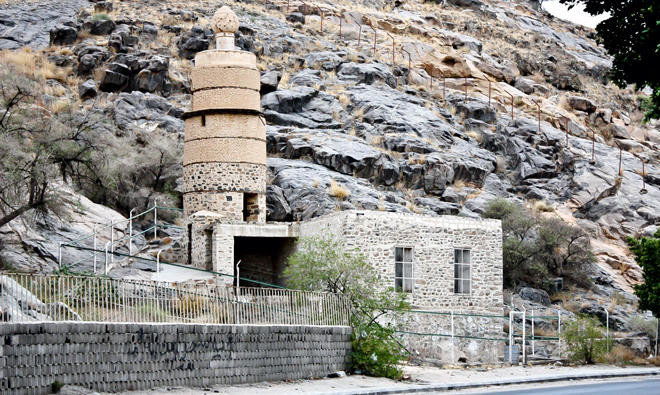
Taif mosque is a historic Saudi jewel with a story to tell


Report: Low light pollution in Northern Borders is ideal for astronomers
- Region has a vast desert horizon and few tall buildings
- Rare meteorological event recently in Northern Borders
RIYADH: The Kingdom’s Northern Borders, characterized by significantly lower levels of light pollution, is a prime destination for astronomical observation, the Saudi Press Agency reported on Friday.
The SPA quoted from a recent report from the Visible Infrared Imaging Radiometer Suite which is circling in space.
The VIIRS is a whiskbroom scanner radiometer that collects imagery and radiometric measurements of land, atmosphere, cryosphere, and oceans in the visible and infrared bands of the electromagnetic spectrum.
This lower level of light pollution, according to the VIIRS, is found in the open areas surrounding Turaif, east of Rafha, and west of the city of Arar.
The Bortle Scale, which measures night-sky brightness, shows readings allowing the Milky Way to be seen with the naked eye on clear nights.
“The vast desert horizon and the scarcity of tall buildings contribute to improved astronomical observation conditions by minimizing ambient light and enhancing viewing quality,” the SPA reported.
“This allows celestial phenomena, such as meteor showers and planetary conjunctions, to be observed with greater precision.”
The report added: “Due to these factors, the region is an ideal destination for amateur astrophotographers and astrophysicists seeking a dark, expansive sky that enables them to observe celestial objects with greater clarity.”
Recently a striking astronomical and optical phenomenon was observed in the Northern Borders, as light pillars appeared in the sky, drawing the attention of locals and enthusiasts of natural phenomena.
A light pillar is an optical phenomenon that occurs in the atmosphere as a vertical column extending above or below its source. This effect is caused by the reflection of light on tiny ice crystals suspended in clouds or the air.
Abouazza El-Mhamdi, an associate professor in the physics and astronomy department at King Saud University, told Arab News at that it was a “rare meteorological event — the vibrant light pillars that illuminated the night sky, was crucial for astronomy and astro tourism in the region.”
“Although these pillars are common in Arctic climates like Canada or Russia, their appearance in the Northern Border region is a remarkable anomaly, highlighting the unique and intense winter conditions affecting the Kingdom’s northern reaches,” said El-Mhamdi.


