ANKARA: The Turkish government is gearing up to play a mediating role between the Iraqi central government and the Kurdish Regional Government (KRG) in Irbil to resolve their post-referendum dispute.
The mediation proposal was announced by Turkish Foreign Minister Mevlut Cavusoglu on Wednesday at the state-run Anadolu Agency Editors’ Desk in Ankara.
“There are some requests (to Turkey) to mediate (between Irbil and Baghdad). I will go to Baghdad on Jan. 21. We will discuss this in addition to the bilateral issues, and our desire is to overcome these problems as soon as possible in the framework of Iraq’s territorial integrity,” he said.
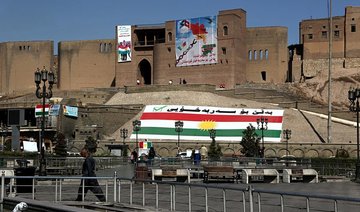
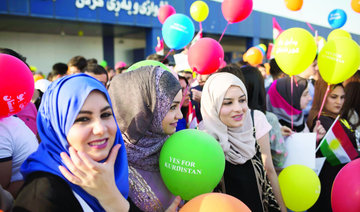
Turkey has always voiced its opposition to the independence referendum that was held by the KRG on Sept. 25 last year, but it did not close its land border with the region despite calls from Baghdad.
In the first two weeks of December, KRG high-level officials visited France and Germany by taking the overland route through Turkey, and then taking a flight from there to discuss the deadlock on Irbil-Baghdad relations.
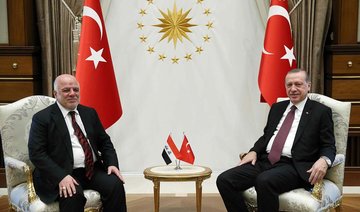
The statement follows an announcement by Iraqi Prime Minister Haider Al-Abadi on Tuesday at a news conference in Baghdad, which said that Iraq remains committed to its cooperation in various areas with Turkey, including border management, bilateral trade relations and oil shipments, especially from Mosul and Kirkuk.
According to official figures, the trade volume between Turkey and Iraq is currently around $8 billion, $2.5 billion of which is with northern Iraq. Much of this trade is conducted through the Habur border crossing whose control was recently handed over to Baghdad at Turkey’s initiative.
The construction of an oil pipeline to export Iraqi oil from Kirkuk area via Turkey’s Ceyhan port, on Turkey’s eastern Mediterranean coast, is also expected to be completed soon.
Experts think that Turkey, as a neutral actor that has resilient and longstanding ties with the two sides, is in a unique position to mediate between Baghdad and Irbil to resolve the crisis.
Bilgay Duman, an expert on Iraqi affairs at Ankara-based think tank ORSAM, said Ankara has always supported the dialogue process within Iraq, and considered both sides as complementary to each other, rather than being alternative.
“Turkey wants stability at its doorstep. It saw any independence attempt of Irbil as a red line and always supported Iraq’s stability and territorial integrity,” Duman told Arab News.
According to Duman, any continuing instability might allow the outlawed Kurdistan Workers’ Party (PKK) based in northern Iraq to fill a power vacuum in the territories near the Turkish border.
It is not the first time Ankara has played a mediation role in Iraq, especially considering its key geographic position for the transit of oil.
“It acted before as a key facilitator between Irbil and Baghdad between 2013-2015 for regulating the profits from oil exports and helping them to reach to an agreement,” Duman said.
On Jan. 4, KRG’s Prime Minister Nechirvan Barzani met with the new Turkish Consul General to Irbil, Hakan Karacay, who expressed Ankara’s readiness to help mend Irbil-Baghdad ties.
“Irbil faces widespread anti-government protests mainly due to the deteriorating economic conditions, while Baghdad wants to overcome all bilateral problems and solely concentrate on the upcoming local and general elections due to be held on May 12,” Duman said.
However, Duman thinks that any rapprochement between Baghdad and Irbil will contribute to the political, social and economic rights of Turkmens in Iraq who have been badly hurt by this crisis.
Turkey is interested in the Turkmen population in Iraq due to its ethnic, linguistic, religious, cultural and historical ties.
According to Muhanad Seloom, director of the Iraqi Center for Strategic Studies in London, Ankara has the capability to act as a mediator for several reasons.
“It is true that Turkey has vested interests in countering the rise of Kurdish ethno-nationalist aspirations, yet, Turkey has played a significant role in helping the KRG develop its economic and financial infrastructures,” Seloom told Arab News.
He explained that although Baghdad-Ankara relations were strained prior and during the war against Daesh due to differences over local and regional policies, especially in Iraq and Syria, the relations took a positive turn last October with the visit of the Iraqi premier to Ankara to discuss post-referendum actions with Ankara.
“During this visit, the two sides agreed to coordinate efforts to preserve the territorial integrity of Iraq and regional stability,” Seloom said.
Seloom thinks that for Turkey, playing a mediating role between Baghdad and Irbil will be very useful on many levels.
“Despite differences with the KRG over holding the independence referendum, the Turkish government relations with the KRG have not been completely destroyed due to deeply rooted financial and economic ties,” he said.
“For example, the KRG used to sell oil through Turkish ports and revenues were handled by financial institutions based in Turkey. Prior to the current crisis, Turkish companies were the main winners of KRG’s construction and services contracts,” he said.
Equally, Seloom thinks that the Turkish government wants to establish stronger economic ties with Baghdad by playing a role in resolving the crisis between Baghdad and Irbil.
“It is also important to note that the Turkish government seeks to counterbalance Iran’s increasing influence in Iraq. While Iran is dealing with its internal unrest, Turkey sees an opportunity to seize,” he said.


![]()

Turkey to mediate between KRG and Baghdad
Turkey to mediate between KRG and Baghdad
Latest updates


© 2026 SAUDI RESEARCH & PUBLISHING COMPANY, All Rights Reserved And subject to Terms of Use Agreement.