Kurdistan region refuses to hand over border crossings to Iraqi government

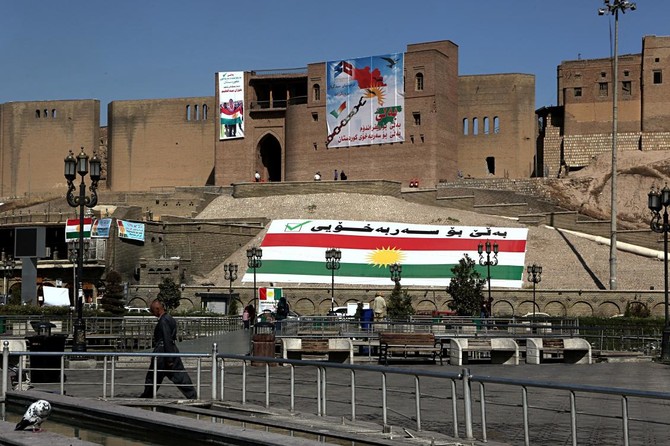
Kurdish flags and pro-independence items hang on Irbil's citadel in central Irbil. (AP)
Updated 29 September 2017
Follow

Kurdistan region refuses to hand over border crossings to Iraqi government

IRBIL: The Kurdistan Regional Government (KRG) in northern Iraq refused to relinquish control of its border crossings to the Iraqi government, Irbil-based TV Rudaw said on Friday, citing a KRG official.
Relinquishing control over border crossings with Turkey, Iran and Syria was a demand made by Iraq, Iran and Turkey in retaliation for the Kurdish independence referendum held on Monday in northern Iraq.
Backed by Ankara and Tehran, the Iraqi government has demanded that the Kurdish leadership cancel the result of the referendum or face sanctions, international isolation and possibly a military intervention.
An embargo on direct international travel to Kurdistan has been imposed by the Iraqi government to force the KRG to hand over the control of its airports to Baghdad.
Talar Saleh, the general director of Irbil International Airport, said Kurdish authorities were unaware of how to comply with Baghdad’s demand to hand the airport over to federal authorities before Friday evening in order to avert the threatened flight ban.
“We didn’t understand what it meant,” Saleh said of the demand. “An airport isn’t an item that can be handed over to someone.”
Saleh said authorities in Baghdad did not respond to requests for clarification. She condemned the ban, accusing the central government of “just punishing their own people.”
Military, humanitarian and diplomatic flights will continue from the airport uninterrupted according to the information relayed from Baghdad, Saleh added.


Syrian Alawites protest in coastal heartland after mosque bombing

Updated 59 min 20 sec ago
Follow

Syrian Alawites protest in coastal heartland after mosque bombing

  • Syrian Alawites took to the streets on Sunday in the coastal city of Latakia to protest after a mosque bombing that killed eight people in Homs two days before

LATAKIA: Syrian Alawites took to the streets on Sunday in the coastal city of Latakia to protest after a mosque bombing that killed eight people in Homs two days before.
The attack, which took place in an Alawite area of Homs city, was the latest against the religious minority, which has been the target of several episodes of violence since the December 2024 fall of longtime ruler Bashar Assad, himself an Alawite.
Security forces were deployed in the area, and intervened to break up clashes between demonstrators and counter-protesters, an AFP correspondent witnessed.
“Why the killing? Why the assassination? Why the kidnapping? Why these random actions without any deterrent, accountability or oversight?” said protester Numeir Ramadan, a 48-year-old trader.
“Assad is gone, and we do not support Assad... Why this killing?“
Sunday’s demonstration came after calls from prominent spiritual leader Ghazal Ghazal, head of the Islamic Alawite Council in Syria and Abroad, who on Saturday urged people to “show the world that the Alawite community cannot be humiliated or marginalized.”
“We do not want a civil war, we want political federalism. We do not want your terrorism. We want to determine our own destiny,” he said in a video message on Facebook.
Protesters carried pictures of Ghazal along with banners expressing support for him, while chanting calls for decentralized government authority and a degree of regional autonomy.
“Our first demand is federalism to stop the bloodshed, because Alawite blood is not cheap, and Syrian blood in general is not cheap. We are being killed because we are Alawites,” Hadil Salha, a 40-year-old housewife said.
Most Syrians are Sunni Muslim, and the city of Homs — where Friday’s bombing took place — is home to a Sunni majority but also has several areas that are predominantly Alawite, a community whose faith stems from Shiite Islam.
The community is otherwise mostly present across their coastal heartland in Latakia and Tartus provinces.
Since Assad’s fall, the Syrian Observatory for Human Rights monitor and Homs province residents have reported kidnappings and killings targeting members of the minority community.
Alawite massacres 
The country has also seen several bloody flare-ups of sectarian violence.
Syria’s coastal areas saw the massacre of Alawite civilians in March, with authorities accusing armed Assad supporters of sparking the violence by attacking security forces.
A national commission of inquiry said at least 1,426 members of the minority were killed, while the Syrian Observatory for Human Rights monitor put the toll at more than 1,700.
Late last month, thousands of people demonstrated on the coast to protest fresh attacks targeting Alawites in Homs and other regions.
Before and after the March bloodshed, authorities carried out a massive arrest campaign in predominantly Alawite areas, which are also former Assad strongholds.
Protesters on Sunday also demanded the release of detainees.
On Friday, Syrian state television reported the release of 70 detainees in Latakia “after it was proven that they were not involved in war crimes,” saying more releases would follow.
Despite assurances from Damascus that all Syria’s communities will be protected, the country’s minorities remain wary of their future under the new Islamist authorities, who have so far rejected calls for federalism.