Iran protests show danger of economic woes

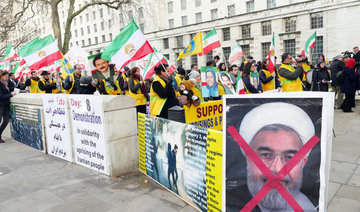
Demonstrators attend a protest over Iran's weak economy in Tehran, Iran. (AP)
Updated 09 January 2018
Follow

Iran protests show danger of economic woes

DUBAI: The protesters rallied for days in Iran, chanting against government corruption and demanding justice.
That was last year, when depositors who lost their savings in the collapse of a major government-run credit union took to the streets, shouting “Death to (Valiullah) Seif,” Iran’s Central Bank governor.
In the past 10 days, there were new protests, the largest in Iran since its 2009 disputed presidential election, fueled by young people angry over their bleak prospects. This time, they shouted slogans against President Hassan Rouhani and Supreme Leader Ayatollah Ali Khamenei.
The protests in dozens of towns and cities also showed that a sector of the public was willing to openly call for the removal of Iran’s system of rule by clerics — frustrated not just by the economy but also by concern over Iran’s foreign wars and general direction.
That sentiment likely extends beyond those who took to the streets. But the protests also showed the constraints on discontent. Fear of reprisals probably kept some people away from the protests.
Without drastic change in people’s livelihoods, unrest over the economy will only intensify, becoming perhaps the greatest challenge for Iran as it nears its fourth decade of existence and a new era of leadership looms.
The collapse last year of the Caspian Credit Institute, which promised depositors returns often seen in Ponzi schemes, showed the economic desperation faced by many in Iran. Retirees unable to make ends meet on their pensions can be found driving many of the taxis crowding Tehran’s roads. Universities turn out students with no hope of employment in their fields, while those lucky enough to have work often have a second or even a third job.
Banks remain saddled with bad loans, a warning repeatedly sounded by the International Monetary Fund (IMF). Some of this stretches back to the days of nuclear sanctions, while others find themselves mired in the murky finances of the paramilitary Revolutionary Guard, which is estimated to control a third of the total economy.
Inflation, initially brought under control by Rouhani, has slipped back into double digits, according to recent figures. He cut some subsidies offered by his hard-line predecessor, Mahmoud Ahmadinejad. Those subsidies benefited rural and poor voters in the provinces, the same people who appear to have taken to the streets in the recent protests, initially sparked by food prices.
The recent protests saw some marchers chant against Iran’s foreign wars, demanding the government focus first on those at home.
Protesters denounced the money going to support Iranian proxies fighting in the region rather than helping people in Iran.
Approaching the 40th anniversary of the revolution, Iran will increasingly consider who will follow the 78-year-old Khamenei, who underwent prostate surgery in 2014. Among those under consideration is Rouhani, himself a cleric. Both the US and analysts studying Iran say hard-liners initially fomented the economic protests to put pressure on Rouhani but quickly lost control of them.
The economic resentment seen in recent days could prompt the rise of another Ahmadinejad-style hard-line populist.
It is hard to tell right now who emerged stronger after the protests — Rouhani or his hard-line opponents. Each tried to wield anger over the economy against the other. Weeks before the protests, Rouhani publicly complained that large parts of the government budget went to religious institutions, largely seen as power bases of the hard-liners, seeking to deflect blame over the economy.


First Ramadan after truce brings flicker of joy in devastated Gaza

Updated 55 min 51 sec ago
Follow

First Ramadan after truce brings flicker of joy in devastated Gaza

  • Ramadan lanterns and string lights appear on streets lined with collapsed buildings and piles of rubble in Gaza City
  • The first holy month since the October ceasefire brings mixed feelings for the many still living in tents

GAZA CITY: Little Ramadan lanterns and string lights appeared on streets lined with collapsed buildings and piles of rubble in Gaza City, bringing joy and respite as Islam’s holiest month began — the first since October’s ceasefire.
In the Omari mosque, dozens of worshippers performed the first Ramadan morning prayer, fajr, bare feet on the carpet but donning heavy jackets to stave off the winter cold.
“Despite the occupation, the destruction of mosques and schools, and the demolition of our homes... we came in spite of these harsh conditions,” Abu Adam, a resident of Gaza City who came to pray, told AFP.
“Even last night, when the area was targeted, we remained determined to head to the mosque to worship God,” he said.
A security source in Gaza told AFP Wednesday that artillery shelling targeted the eastern parts of Gaza City that morning.
The source added that artillery shelling also targeted a refugee camp in central Gaza.
Israel does not allow international journalists to enter the Gaza Strip, preventing AFP and other news organizations from independently verifying casualty figures.

‘Stifled joy’

In Gaza’s south, tens of thousands of people still live in tents and makeshift shelters as they wait for the territory’s reconstruction after a US-brokered ceasefire took hold in October.
Nivin Ahmed, who lives in a tent in the area known as Al-Mawasi, told AFP this first Ramadan without war brought “mixed and varied feelings.”
“The joy is stifled. We miss people who were martyred, are still missing, detained, or even traveled,” she said.
“The Ramadan table used to be full of the most delicious dishes and bring together all our loved ones,” the 50-year-old said.
“Today, I can barely prepare a main dish and a side dish. Everything is expensive. I can’t invite anyone for Iftar or suhoor,” she said, referring to the meals eaten before and after the daily fast of Ramadan.
Despite the ceasefire, shortages remain in Gaza, whose battered economy and material damage have rendered most residents at least partly dependent on humanitarian aid for their basic needs.
But with all entries into the tiny territory under Israeli control, not enough goods are able to enter to bring prices down, according to the United Nations and aid groups.

‘Still special’

Maha Fathi, 37, was displaced from Gaza City and lives in a tent west of the city.
“Despite all the destruction and suffering in Gaza, Ramadan is still special,” she told AFP.
“People have begun to empathize with each other’s suffering again after everyone was preoccupied with themselves during the war.”
She said that her family and neighbors were able to share moments of joy as they prepared food for suhoor and set up Ramadan decorations.
“Everyone longs for the atmosphere of Ramadan. Seeing the decorations and the activity in the markets fills us with hope for a return to stability,” she added.
On the beach at central Gaza’s Deir el-Balah, Palestinian artist Yazeed Abu Jarad contributed to the holiday spirit with his art.
In the sand near the Mediterranean Sea, he sculpted “Welcome Ramadan” in ornate Arabic calligraphy, under the curious eye of children from a nearby tent camp.
Nearly all of Gaza’s 2.2 million residents were displaced at least once during the more than two years of war between Israel and Hamas, sparked by the latter’s unprecedented October 7 attack on Israel.
Mohammed Al-Madhoun, 43, also lives in a tent west of Gaza City, and hoped for brighter days ahead.
“I hope this is the last Ramadan we spend in tents. I feel helpless in front of my children when they ask me to buy lanterns and dream of an Iftar table with all their favorite foods.”
“We try to find joy despite everything,” he said, describing his first Ramadan night out with the neighbors, eating the pre-fast meal and praying.
“The children were as if they were on a picnic,” he said.