UNITED NATIONS: The United Nations peacekeeping chief on Tuesday condemned the Democratic Republic of Congo’s security forces for violently cracking down on protesters and said authorities must prosecute those responsible.
At least five people were killed during clashes on December 31 when police burst into churches, firing tear gas and shooting bullets in the air to break up protests in the capital Kinshasa and in the central city of Kananga, according to UN figures.
The demonstrations took place on the first anniversary of a political deal brokered by the Catholic church that was to pave the way for elections in 2017 and the end of President Joseph Kabila’s rule.
The elections were pushed back to December 2018 after the government cited delays in preparing the nationwide polls.
Jean-Pierre Lacroix, the UN under secretary-general for peacekeeping, told the Security Council that he “condemned the violent repression by the national security forces of the demonstrations organized by civil society on December 31.”
He added that authorities must “diligently carry out the necessary investigations to establish who is responsible and bring to justice the perpetrators of these human rights violations.”
Kabila has been in power since 2001 when he succeeded his assassinated father Laurent Kabila.
He refused to step down at the end of his second and final term in December 2016.
DR Congo’s Ambassador Ignace Mata Mavita said his government “regretted” the violence. The authorities will investigate and take action against security forces who burst into churches, he told the council.
The ambassador, however, accused the opposition of seeking to undermine the elections by holding protests.
“The right attitude of all political actors and all the Congolese people should be to do everything possible to prepare for the smooth running of these elections in a peaceful atmosphere,” he told the council.
“It is not normal to see the kind of unrest and demonstrations that took place” on December 31, he added.
France called for those responsible for the repression to face justice.
The Security Council was meeting for the first time to discuss the situation in the DR Congo since the date of December 23, 2018 was set for the historic elections.
The council backs the new timetable for the vote and warned that there should be no more delays.


![]()
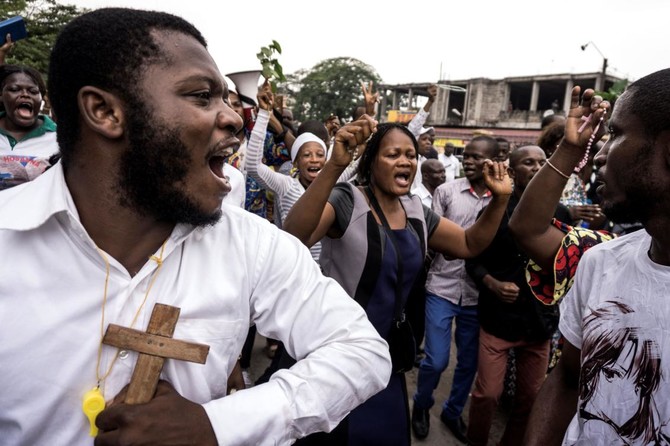

UN pushes DR Congo to investigate crackdown on protesters
UN pushes DR Congo to investigate crackdown on protesters
Kyrgyzstan parliament speaker resigns after spy chief sacking
BISHKEK: Kyrgyzstan’s parliament speaker said Thursday he would step down, two days after President Sadyr Japarov dismissed the Central Asian country’s powerful secret service chief and arrested political figures who called for early elections.
In a surprise move, Japarov had sacked his one-time close ally — spy chief Kamchybek Tashiev — in a decision Bishkek said was meant to “prevent division in society.”
Japarov is seeking re-election next year in a country that was once a regional leader in terms of openness, though marked by political volatility.
Rights groups have accused him of authoritarian tendencies, as he seeks to assert his control and cast himself as a bringer of stability.
Speaker Nurlanbek Turgunbek uulu — close to the sacked security boss — told MPs he would step down, insisting that he was not resigning under pressure.
“Reforms initiated by the president must be carried out. Political stability is indispensable,” he said.
Kyrgyzstan has in recent years been de-facto governed by the Japarov-Tashiev tandem.
Both came to power in the wake of the 2020 revolution — the third since Bishkek gained independence from the Soviet Union in 1991.
Several NGOs have in recent months denounced the deterioration of freedom of expression in Kyrgyzstan.
Japarov had unexpectedly sacked Tashiev and three of his deputies on Tuesday, also weakening the powers of the secret services.
Japarov rarely speaks publicly. His spokesman had said the decision was taken “in the interests of the state, with the aim of preventing divisions within society, including between government structures, and to strengthen unity.”
Tashiev was in Germany for health treatment when the sacking was announced and had said it was a “total surprise” to him.
The decision came the day after the publication of an open letter from 75 political figures and ex-officials calling to bring forward presidential elections — scheduled for January 2027.
Five of those who signed the letter — which criticized the economic situation in the country — were arrested Wednesday on charges of organizing mass riots.
In a surprise move, Japarov had sacked his one-time close ally — spy chief Kamchybek Tashiev — in a decision Bishkek said was meant to “prevent division in society.”
Japarov is seeking re-election next year in a country that was once a regional leader in terms of openness, though marked by political volatility.
Rights groups have accused him of authoritarian tendencies, as he seeks to assert his control and cast himself as a bringer of stability.
Speaker Nurlanbek Turgunbek uulu — close to the sacked security boss — told MPs he would step down, insisting that he was not resigning under pressure.
“Reforms initiated by the president must be carried out. Political stability is indispensable,” he said.
Kyrgyzstan has in recent years been de-facto governed by the Japarov-Tashiev tandem.
Both came to power in the wake of the 2020 revolution — the third since Bishkek gained independence from the Soviet Union in 1991.
Several NGOs have in recent months denounced the deterioration of freedom of expression in Kyrgyzstan.
Japarov had unexpectedly sacked Tashiev and three of his deputies on Tuesday, also weakening the powers of the secret services.
Japarov rarely speaks publicly. His spokesman had said the decision was taken “in the interests of the state, with the aim of preventing divisions within society, including between government structures, and to strengthen unity.”
Tashiev was in Germany for health treatment when the sacking was announced and had said it was a “total surprise” to him.
The decision came the day after the publication of an open letter from 75 political figures and ex-officials calling to bring forward presidential elections — scheduled for January 2027.
Five of those who signed the letter — which criticized the economic situation in the country — were arrested Wednesday on charges of organizing mass riots.
Latest updates


Recommended


© 2026 SAUDI RESEARCH & PUBLISHING COMPANY, All Rights Reserved And subject to Terms of Use Agreement.