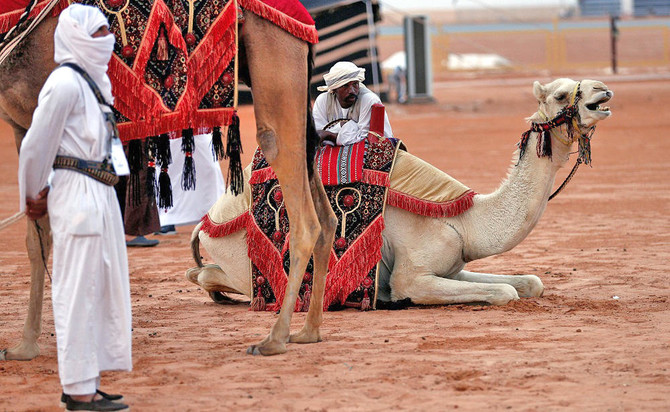
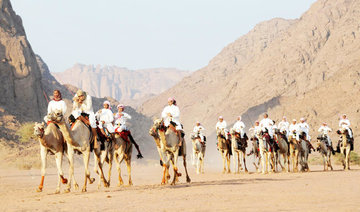
The administration of King Abdulaziz Camel Festival has stressed that strict penalties, including the ban from participation, are awaiting those instigating tribal slurs and gatherings that harass visitors and participants of the Festival.
The administration said such practices are totally rejected and unacceptable.
Head of Organization and Field Committees Fawzan Al-Madi said the administration of King Abdulaziz Camel Festival does not prevent gatherings but it makes them legalized and organized adding that there are gatherings which reflect pride while raising Saudi flags, chanting national songs and expressing national unity.
The undesired and negative joy is that which comes through harmful gathering which carries slogans and instigates slurs as it raises flags not the national flag, he said. he said the harmful gathering is that one which hampers work of the security men adding that such excesses will expose their instigators to penalties including their ban from participation. He called on the participants to control their supporters and alert them not to exceed the instructions.
It is to be recalled that excesses in gatherings with camels joining the Festival as they display their skills in front of the jury committee are considered a negative phenomenon which is deplorable by all, whether are participants or visitors, notably if it instigates tribal slurs or carries un-known flags.
The owner of the camel might be banned from the Festival for irregularities, which have already been warned of while the crowded might harm himself or others. To this end, the administration of the Festival and its staff are working to ensure the safety of participants and visitors, he said.

Tribal slurs banned in National Camel Festival
Saudi Arabia champions AI and sustainable growth at UN tourism meeting in Kuwait
- Saudi Tourism Minister says tourism today accounts for approximately 10 percent of the world economy, contributing about $10 trillion to global GDP
KUWAIT CITY: Saudi Arabia’s Tourism Minister Ahmed Al-Khateeb has called for stronger international cooperation to build a tourism ecosystem that is integrated, resilient, and future-ready, the Saudi Press Agency reported Thursday.
In a opening address at the 52nd UN Tourism Regional Commission for the Middle East in Kuwait City, he noted that tourism is “no longer a peripheral activity but a massive engine of economic development.”
“With an estimated contribution exceeding $10 trillion to global GDP, tourism today accounts for approximately 10 percent of the world economy,” said Al-Khateeb, speaking as president of the 26th UN Tourism General Assembly. The three-day conference opened on Feb. 10 a.
He pointed to the Middle East’s exceptional recovery, which recorded a 39 percent increase in international arrivals in 2025 compared to 2019, welcoming nearly 100 million visitors last year.
The minister highlighted Saudi Arabia’s driving force behind these regional statistics, noting that the Kingdom now represents approximately 30% of the Middle East tourism market in both visitor numbers and spending.
“We are proud that Saudi tourism’s uninterrupted growth has become a driving force for regional tourism, and we look forward to continuing our close cooperation with UN Tourism to share our expertise with the world,” he said.
Focus on AI
Addressing the meeting’s central theme of Artificial Intelligence (AI), Al-Khateeb emphasized the need for responsible innovation. He described AI as a key enabler for growth but stressed that the “human touch” defining the hospitality sector must be maintained and the workforce protected.
On the sidelines of the regional commission, the minister met with counterparts from across the region to explore ways to promote regional cooperation and alignment to enhance resilience and build tourism industries that can drive inclusive economic and social development.
Al-Khateeb also met with leading investors from Kuwait to discuss investments in the Kingdom’s tourism sector and explore new opportunities to leverage Saudi Arabia’s integrated investment ecosystem, designed to enable regional and international investors to achieve sustainable, long-term value.
The 52nd UN Tourism Regional Commission for the Middle East is the first held in the region since the 26th UN Tourism General Assembly, hosted in Riyadh last November.
That assembly resulted in the historic “Riyadh Declaration on the Future of Tourism,” which established a global consensus on sustainability, inclusive growth, and the responsible adoption of human-centric AI for the next fifty years.