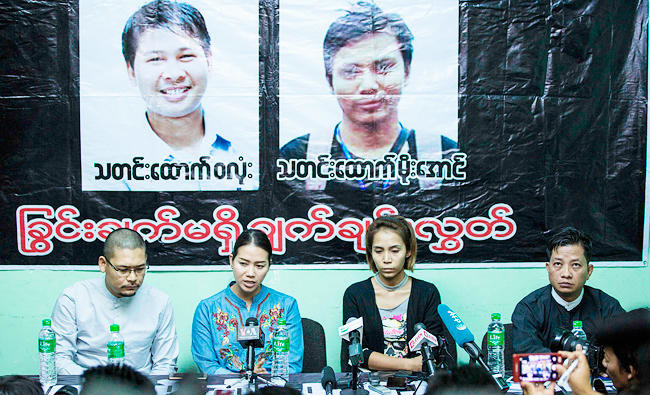
BANGKOK: Myanmar is set to put two reporters from the Reuters news agency on trial this week after they were charged under a colonial-era state secrets act, in a case that highlights growing concerns about press freedom in the country.
Wa Lone and Kyaw Soe Oo were arrested Dec. 12 for allegedly acquiring “important secret papers” from two police officers. The officers had worked in Rakhine state, where abuses widely blamed on Myanmar’s military have driven hundreds of thousands of Rohingya Muslims to flee into neighboring Bangladesh.
The charges against the two are punishable by up to 14 years in prison.
Rights and media groups have criticized Myanmar’s new civilian government led by Nobel Peace laureate Aung San Suu Kyi for continuing to use colonial-era laws to threaten and imprison journalists. Such laws were widely used by the military junta that previously ruled the country to muzzle critics and the media.
Under the current government, at least 32 journalists have been charged, mostly under colonial-era laws, according to the local group We Support Journalists.
“Such arrests and laws were widely used by the military junta to shut us down,” the group’s founder, Maung Saungkha, said by phone. “But it’s sad to see media freedom is even worse under the so-called democratically elected government.”
The arrest of the two Myanmar journalists, whose trial begins Wednesday, caused an international outcry. After they were detained, UN Secretary-General Antonio Guterres said the arrests showed how press freedom was deteriorating in Myanmar, while US Secretary of State Rex Tillerson called for their immediate release.
Reuters President and Editor-in-Chief Stephen J. Adler also has called on Myanmar to free the journalists.
“Their arrest and continued incarceration represent an egregious attack on press freedom — preventing them, and deterring other journalists, from reporting independently in Myanmar,” Adler said in a statement Monday.
Critics and rights groups say that in some respects, press freedom in Myanmar is more restrictive now than it was during the previous quasi-civilian administration, which bridged the former military government to the current civilian one. Suu Kyi’s government, which has been in power for two years, has done nothing to change laws that create barriers to a free press.
“Nearly two years later, we have been gravely disappointed by the lack of progress on legal reform and the new clampdown on journalists under Suu Kyi’s rule,” said Shawn Crispin, senior Southeast Asia representative for the New York-based Committee to Protect Journalists.
In November, Myanmar authorities sentenced two foreign journalists working for Turkish state broadcaster TRT, along with their local interpreter and driver, to two months in prison for flying a drone over the parliament building. All four were released in late December.
A few days after the Reuters journalists were arrested, Myanmar President Htin Kyaw, a close ally and confidant of Suu Kyi, the country’s de facto leader, authorized police to proceed with the charges against them.
Despite facing heavy criticism for the move, the government said it was simply implementing the rule of law.
“It’s up to the court to decide whether the journalists are guilty or not because as a government, we don’t interfere in the country’s judicial system,” said government spokesman Zaw Htay.
Wa Lone, who joined Reuters in June 2016, has covered a range of stories related to the Rohingya crisis, while Kyaw Soe Oo began working for the news agency in September. Since their arrest, they’ve been held in the country’s notorious Insein prison.
More than 650,000 Rohingya have fled from Myanmar into Bangladesh since Aug. 25, when Myanmar’s army began what it called “clearance operations” following an attack on police posts by Rohingya insurgents. The aid group Doctors Without Borders estimates at least 6,700 Rohingya civilians were killed in the first month of the crackdown.
Since the crisis in northern Rakhine state began, new restrictions on press access have made it nearly impossible for journalists to cover independently in the region.
“Suu Kyi’s government clearly feels foreign media coverage of the Rohingya crisis has damaged its international image and now it’s fighting back through bogus legal threats and jailing of journalists,” Crispin said.

Myanmar trial set to begin for 2 Reuters journalists
EU leaders to reassess US ties despite Trump U-turn on Greenland
BRUSSELS: EU leaders will rethink their ties with the US at an emergency summit on Thursday after Donald Trump’s threat of tariffs and even military action to acquire Greenland badly shook confidence in the transatlantic relationship, diplomats said.
Trump abruptly stepped back on Wednesday from his threat of tariffs on eight European nations, ruled out using force to take Greenland, a semi-autonomous territory of NATO ally Denmark, and suggested a deal was in sight to end the dispute.
German Chancellor Friedrich Merz, welcoming Trump’s U-turn on Greenland, urged Europeans not to be too quick to write off the transatlantic partnership.
But EU governments remain wary of another change of mind by a mercurial president who is increasingly seen as a bully that Europe will have to stand up to, and they are focused on coming up with a longer-term plan on how to deal with the United States under this administration and possibly its successors too.
“Trump crossed the Rubicon. He might do it again. There is no going back to what it was. And leaders will discuss it,” one EU diplomat said, adding that the bloc needed to move away from its heavy reliance on the US in many areas.
“We need to try to keep him (Trump) close while working on becoming more independent from the US It is a process, probably a long one,” the diplomat said.
EU RELIANCE ON US
After decades of relying on the United States for defense within the NATO alliance, the EU lacks the needed intelligence, transport, missile defense and production capabilities to defend itself against a possible Russian attack. This gives the US substantial leverage.
The US is also Europe’s biggest trading partner, making the EU vulnerable to Trump’s policies of imposing tariffs to reduce Washington’s trade deficit in goods, and, as in the case of Greenland, to achieve other goals.
“We need to discuss where the red lines are, how we deal with this bully across the Atlantic, where our strengths are,” a second EU diplomat said.
“Trump says no tariffs today, but does that mean also no tariffs tomorrow, or will he again quickly change his mind? We need to discuss what to do then,” the second diplomat said.
The EU had been considering a package of retaliatory tariffs on 93 billion euros ($108.74 billion) on US imports or anti-coercive measures if Trump had gone ahead with his own tariffs, while knowing such a step would harm Europe’s economy as well as the United States.
WHAT’S THE GREENLAND DEAL?
Several diplomats noted there were still few details of the new plan for Greenland, agreed between Trump and NATO Secretary General Mark Rutte late on Wednesday on the sidelines of the World Economic Forum in Davos, Switzerland.
“Nothing much changed. We still need to see details of the Greenland deal. We are a bit fed up with all the bullying. And we need to act on a few things: more resiliency, unity, get our things together on internal market, competitiveness. And no more accepting tariff bullying,” a third diplomat said.
Rutte told Reuters in an interview in Davos on Thursday that under the framework deal he reached with Trump the Western allies would have to step up their presence in the Arctic.
He also said talks would continue between Denmark, Greenland and the US on specific issues.
Diplomats stressed that, although Thursday’s emergency EU talks in Brussels would now lose some of their urgency, the longer-term issue of how to handle the relationship with the US remained.
“The approach of a united front in solidarity with Denmark and Greenland while focusing on de-escalation and finding an off-ramp has worked,” a fourth EU diplomat said.
“At the same time it would be good to reflect on the state of the relationship and how we want to shape this going forward, given the experiences of the past week (and year),” he said.
Trump abruptly stepped back on Wednesday from his threat of tariffs on eight European nations, ruled out using force to take Greenland, a semi-autonomous territory of NATO ally Denmark, and suggested a deal was in sight to end the dispute.
German Chancellor Friedrich Merz, welcoming Trump’s U-turn on Greenland, urged Europeans not to be too quick to write off the transatlantic partnership.
But EU governments remain wary of another change of mind by a mercurial president who is increasingly seen as a bully that Europe will have to stand up to, and they are focused on coming up with a longer-term plan on how to deal with the United States under this administration and possibly its successors too.
“Trump crossed the Rubicon. He might do it again. There is no going back to what it was. And leaders will discuss it,” one EU diplomat said, adding that the bloc needed to move away from its heavy reliance on the US in many areas.
“We need to try to keep him (Trump) close while working on becoming more independent from the US It is a process, probably a long one,” the diplomat said.
EU RELIANCE ON US
After decades of relying on the United States for defense within the NATO alliance, the EU lacks the needed intelligence, transport, missile defense and production capabilities to defend itself against a possible Russian attack. This gives the US substantial leverage.
The US is also Europe’s biggest trading partner, making the EU vulnerable to Trump’s policies of imposing tariffs to reduce Washington’s trade deficit in goods, and, as in the case of Greenland, to achieve other goals.
“We need to discuss where the red lines are, how we deal with this bully across the Atlantic, where our strengths are,” a second EU diplomat said.
“Trump says no tariffs today, but does that mean also no tariffs tomorrow, or will he again quickly change his mind? We need to discuss what to do then,” the second diplomat said.
The EU had been considering a package of retaliatory tariffs on 93 billion euros ($108.74 billion) on US imports or anti-coercive measures if Trump had gone ahead with his own tariffs, while knowing such a step would harm Europe’s economy as well as the United States.
WHAT’S THE GREENLAND DEAL?
Several diplomats noted there were still few details of the new plan for Greenland, agreed between Trump and NATO Secretary General Mark Rutte late on Wednesday on the sidelines of the World Economic Forum in Davos, Switzerland.
“Nothing much changed. We still need to see details of the Greenland deal. We are a bit fed up with all the bullying. And we need to act on a few things: more resiliency, unity, get our things together on internal market, competitiveness. And no more accepting tariff bullying,” a third diplomat said.
Rutte told Reuters in an interview in Davos on Thursday that under the framework deal he reached with Trump the Western allies would have to step up their presence in the Arctic.
He also said talks would continue between Denmark, Greenland and the US on specific issues.
Diplomats stressed that, although Thursday’s emergency EU talks in Brussels would now lose some of their urgency, the longer-term issue of how to handle the relationship with the US remained.
“The approach of a united front in solidarity with Denmark and Greenland while focusing on de-escalation and finding an off-ramp has worked,” a fourth EU diplomat said.
“At the same time it would be good to reflect on the state of the relationship and how we want to shape this going forward, given the experiences of the past week (and year),” he said.
© 2026 SAUDI RESEARCH & PUBLISHING COMPANY, All Rights Reserved And subject to Terms of Use Agreement.