Shafiq’s election withdrawal deprives El-Sisi of only serious rival

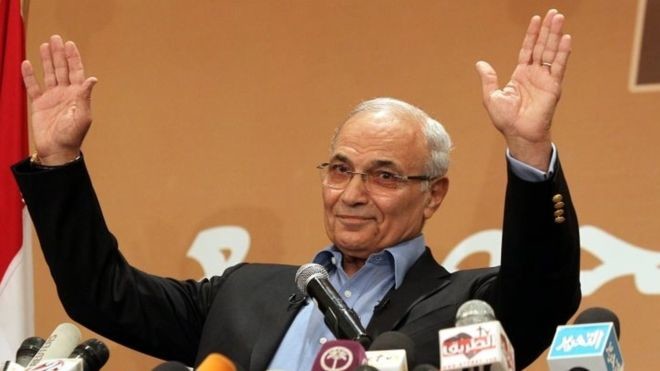
After narrowly losing a presidential election to Muslim Brotherhood candidate Mohamed Mursi in 2012, Ahmed Shafiq fled to the UAE where he has lived ever since and disappeared from Egypt’s political scene. (AFP)
Updated 09 January 2018
Follow

Shafiq’s election withdrawal deprives El-Sisi of only serious rival

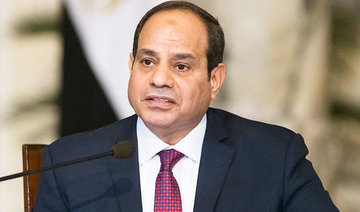
CAIRO: The decision by Egypt’s former prime minister not to run in presidential elections deprives the race of its most serious challenger to Abdel Fattah El-Sisi.
Egypt will hold a presidential vote at the end of March, the election commission said on Monday.
While he has not yet announced his candidacy, El-Sisi is widely expected to stand and win the third presidential election in Egypt since the uprising that toppled Hosni Mubarak in 2011.
Ahmed Shafiq said on Sunday he would not be running — reversing a pledge that he would take part.
The ex-air force commander said he did not consider himself “the best person” to fill the position.
“Given that he came in second place in Egypt’s 2012 presidential race, I believe Shafiq was going to be a strong contender,” Amr Hashem, political analyst at the Ahram Center for Strategic Studies, said.
“He was a heavyweight candidate for many factors, and his presence could have made the election season a hot one. But due to all the pressure on him lately, his withdrawal was somehow expected.”
“With his withdrawal, it is likely that no other candidate would be able to potentially make a strong standing in competition with El-Sisi,” Justin Dargin, an expert on the Middle East from Oxford University, said.
After narrowly losing a presidential election to Muslim Brotherhood candidate Mohamed Mursi in 2012, Shafiq fled to the UAE where he has lived ever since and disappeared from Egypt’s political scene.
During that time, Shafiq was tried in absentia on corruption charges, but was eventually acquitted.
He returned to the limelight last month when he announced his intention to run in the elections and return soon to Egypt to start his campaign.
A few hours later, Al Jazeera aired a video in which Shafiq said he was not allowed to leave the UAE and criticized the UAE for meddling in Egypt’s affairs.
Despite claims by Shafiq’s lawyer and his party that the video was leaked to the Qatari-owned TV network, Shafiq was reportedly given 48 hours to leave the UAE.
His arrival in Egypt was surrounded by controversy and Shafiq took part in a phone interview with a popular TV show, during which he said he was OK.
His appearance on Al Jazeera placed him in hot water, with some accusing him of collaborating with the Muslim Brotherhood and Qatar, considered enemies of the Egyptian state.
The 76-year-old former aviation minister was the last prime minister to hold office under Mubarak.
Announcing on Twitter his decision to withdraw, he said that his time back in Egypt had led him to reconsider the decision.
“My absence of more than five years perhaps distanced me from being able to very closely follow what is going on in our nation in terms of developments and achievements despite the difficulty of the conditions,” he said.
“I have seen that I will not be the ideal person to lead the state’s affairs during the coming period. Thus, I have decided not to run in the upcoming 2018 presidential elections.”
“It was expected that he would reconsider his intention to run. There were several factors that played a role,” Dargin said.
“And, even if Shafiq did run, it appears that with the Egyptian body politic, he is not nearly as popular as El-Sisi, seeing that his years away from Egypt left him out of touch with the enormous changes that occurred since the revolution.
“It would be expected that even if Shafiq did run, El-Sisi would still dominate the polls because of his popularity and the respect garnered since he ascended to the presidency.”


Palestinians attempt to use Gaza’s Rafah Border crossing amidst delays

Updated 08 February 2026
Follow

Palestinians attempt to use Gaza’s Rafah Border crossing amidst delays

  • The Rafah Crossing opened to a few Palestinians in each direction last week, after Israel retrieved the body of the last hostage held in Gaza and several American officials visited Israel to press for the opening

CAIRO: Palestinians on both sides of the crossing between Gaza and Egypt, which opened last week for the first time since 2024, were making their way to the border on Sunday in hopes of crossing, one of the main requirements for the US-backed ceasefire. The opening comes as Prime Minister Benjamin Netanyahu is expected to travel to Washington this week, though the major subject of discussion will be Iran, his office said.
The Rafah Crossing opened to a few Palestinians in each direction last week, after Israel retrieved the body of the last hostage held in Gaza and several American officials visited Israel to press for the opening. Over the first four days of the crossing’s opening, just 36 Palestinians requiring medical care were allowed to leave for Egypt, plus 62 companions, according to United Nations data.
Palestinian officials say nearly 20,000 people in Gaza are seeking to leave for medical care that they say is not available in the war-shattered territory. The few who have succeeded in crossing described delays and allegations of mistreatment by Israeli forces and other groups involved in the crossing, including and an Israeli-backed Palestinian armed group, Abu Shabab.
A group of Palestinian patients and wounded gathered Sunday morning in the courtyard of a Red Crescent hospital in Gaza’s southern city of Khan Younis, before making their way to the Rafah crossing with Egypt for treatment abroad, family members told The Associated Press.
Amjad Abu Jedian, who was injured in the war, was scheduled to leave Gaza for medical treatment on the first day of the crossing’s reopening, but only five patients were allowed to travel that day, his mother, Raja Abu Jedian, said. Abu Jedian was shot by an Israeli sniper while he was building traditional bathrooms in the central Bureij refugee camp in July 2024, she said.
On Saturday, his family received a call from the World Health Organization notifying them that he is included in the group that will travel on Sunday, she said.
“We want them to take care of the patients (during their evacuation),” she said. “We want the Israeli military not to burden them.”
The Israeli defense branch that oversees the operation of the crossing did not immediately confirm the opening.
A group of Palestinians also arrived Sunday morning at the Egyptian side of the Rafah crossing border to return to the Gaza Strip, Egypt’s state-run Al-Qahera News satellite television reported.
Palestinians who returned to Gaza in the first few days of the crossing’s operation described hours of delays and invasive searches by Israeli authorities and an Israeli-backed Palestinian armed group, Abu Shabab. A European Union mission and Palestinian officials run the border crossing, and Israel has its screening facility some distance away.
The crossing was reopened on Feb. 2 as part of a fragile ceasefire deal that stopped the war between Israel and Hamas. Amid confusion around the reopening, the Rafah crossing was closed Friday and Saturday.
The Rafah crossing, an essential lifeline for Palestinians in Gaza, was the only crossing not controlled by Israel prior to the war. Israel seized the Palestinian side of Rafah in May 2024, though traffic through the crossing was heavily restricted even before that.
Restrictions negotiated by Israeli, Egyptian, Palestinian and international officials meant that only 50 people would be allowed to return to Gaza each day and 50 medical patients — along with two companions for each — would be allowed to leave, but far fewer people than expected have crossed in both directions.