SEOUL: South Korea will seek discussions on resuming reunions of separated families at this week’s inter-Korean talks, Seoul’s top delegate said Monday, as the North trumpeted the importance of achieving reunification.
The two Koreas agreed last week to hold their first official dialogue in more than two years and will meet Tuesday at the border truce village of Panmunjom.
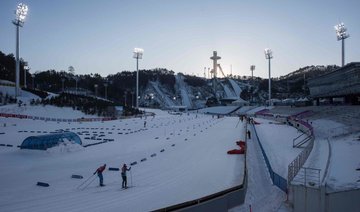
The talks will largely focus on the North’s participation in next month’s Winter Olympics in the South, but the two sides are also expected to bring up their own issues of interest.
“We will prepare for discussions on the issue of separated families and ways to ease military tensions,” Unification Minister Cho Myoung-Gyon told reporters, according to the Yonhap news agency.
Because the 1950-53 Korean War ended with an armistice rather than a formal peace treaty, the two Koreas remain technically at war.
Tensions soared last year as the North made rapid progress on its banned weapons programs, launching ballistic missiles it said are capable of reaching the US and carrying out its sixth nuclear test, by far its most powerful.
Their tentative rapprochement comes after North Korea’s leader Kim Jong-un warned in his New Year speech that he had a nuclear button on his desk — but also said Pyongyang could send a team to the Winter Olympics in Pyeongchang.
Seoul responded with an offer of talks, and last week the hotline between the neighbors was restored after being suspended for almost two years.
South Korean Foreign Minister Kang Kyung-wha said the North’s participation in Pyeongchang would strengthen the Games’ profile as “a peace Olympics,” Yonhap reported, and could lead to further progress.
Later Monday, the International Olympic Committee (IOC) said it had “extended the deadline” for North Korea’s participation in the Winter Olympics.
On Saturday, North Korea Olympic body member Chang Ung said the isolated state was “likely to participate” in the Games from Feb. 9-25, Kyodo news agency reported.
Talks between the two Koreas hosted by IOC President Thomas Bach will take place at the Olympic movement’s Swiss headquarters on Tuesday.
North Korea’s state media has stopped condemning the South and instead called for “independent reunification” without relying on other countries such as the US.
“The master of improved inter-Korean relations is not the outsiders but the Korean nation itself,” the North’s official Korean Central News Agency said at the weekend.
“The flunkeyism and idea of dependence on outside forces are the venom which makes the nation slavish and spiritless,” it added.

Seoul seeks to put family reunions on North Korea talks agenda

Only 4% women on ballot as Bangladesh prepares for post-Hasina vote
- Women PMs have ruled Bangladesh for over half of its independent history
- For 2026 vote, only 20 out of 51 political parties nominated female candidates
DHAKA: As Bangladesh prepares for the first election since the ouster of its long-serving ex-prime minister Sheikh Hasina, only 4 percent of the registered candidates are women, as more than half of the political parties did not field female candidates.
The vote on Feb. 12 will bring in new leadership after an 18-month rule of the caretaker administration that took control following the student-led uprising that ended 15 years in power of Hasina’s Awami League party.
Nearly 128 million Bangladeshis will head to the polls, but while more than 62 million of them are women, the percentage of female candidates in the race is incomparably lower, despite last year’s consensus reached by political parties to have at least 5 percent women on their lists.
According to the Election Commission, among 1,981 candidates only 81 are women, in a country that in its 54 years of independence had for 32 years been led by women prime ministers — Hasina and her late rival Khaleda Zia.
According to Dr. Rasheda Rawnak Khan from the Department of Anthropology at Dhaka University, women’s political participation was neither reflected by the rule of Hasina nor Zia.
“Bangladesh has had women rulers, not women’s rule,” Khan told Arab News. “The structure of party politics in Bangladesh is deeply patriarchal.”
Only 20 out of 51 political parties nominated female candidates for the 2026 vote. Percentage-wise, the Bangladesh Socialist Party was leading with nine women, or 34 percent of its candidates.
The election’s main contender, the Bangladesh Nationalist Party, whose former leader Zia in 1991 became the second woman prime minister of a predominantly Muslim nation — after Pakistan’s Benazir Bhutto — was the party that last year put forward the 5 percent quota for women.
For the upcoming vote, however, it ended up nominating only 10 women, or 3.5 percent of its 288 candidates.
The second-largest party, Jamaat-e-Islami, has not nominated a single woman.
The 4 percent participation is lower than in the previous election in 2024, when it was slightly above 5 percent, but there was no decreasing trend. In 2019, the rate was 5.9 percent, and 4 percent in 2014.
“We have not seen any independent women’s political movement or institutional activities earlier, from where women could now participate in the election independently,” Khan said.
“Real political participation is different and difficult as well in this patriarchal society, where we need to establish internal party democracy, protection from political violence, ensure direct election, and cultural shifts around female leadership.”
While the 2024 student-led uprising featured a prominent presence of women activists, Election Commission data shows that this has not translated into their political participation, with very few women contesting the upcoming polls.
“In the student movement, women were recruited because they were useful, presentable for rallies and protests both on campus and in the field of political legitimacy. Women were kept at the forefront for exhibiting some sort of ‘inclusive’ images to the media and the people,” Khan said.
“To become a candidate in the general election, one needs to have a powerful mentor, money, muscle power, control over party people, activists, and locals. Within the male-dominated networks, it’s very difficult for women to get all these things.”