MANILA: Ambitious individuals will follow in the footsteps of Isnilon Hapilon and Omar Khayam Maute, the top militant leaders in the Philippines who were killed in an army offensive, security officials said.
Hapilon was the Daesh-designated chief for Southeast Asia, and Maute was a leader of the group that laid siege to Marawi City.
The military continues to monitor parts of Central Mindanao such as Cotabato and Maguindanao, where there are militant groups sympathetic to Daesh. Communities in these areas are reportedly bracing for further battles.
The military and defense departments say these groups do not have the capability to launch attacks similar to what the Maute Group did in Marawi.
“The elimination of Hapilon and the Maute clan’s leadership dealt Daesh a major blow in the country,” Arsenio Andolong, Department of National Defense (DND) spokesman, told Arab News.
“They still have supporters who are at large, but given the decimation of their leadership structure in the Philippines, we doubt they can muster the same number of forces that they did in Marawi,” he said.
“They’re obsessed with promoting the perception that they’re still an entity to be reckoned with, but they’re now in a state of disarray, and we’re actively pursuing them so as not to allow them to consolidate and achieve any cohesion,” he added, referring to Maute remnants.
Andolong said among those who have embraced violent extremism, there will always be those who will look at Hapilon and the Mautes as inspirations.
“This is deeply imbedded in the psyche of those who’ve been radicalized,” he added.
“Even if the battle for Marawi hadn’t happened, there will still be those — Muslim or non-Muslim — who will be lured in and driven by the ideas of violent extremism.”
Armed Forces of the Philippines (AFP) spokesman Maj. Gen. Restituto Padilla said following the government’s success in Marawi, Maute’s capacity to launch another major attack has been adequately degraded, and it will take a while for it to regroup and reorganize.
“It won’t be able to launch Marawi-like attacks now or in the near future,” Padilla told Arab News.
But other groups, such as the Bangsamoro Islamic Freedom Fighters (BIFF) and the Ansarul Khilafah Philippines (AKP) in Central Mindanao, continue to pose a threat, he said.
However, the AFP and other security agencies have been proactive in addressing such threats, he added.
The nature and scale of attacks by these groups would not match what was witnessed in Marawi, Padilla said.
But “the capacity for grenade-throwing incidents, IED (improvised explosive devices) attacks, harassment of military and police areas, and terrorist activities to scare residents of certain communities will continue. The AFP’s focus will be to degrade and neutralize all these groups.”
Padilla said the possibility of lone-wolf attacks cannot be ruled out. “That’s why we’ve constantly called on the public to remain vigilant and cooperate with the authorities.”
Rejecting the claim by security experts that the battle for Marawi might inspire an ambitious new generation of Muslim extremists in Mindanao, he added: “We believe we’ve greatly contributed to facilitating a more stable regional security environment.”
The Marawi crisis has highlighted the need for greater regional cooperation, he said, adding that all foreign fighters in the city had been killed.
But their exact number is hard to determine as “most of the cadavers that have been recovered are beyond recognition.”


![]()

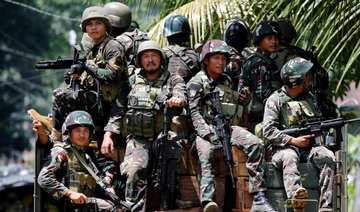
Philippine Army anticipates more militant threats after Marawi
Philippine Army anticipates more militant threats after Marawi


Latest updates


© 2026 SAUDI RESEARCH & PUBLISHING COMPANY, All Rights Reserved And subject to Terms of Use Agreement.