NEW DELHI: The Indian government named a reporter in a police complaint after she wrote an article alleging a data breach in a federal identity database, drawing criticism from a journalist group that accused officials of trying to muzzle free speech.
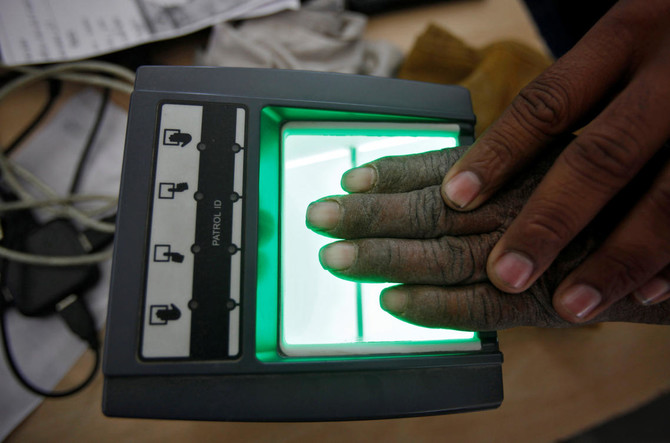
The Unique Identification Authority of India (UIDAI), which runs the world’s largest biometric identity card scheme called “Aadhaar,” started investigating a report last week by The Tribune newspaper which said access to the identity database of more than 1 billion citizens was being sold for just 500 rupees, or $8, on social media.
UIDAI on Sunday said four people were named in its complaint to police in New Delhi to investigate the incident, including the reporter, and also her newspaper, which is based in the north Indian city of Chandigarh.
The Editors Guild of India condemned UIDAI’s action, saying it was designed to “browbeat a journalist.”
“It is unfair, unjustified and a direct attack on the freedom of the press,” the Guild said in a statement on Sunday.
The UIDAI said in a statement on Sunday that it respects freedom of press, adding that it was duty bound to name everyone involved in the incident, including the reporter.
“It does not mean that those who are named in the report are necessarily guilty,” the authority said.
The Tribune newspaper said it regretted the decision of the authorities.
India last year slipped three places to 136th in the World Press Freedom Index of 180 nations, compiled by Reporters Without Borders.
Journalists in India have increasingly become targets of online smear campaigns, with prosecutorial actions being used to gag journalists who are overly critical of the government, the group said.
The Tribune newspaper last week reported that it was able to buy login credentials to the government’s Aadhaar database, allowing it to acquire information such as the names, telephone numbers and home addresses of millions of people.
The alleged breach is the latest in the Aadhaar program, which is facing increasing scrutiny over privacy concerns.
After the report was published, the UIDAI said the “case appears to be an instance of misuse.”
The Aadhaar scheme was introduced in 2009 to streamline welfare payments and reduce wastage in public spending. Since then, the government of Prime Minister Narendra Modi has been keen to mandate the use of Aadhaar for everything from filing income taxes to the registration of mobile phone numbers and booking railway tickets.


India sparks outcry over press freedom by naming journalist in probe on database breach
India sparks outcry over press freedom by naming journalist in probe on database breach


Israel extends foreign media ban law until end of 2027
- Order replaces temporary emergency legislation that allowed authorization of so-called ‘Al Jazeera bill’
- Extension of temporary order empowers Communications Ministry to restrict foreign channels deemed to cause ‘real harm to state security’
LONDON: Israel’s Knesset approved late Monday an extension of the temporary order empowering the Communications Ministry to shut down foreign media outlets, pushing the measure through until Dec. 31, 2027.
The bill, proposed by Likud lawmaker Ariel Kallner, passed its second and third readings by a 22-10 vote, replacing wartime emergency legislation known as the “Al Jazeera Law.”
Under the extended order, the communications minister — with prime ministerial approval and security cabinet or government ratification — can restrict foreign channels deemed to cause “real harm to state security,” even outside states of emergency.
Measures include suspending broadcasts, closing offices, seizing equipment, blocking websites, and directing the defense minister to block satellite signals, including in the West Bank, without disrupting other channels.
Administrative orders last 90 days, with possible extensions. Unlike the temporary measure, the new law does not require court approval to shut down a media outlet.
The move has drawn sharp criticism from human rights and media groups, who warn it entrenches restrictions on Arab and foreign outlets amid a broader erosion of press freedoms.
“Israel is openly waging a battle against media outlets, both local and foreign, that criticize the government’s narrative; that is typical behavior of authoritarian regimes,” International Federation of Journalists General Secretary Anthony Bellanger said in November after the bill’s first reading.
“We are deeply concerned about the Israeli parliament passing this controversial bill, as it would be a serious blow to free speech and media freedom, and a direct attack on the public’s right to know.”
In a parallel development, the Israeli Cabinet unanimously approved on Monday the shutdown of Army Radio (Galei Tzahal) after 75 years, with operations ceasing on March 1, 2026.
In a statement, Attorney General Gali Baharav-Miara warned the decision “undermines public broadcasting in Israel and restricts freedom of expression,” lacking a legal basis.


