PHNOM PENH: Cambodian Premier Hun Sen led a huge rally on Sunday marking the anniversary of the fall of the genocidal Khmer Rouge regime, seizing the opportunity to burnish his image as savior of the nation.
Tens of thousands of people attended the event organized by Hun Sen’s ruling Cambodian People’s Party, which has dominated the country since it was installed by the Vietnamese forces which toppled Khmer Rouge leader Pol Pot on Jan. 7, 1979.
The gathering on “Victory Over Genocide Day” attracted a much larger turnout than in previous years. Hun Sen’s control over Cambodia is stronger than ever following the systematic removal of his rivals before a July election.
The crackdown culminated in the dissolution of the main opposition party in November, a move lambasted by Western democracies as a naked power grab by the strongman, who is determined to extend his 32-year rule.
Speaking before a sea of supporters on Sunday, Hun Sen took credit for the stability and growth his government has overseen since the Khmer Rouge era. At least 1.7 million Cambodians died during the regime’s fanatical Maoist rule from 1975-79.
Most died through execution, starvation or overwork during the group’s attempts to transform the country into an agrarian utopia.
Hun Sen, a former Khmer Rouge cadre who later defected and joined the resistance, frequently reminds the public of Cambodia’s horrific past and warns that fresh unrest could break out if his government is ousted.
In a lengthy address Hun Sen also cheered the recent crushing of the opposition, saying it “evaded a new disaster for the nation, and will ensure the growth of democracy, human rights and rule of law in Cambodia.”
Rights groups strongly disagree, saying the move plunged Cambodia’s fragile democracy into peril.
The US and EU have withdrawn support for the July election due to the ruling, saying the vote would not be legitimate without the now dissolved Cambodia National Rescue Party, which won 44.5 percent of the vote in the 2013 election, according to election authorities.
Hun Sen has responded by ramping up his ultra-nationalist rhetoric, reiterating on Sunday that “Cambodia does not bow to external pressure.”
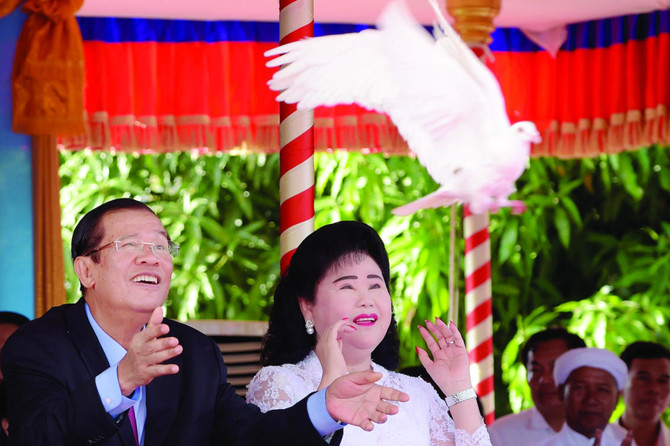
After the speech Hun Sen and his wife released white doves into the crowd and received flowers from foreign diplomats.
Hun Sen’s self-styled reputation as rescuer of the impoverished kingdom was also on display in the past week in a new documentary recording his role in the toppling of the Khmer Rouge.
But while the premier boasts about the stability and economic growth nurtured during his time in office, critics point out the myriad rights abuses and endemic corruption that have flourished under his watch.
Some Cambodians have also criticized the celebration of the Jan. 7 anniversary, saying it represents the start of a decade-long occupation by Vietnam rather than a day of liberation.


![]()
Cambodian PM leads huge rally on anniversary of Khmer Rouge’s fall
Cambodian PM leads huge rally on anniversary of Khmer Rouge’s fall

Latest updates


© 2026 SAUDI RESEARCH & PUBLISHING COMPANY, All Rights Reserved And subject to Terms of Use Agreement.