TOKYO: Known as “Miss Bitcoin” on Japanese social media, Mai Fujimoto said she invests all of her savings in the virtual currency that has proved a huge hit in Japan.
“I convert all my disposable income into cryptocurrency,” the 32-year-old tells AFP. “I’ve been doing this for nearly a year now. I convert all my savings into cryptocurrency instead of putting them in a bank.”
She is not alone in her enthusiasm.
Bitcoin is recognized as legal tender in the world’s third-biggest economy and nearly one third of global bitcoin transactions in December were denominated in yen, according to specialized website jpbitcoin.com.
This has led to many analysts speculating that the famous Mrs.Watanabe — shorthand for Japanese individual foreign exchange investors — is behind the recent volatile frenzy that pushed the price of bitcoin up to nearly $20,000 before dropping back.
But why Japan?
Firstly, unlike regional rivals China and South Korea, whose regulators have clamped down hard on the crypto-currency, Japan has welcomed it with open arms.
In April, Japan passed a law recognizing bitcoin and other virtual currencies as legal tender — while also stressing the need for transparency and financial stability.
And there is little doubt that Japan’s global weight grew after China closed down bitcoin trading platforms last year.
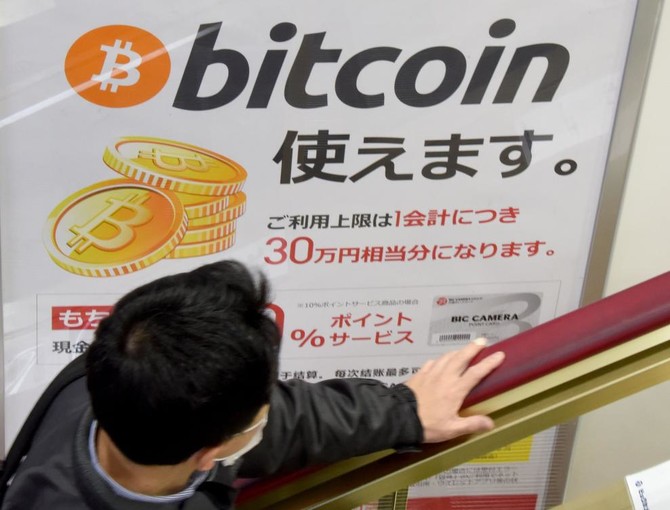
Some well-known Japanese businesses have started accepting payment in bitcoin and one firm made waves when it said it would pay part of its employees’ salaries in the currency if they wish.
“The involvement of big companies, the sense of security derived from government approval and media exposure really brought in a whole new group of people to the market,” said Koji Higashi, a well-known commentator on the crypto-business in Japan.
Another factor contributing to a bitcoin boom in Japan: ultra-low interest rates from the deflation-battling central bank that has left investors scratching their heads for places to find returns on their cash.
While Japanese are generally considered risk-averse investors, they are also well-versed in the complexities of market trading, especially in foreign exchange.
A lot of ordinary Japanese people are trading “high levels” of money on the foreign exchange markets, said Yuzo Kano, founder and chief executive of bitFlyer, Japan’s main bitcoin trading platform.
A lot of these stay-at-home FX day traders — the mythical Mrs.Watanabe — are now turning their hand to bitcoin, noted analysts from Deutsche Bank in a recent report.
Analyst Higashi, on the other hand, thinks that the blanket domestic and international media coverage of the rise of bitcoin has prompted many Japanese to join the party.
“Everyone else is doing it now and I heard they are making a lot of money. I have to get on it now.’ That’s a very Japanese way of thinking,” he told AFP.
“To be honest, I am not sure if people are buying into bitcoin based on rational decision-making. It feels more of a short-term irrational mania to me,” he added.
Whatever the reason, “Miss Bitcoin” has been a convert since 2012.
“At the time, I was working with children and creating an online donation platform. And for the first time, I learned how expensive it is to send money abroad,” Fujimoto recalled.
“So, I was really impressed when I heard that I don’t have to go through banks if I use bitcoin payment,” added the businesswoman.
She snapped up her first bitcoin for 1,200 yen ($10) in 2012. On Sunday it was trading at $16,726.
But the cryptocurrency mania has not been all plain sailing in Japan.
In 2014, Tokyo-based exchange platform MtGox filed for bankruptcy, with French CEO Mark Karpeles saying it had lost nearly half a billion dollars’ worth of the digital currency in a possible theft.
And another factor may end up cooling the enthusiasm of individual investors — profits made from bitcoin trading are considered as “miscellaneous income” and subject to a higher tax rate of 55 percent.
“Now, a lot of traders are struggling to calculate the amount to be taxed and I think there will be a lot of tax evasion scandals in the near future,” said Higashi.
Different approaches to bitcoin in Asia
CHINA
In mid-September, China’s central bank, the People’s Bank of China (PBOC), told virtual currency trading platforms based in Beijing and Shanghai to cease market operations.
Authorities also clamped down on ethereum and any other electronic units that are exchanged online without being regulated by any country.
The PBOC said it wanted to fight “speculation” around the crypto-currencies, which “seriously disrupted the financial system.”
This came after the National Internet Finance Association of China — an offshoot of the PBOC — drew up a damning report on virtual currencies, saying they were “increasingly used as a tool in criminal activities” such as drug trafficking.
SOUTH KOREA
Hyper-wired South Korea was also a hotbed for virtual currencies such as bitcoin, accounting for some 20 percent of global transactions, about 10 times its share of the world economy.
But South Korean authorities late last year banned financial institutions from dealing in virtual currencies on fears of a bubble fueled by retail speculators.
About one million South Koreans, many of them small-time investors, are estimated to own bitcoins and demand is so high that prices are around 20 percent higher than in the US.
Initial coin offerings (ICOs) — where companies sell newly mined cryptocurrencies to investors for real money — were also outlawed.
SINGAPORE
Singapore’s central bank has issued a warning over cryptocurrencies, cautioning the public about the risk of jumping in on the “bitcoin bubble.”
The Monetary Authority of Singapore noted they are not backed by any central bank and are unregulated, which means those who lose their investments have no grounds for redress under Singapore law.
Yusho Liu, co-founder of Singapore-based cryptocurrency wallet Coinhako, said demand has been soaring, with transactions up around 10-fold over the past year.
However, while regulators have been prepared to offer a cautious free rein to the digital units, “financial institutions and service providers have been rather resistant,” Liu told AFP.
JAPAN
The high-profile collapse of digital currency exchange platform MtGox failed to douse the enthusiasm for virtual currencies in Japan, which in April became the first country in the world to proclaim it as legal tender.
As many as 10,000 businesses in Japan are thought to accept bitcoin and bitFlyer, the country’s main bitcoin exchange, saw its user base pass the one-million mark in November.
Many Japanese, especially younger investors, have been seduced by the idea of strong profits in the context of ultra-low interest rates that offer little in the way of returns.
However, the governor of the Bank of Japan, Haruhiko Kuroda, has recently issued a warning that the recent rise of the bitcoin price was “abnormal.”