RIYADH: Germany has expressed grave concerns on Iran’s foreign policy in the Arab world, and has vehemently opposed the continuous development of its missile capabilities.
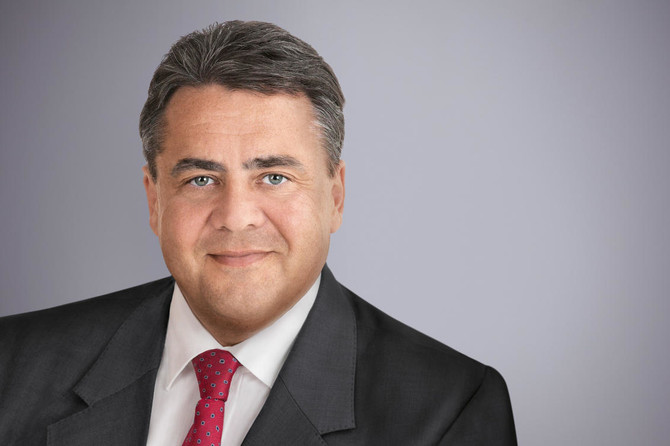
“Like Saudi Arabia, Germany is most concerned about Iran’s foreign policy role in the region,” said German Foreign Minister Sigmar Gabriel in an exclusive interview with Arab News on Saturday.
Gabriel made his views about Iran’s belligerent policy clear, saying: “Together with the US, we want to work to counteract the problematic role played by Iran in the region ... It was with this in mind that we also clearly condemned the Iranian missile tests as they are not in line with the UN Security Council Resolution 2231.”
The foreign minister gave an overview of the growing Saudi-German relations with special reference to issues such as Yemen and Syria. He also spoke about the Palestinian-Israeli conflict, and human trafficking in Libya, where there is a need to improve the situation of refugees and migrants. The Europeans and Africans agreed on the fringes of the EU-AU summit in Abidjan to hold constructive talks on Libya.
Referring to the need to persuade Iran not to meddle in the affairs of Arab nations, Gabriel said: “German-Saudi relations are not only of great importance to us bilaterally, but also to the whole region... We are moving in the same direction on important foreign policy issues, for example in the fight against so-called Islamic State… our relations are so important and strong that we will surely be able to cope with having different views on individual issues from time to time.”
However, he said: “We must not allow ourselves to be divided.” Berlin and Riyadh certainly have similar views in their analysis of policy, he noted. “As far as Lebanon is concerned, we share Saudi Arabia’s concern about the role of Hezbollah as a militia and about its role in the region.”
Asked about his assessment of the Syrian crisis, the German foreign minister said that the Syrian crisis is far from over, contrary to what some people say. “People are being bombarded, displaced and starved every day. Take eastern Ghouta, for example... hundreds of thousands are trapped, many of them women and children. The regime is preventing the UN from being able to distribute food and medication there.”
He said that Germany has already done much to reduce the suffering of people in Syria. “We have contributed over 700 million euros for humanitarian aid measures in this year alone,” said Gabriel, adding that this support is not enough as long as the conflict continues. “This is why we need a political solution at long last – under the auspices of the UN and on the basis of the relevant resolutions. I am referring to UN Resolution 2254 here in particular, which sets out a clear framework.”
Asked about his perception of the crisis in Yemen and the killing of former President Ali Abdullah Saleh, Gabriel said: “Our objective in Yemen — and we are on the same page here with Saudi Arabia — is the restoration of peace and stability and the return of the legitimate government to Sanaa, as well as the protection of the Yemeni people.” The conflict can only be resolved in the long term by political means — through inclusive negotiations under the auspices of the UN special envoy, he noted.
To this end, he said: “Germany condemned the Houthis’ missile attacks on Riyadh in the strongest possible terms and is also deeply concerned by the killing of Saleh, as well as by recent developments in Sanaa.” He expressed appreciation for Riyadh and said: “Saudi Arabia is the biggest humanitarian donor in Yemen, which is a fact that is unfortunately sometimes forgotten.” At the same time, Germany is also one of the largest donors of humanitarian aid in Yemen – which is also perhaps not sufficiently well known in the region, Gabriel said.
“We stand shoulder to shoulder with the people of Yemen and recently increased our humanitarian aid to a total of 165 million euros for 2017,” he noted. On the US declaration of Jerusalem as capital of Israel, he said: “Our position, like the position of the EU, remains unchanged.” A solution to the status of Jerusalem must be found through negotiations, said the German foreign minister, while also referring to the Arab Peace Initiative launched by the Kingdom back in 2002.


![]()
German foreign minister voices grave concern over Iran’s foreign policy
German foreign minister voices grave concern over Iran’s foreign policy


Latest updates


Recommended


© 2026 SAUDI RESEARCH & PUBLISHING COMPANY, All Rights Reserved And subject to Terms of Use Agreement.