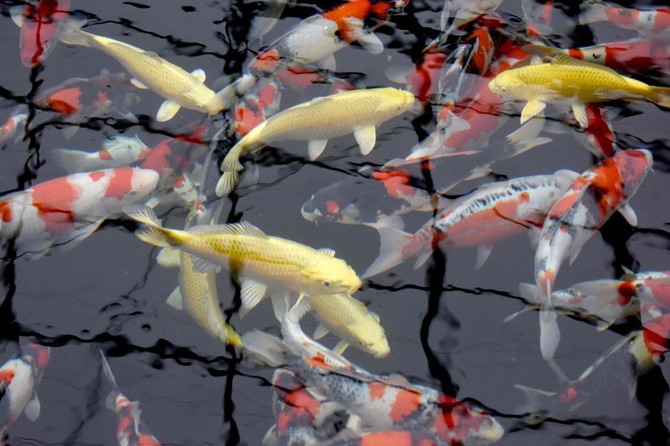
KAZO: Hand-reared for their color and beauty, koi carp have become an iconic symbol of Japan that can sell for hundreds of thousands of dollars and even participate in fishy beauty contests.
The nation’s koi carp were brought to the world’s attention when visiting US President Donald Trump was snapped unceremoniously dumping the last of a box of feed into a palace pond in Tokyo.
But the fish have for decades been popular in Japan, where top breeders take their most prized specimens (known as “nishikigoi”) to highly competitive “beauty parades.”
At one such competition in Tokyo, judges in sharp suits, notebooks in hand, stride around tanks lined up along a pedestrian street where the valuable koi strut their stuff.
They come in all the colors of the rainbow: pearly white, bright red, cloudy-grey, dark blue, gleaming golden yellow.
But it is the curvature of the fish that accounts for 60 percent of the final score, explained competition organizer Isamu Hattori, who runs Japan’s main association for breeders of koi carp.
Color and contrast make up another 30 percent, he told AFP.
And the final 10 percent? “Hinkaku” — a concept that is tricky to define and even harder to judge, best translated as the “presence” or “aura” of the fish.
“’Hinkaku’. It’s either there in the genes at birth, or it’s not,” mused Mikinori Kurikara, a koi breeder in Saitama, north of Tokyo, who says he can spot it in fish when they reach eight or nine months old.
“Put it this way, it’s like looking after your own children every day. You care for your kids and want them to grow healthy. In the same way, you take care of these fish, appreciate them and adore them,” he told AFP.
At his farm, thousands of tiny “nishikigoi” (colored carp) dart around deep basins of carefully purified water, meticulously divided by age and color.
A less glorious fate awaits the other koi who have not been fortunate enough to catch the eye of the breeder: they are sold off as feed for tropical fish.
“It’s a really delicate job, really difficult. Everything matters: the ground, the water quality, the food,” explained the 48-year-old, who took over the farm from his father and is training his son, half his age, in the subtle arts of koi breeding.
“We have many secrets,” he adds mischievously. “But even if we let them slip, it wouldn’t work. You have to be able to feel it.”
These days, any self-respecting traditional Japanese garden has plenty of colorful koi gracing its ponds, but it is a relatively recent tradition.
Around 200 years ago, villagers in the mountainous region around Niigata (in the north-west of Japan) started to practice genetic engineering without knowing what they were doing.
For the first time, they began to cross-breed rare colorful carp, not for food but for pure aesthetical value.
The craze for nishikigoi gradually took over the whole of Japan and then spread into other parts of Asia.
They are especially popular in China, where carp swimming against the tide symbolizes the idea of perseverance leading to riches — rather like people climbing the social ladder, said Yutaka Suga, professor at the Institute for Advanced Studies on Asia at Tokyo University.
Today, koi is big business and Japanese exports are booming — 90 percent of domestic production is exported and sold at auction.
In 2016, Japan exported a record 295 tons of koi carp, generating turnover of 3.5 billion yen ($31 million), an increase of almost 50 percent from 2007, according to Japan’s agriculture ministry.
As for individual carp, “the prices have become insane,” said carp association boss Hattori.
“Today, a two-year-old carp can sell for 30 million yen each ($265,000) whereas 10 years ago, two million yen was already a very good price,” he told AFP.
Like racehorse owners, many foreign owners leave their prized possessions in their home Japanese farms so they can compete in the most prestigious fishy pageants, which are only open to domestic rearers.
One such owner, Chinese koi collector Yuan Jiandong, was in Tokyo to cheer on some of his own carp.
“It’s not a way of making money. It’s a way of spending it for fun,” laughed the pharmaceutical boss from Shanghai.
But owning koi is so much more than a vulgar display of wealth, he said.
“When you see these beautiful fish gliding around in your pond, you forget the stresses of daily life and you find peace of mind.”
And you can’t put a price on that.


Koi story: priceless Japanese fish make a splash
Koi story: priceless Japanese fish make a splash

Ithra offers a glimpse of colorful Spain through fashion
DHAHRAN: Step into Spain without leaving Dhahran at the “Threads of Espana: Fashion Across the Spanish Regions” show currently on at the King Abdulaziz Center for World Culture.
From structured capes to swirling silhouettes, the show at Ithra brings the nation’s colorful fabric traditions to life.
Arab News spoke recently with Cecilia Revuelta, a co-organizer of the exhibition who flew in from Spain.
“We did a selection of traditional costumes of each area in Spain. So first of all, here we have the three costumes of a traditional torero. These suits are from a real torero who’s still active.”
A torero — from toro, meaning bull — is a Spanish bullfighter.
“His name is Jorge Garcia De La Pena, and thanks to our relationship with him, he lent us the three costumes and the two capes,” she added.
“Actually, one of the capes even has the bull blood in them; we decided not to wash it or anything because we think it’s totally more real like this.”

Revuelta described the garments, split among different display areas, as “real art pieces, very heavy and delicate pieces. Also, we brought some flamenca dresses.”
“They’re from a private Spanish collector who dances flamenco and she’s a real fan of the flamenco culture. And she has a big, big, big collection of dresses and we did a small selection to bring it here to Ithra.”
Northern Spain is represented through costumes created stitch-by-stitch specifically for the Ithra exhibition.
“We also fabricated from scratch the costumes of Galicia. They’re the typical traditional costumes that they use in the north of Spain in the countryside, in the small villages. When it’s very cold and rainy and you can see they have a lot of layering and many details.”
“These dresses are very expensive because they are real, real pieces of art. One of these dresses costs more than 4,000 euros ($4,750). Most of them are handmade with a lot of details and stones and different colors and layers. It’s really amazing.”
For Revuelta, the exhibition reflects her love of fashion and its history. “It’s my favorite part (of the Spain Cultural Days festivities) because I love fashion. I love clothes since the beginning.”
Revuelta highlighted the cross-cultural nature of the event.
“I think it’s super positive for all the citizens of Dammam to come here, to get to know more about other countries, different cultures, traditions. They have a lot of workshops. And in the market, we have many different booths selling pieces of art, ceramics and traditional Spanish souvenirs.
“I feel very proud. It is my first time in Saudi Arabia and people here are really interested in knowing more about the different costumes and fashion history of Spain,” she added.
The pieces will remain on display until the completion of the Spain Cultural Days festivities on Jan. 31.


