

Self-healing glass: a cracking discovery from Japan

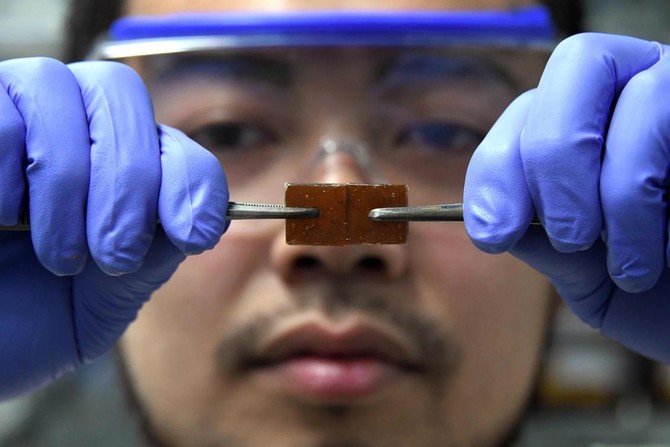
In this picture taken on December 25, 2017, Yu Yanagisawa, a chemistry researcher at the University of Tokyo, presses together two pieces of resin glass together to repair them at the university's lab in Tokyo. The Japanese researcher has developped -- by accident-- a new type of glass that can be repaired simply by pressing it back together after it has cracked. (AFP)
Updated 28 December 2017
Follow

Self-healing glass: a cracking discovery from Japan

TOKYO: A Japanese researcher has developed — by accident-- a new type of glass that can be repaired simply by pressing it back together after it cracks.
The discovery opens the way for super-durable glass that could triple the lifespan of everyday products like car windows, construction materials, fish tanks and even toilet seats.
Yu Yanagisawa, a chemistry researcher at the University of Tokyo, made the breakthrough by chance while investigating adhesives that can be used on wet surfaces.
Does this mean you will soon be able to repair those cracks in your smartphone with a quick press of the fingers? Or surreptitiously piece together a shattered beer glass dropped after one pint too many?
Well, not quite. Not now and in fact, not in the near future.
But it does open a window of opportunity for researchers to explore ways to make more durable, lightweight, glass-like items, like car windows.
In a lab demonstration for AFP, Yanagisawa broke a glass sample into two pieces.
He then held the cross sections of the two pieces together for about 30 seconds until the glass repaired itself, almost resembling its original form.
To demonstrate its strength, he then hung a nearly full bottle of water from the piece of glass — and it stayed intact.
The organic glass, made of a substance called polyether thioureas, is closer to acrylic than mineral glass, which is used for tableware and smartphone screens.
Other scientists have demonstrated similar properties by using rubber or gel materials but Yanagisawa was the first to demonstrate the self-healing concept with glass.
The secret lies in the thiourea, which uses hydrogen bonding to make the edges of the shattered glass self-adhesive, according to Yanagisawa’s study.
But what use is all this if it cannot produce a self-healing smartphone screen?
“It is not realistically about fixing what is broken, more about making longer-lasting resin glass,” Yanagisawa told AFP.

Glass products can fracture after years of use due to physical stress and fatigue.
“When a material breaks, it has already had many tiny scars that have accumulated to result in major destruction,” Yanagisawa said.
“What this study showed was a path toward making a safe and long-lasting resin glass,” which is used in a wide range of everyday items.
“We may be able to double or triple the lifespan of something that currently lasts for 10 or 20 years,” he said.


Apple to update EU browser options, make more apps deletable

Updated 22 August 2024
Follow

Apple to update EU browser options, make more apps deletable

  • iPhone maker came under pressure from regulators to make changes after the EU’s sweeping Digital Markets Act took effect on March 7
  • Apple users will be able to select a default browser directly from the choice screen after going through a mandatory list of options

STOCKHOLM: Apple will change how users choose browser options in the European Union, add a dedicated section for changing default apps, and make more apps deletable, the company said on Thursday.
The iPhone maker came under pressure from regulators to make changes after the EU’s sweeping Digital Markets Act took effect on March 7, forcing big tech companies to offer mobile users the ability to select from a list of available web browsers on a “choice screen.”
The new rules require mobile software makers to show the choice screen where users can select a browser, search engine and virtual assistant as they set up their phones, which earlier came with preferred options from Apple and Google.
In an update later this year, Apple users will be able to select a default browser directly from the choice screen after going through a mandatory list of options.
A randomly ordered list of 12 browsers per EU country will be shown to the user with short descriptions, and the chosen one will be automatically downloaded, Apple said. The choice screen will also be available on iPads through an update later this year.
Apple released a previous update in response to the new rules in March, but browser companies criticized the design of its choice screen, and the Commission opened an investigation on March 25 saying it suspected that the measures fell short of effective compliance.
The company said it has been in dialogue with the European Commission and believes the new changes will address regulators’ concerns.
It also plans to introduce a dedicated area for default apps where a user will be able to set defaults for messaging, phone calls, spam filters, password managers and keyboards.
Users will also be able to delete certain Apple-made apps such as App Store, Messages, Camera, Photos and Safari. Only Settings and Phone apps would not be deletable.