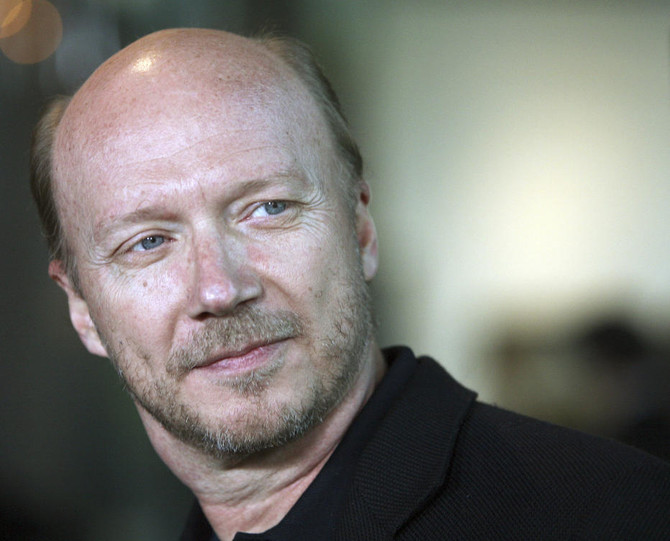
NEW YORK: Oscar-winning Canadian filmmaker Paul Haggis is now accused of sexual abuse by four women, according to an amended civil suit filed on Friday in New York.
Haggis, who wrote and produced “Crash,” and penned the screenplay for “Million Dollar Baby,” is also known for his high-profile split almost a decade ago from the Church of Scientology.
The allegations against him are the latest in a torrent of accusations made against powerful men that began with the fall of film mogul Harvey Weinstein in October, over numerous accusations including rape.
Three women alleging to be victims of Haggis’s abuse are referred to in the lawsuit amended Friday and initially filed on December 15 at a New York court by a film publicist, Haleigh Breest.
She accused Haggis of abusing and raping her in January 2013 when she was 26.
On the same day Haggis, 64, filed his own action against Breest, denying the accusation and accusing her of seeking “to extract many millions of dollars” from him.
Breest’s lawsuit says that since she filed her claim “three other women have accused Paul Haggis of rape and sexual abuse.”
Those three are identified only as Jane Doe one, two and three.
The first woman, a publicist who worked with Haggis on a television program, alleged that in 1996 he forcefully kissed her before making her perform oral sex and then raping her.
Another woman, who wanted to propose an idea for a show, alleged that she had to flee from his office in 2008 when he kissed her by force.
The third woman, whom Haggis met at a film festival, said she was abused in 2015 when he tried to forcefully kiss her.
According to the law firm of Emery Celli Brinckerhoff & Abady, who are acting for the plaintiff and passed the allegations to AFP, the claims show that Haggis “is a serial predator who has preyed upon women for many years.”
A lawyer for the film-maker, Christine Lepera, did not immediately comment when reached by AFP but in a statement to the Deadline.com website said he “denies these anonymous claims in whole.”
She said that Haggis “views the fact that these reports appear to be spearheaded from the law-firm representing Ms Breest, as a further tactic to try to harm him and continue their effort to obtain money.”

Oscar-winner Haggis accused of abusing four women

BMW Art Cars mark 50 years at inaugural Art Basel Qatar
DOHA: BMW’s long-running Art Car initiative took center stage at the inaugural Art Basel Qatar, with Thomas Girst, BMW Group’s head of cultural engagement, reflecting on five decades of collaboration between artists, engineers and the automobile.
Speaking at the fair, Girst situated the Art Car program within BMW’s broader cultural engagement, which he said spanned “over 50 years and hundreds of initiatives,” ranging from museums and orchestras to long-term partnerships with major art platforms.
“Every time Art Basel moves — from Miami to Hong Kong to Qatar — we move along with them,” he said. “That’s why we’re here.”
The occasion also marked the 50th anniversary of the BMW Art Car series, which began in 1975 with Alexander Calder’s painted BMW 3.0 CSL. Since then, the project has grown into a global collection that brings together motorsport, engineering, design and contemporary art. “Those Art Cars speak to a lot of people at the intersection of motorsports, technology, racing engineering, arts, lifestyle and design,” Girst said.
For Girst, the relationship between art and the automobile has deep historical roots. He pointed to early modernist fascination with cars, noting that “since the inception of the automobile,” artists have seen it as both a subject and a symbol of modernity. “There’s a reason for arts and culture and cars to mix and mingle,” he said.
At Art Basel Qatar, visitors were invited to view David Hockney’s BMW Art Car — Art Car No. 14 — displayed nearby. Girst described the work as emblematic of the program’s ethos, highlighting how Hockney painted not just the exterior of the vehicle but also visualized its inner life. The result, he suggested, is a car that reflects both movement and perception, turning the act of driving into an artistic experience.
Central to BMW’s approach, Girst stressed, is the principle of absolute artistic freedom. “Whenever we work with artists, it’s so important that they have absolute creative freedom to do whatever it is they want to do,” he said. That freedom, he added, mirrors the conditions BMW’s own engineers and designers need “to come up with the greatest answers of mobility for today and tomorrow.”
The Art Car World Tour, which accompanies the anniversary celebrations, has already traveled to 40 countries, underscoring the project’s global reach. For Girst, however, the enduring value of the initiative lies less in scale than in its spirit of collaboration. Art, design and technology, he said, offer a way to connect across disciplines and borders.
“That’s what makes us human. We can do better things than just bash our heads in — we can create great things together,” he said.