JEDDAH/LONDON: Anti-regime protests in Iran continued Thursday as the country’s London-based Nobel Peace Laureate Shirin Ebadi came out in support of the demonstrators.
“If the government has not listened to you for 38 years, your role has become to ignore what the government says to you now,” Asharq Al-Awsat, a sister publication of Arab News, quoted Ebadi as saying in an interview published Thursday.
She said Iranians should stay on the streets, and the constitution gives them the right to protest.
In a separate interview with Reuters, Ebadi urged the US and international community to support the nationwide protests with political sanctions and not economic measures that could hit the general population.
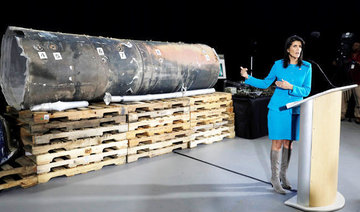
Hours later, Washington imposed sanctions on five Iranian companies it alleges are working on part of Iran’s illegal ballistic missile program.
Treasury Secretary Steven Mnuchin linked the measure to ongoing anti-government protests, arguing that Iran ought to spend more on public welfare rather than banned weapons.
“As the Iranian people suffer, their government and the IRGC (Islamic Revolutionary Guards Corp) fund foreign militants, terrorist groups, and human rights abuses,” he said.
The US also requested a UN Security Council emergency meeting on the unrest in Iran to be held on Friday, diplomats said. Washington asked that the meeting be scheduled at 3 p.m. (2000 GMT).
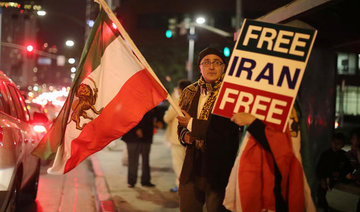
In London, Iranian opposition groups gathered outside Prime Minister Theresa May’s residence to call for the UK government to support protesters in Iran.
The protests in Iran, which began because of economic hardships suffered by the young and the working class, have evolved into an uprising against the powers and privileges of a remote elite, especially Supreme Leader Ali Khamenei.
Even though the regime is playing down the protests, analysts and opposition figures said there has been no let-up in the demonstrations.
“If anything, the uprising is gaining momentum and the protests are intensifying,” Oubai Shahbandar, a Syrian-American analyst and fellow at the New America Foundation’s International Security Program, told Arab News.
“Despite Khamenei’s insistence that anti-regime protests are dying down, the Iranian people in different cities are still taking to the streets,” Shahbandar said.
“Dozens of cities are still seeing clashes between peaceful protesters and the regime’s security forces. We can expect mass protests on Friday. This regime is in serious trouble as the uprising enters its second week.”
Shahriar Kia, a human rights activist, political analyst and People’s Mojahedin Organization of Iran (PMOI) member, told Arab News that it is “ridiculous” of the regime to claim that the protests are dying down.
“The regime wants to boost the morale of its demoralized forces. It’s simply wishful thinking on its part,” he said.
“Despite the regime’s brutality, the protests have continued and as of today, we’re receiving reports of protests from across the country,” he said. “The Iranian people are determined to continue the protests with a view to achieving victory,” Kia said.
“Of course, this isn’t a straight road and one would expect ups and downs, but the protesters won’t give up until the regime is overthrown,” he said.
The protests spreading to 115 cities, the speed at which they turned political, and the slogans chanted by protesters, demonstrate that the uprising is “deep-rooted” and “the regime is doomed,” Kia said.