US sanctions five entities tied to Iran’s missiles program

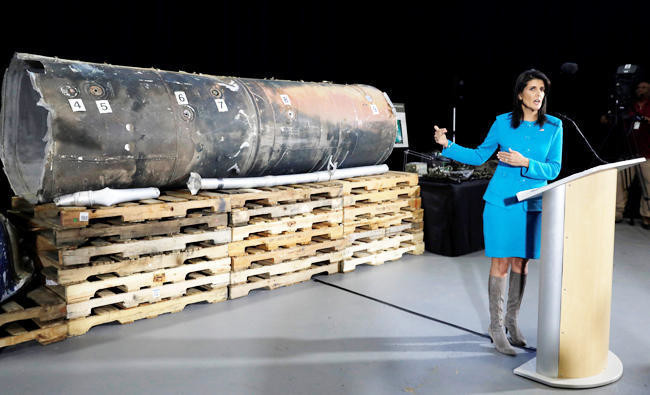
US Ambassador to the United Nations Nikki Haley briefs the media in front of remains of Iranian "Qiam" ballistic missile provided by Pentagon at Joint Base Anacostia-Bolling in Washington. (Reuters)
Updated 05 January 2018
Follow

US sanctions five entities tied to Iran’s missiles program

WASHINGTON: The United States on Thursday sanctioned five Iranian-based entities it said were owned or controlled by an industrial firm responsible for developing and producing Iran’s solid-propellant ballistic missiles.
“These sanctions target key entities involved in Iran’s ballistic missile program, which the Iranian regime prioritizes over the economic well-being of the Iranian people,” US Treasury Secretary Steven Mnuchin said in a statement.
The Treasury Department said the five sanctioned entities — the Shahid Eslami Research Center, Shahid Kharrazi Industries, Shahid Moghaddam Industries, Shahid Sanikhani Industries and Shahid Shustari Industries — were subordinated to the Shahid Bakeri Industrial Group.
The sanctions freeze any property the entities hold in the United States and prohibit Americans from dealing with them.
Iranian-backed Houthi militia in Yemen fired two missiles toward Saudi Arabia's capital Riyadh last year.


US envoy calls for ceasefire deal in northeastern Syria to be maintained

Updated 11 sec ago
Follow

US envoy calls for ceasefire deal in northeastern Syria to be maintained

  • Tom Barrack, ambassador to Turkiye and special envoy for Syria, reiterates Washington’s support for Jan. 18 integration agreement between Syria’s government and Syrian Democratic Forces

LONDON: Tom Barrack, the US ambassador to Turkiye and special envoy for Syria, on Monday reiterated Washington’s desire to ensure the ceasefire agreement in northeastern Syria between Syria’s government and the Syrian Democratic Forces continues.

In a message posted on social media platform X, he wrote: “Productive phone call this evening with his excellency Masoud Barzani to discuss the situation in Syria and the importance of maintaining the ceasefire and ensuring humanitarian assistance to those in need, especially in Kobani.”

Barzani has been the leader of the Kurdistan Democratic Party since 1979, and served as president of Kurdistan region between 2005 and 2017.

The current present, Nechirvan Barzani, previously welcomed a recent decree by the Syrian president, Ahmad Al-Sharaa, officially recognizing the Kurdish population as an integral part of the country.

Barrack reiterated Washington’s support for efforts to advance the Jan. 18 agreement between Syria’s government and the SDF to integrate the latter into state institutions. The SDF is a Kurdish-led faction led by Mazloum Abdi that operates in northeastern Syria and recently clashed with government forces.

On Saturday, the Syrian Arab News Agency reported that the Syrian Ministry of Defense had announced a 15-day extension of the ceasefire deal.