LOS ANGELES: Many in Los Angeles’ Iranian expatriate community, the largest in the US, are heartened by anti-regime street protests back home but want to make sure international focus stays on what they see as a struggle for democracy.
Hundreds of thousands of people have fled Iran since the 1979 Islamic revolution and are concentrated in a neighborhood on the city’s west side nicknamed “Tehrangeles” dotted with Persian shops and restaurants. The community is welcoming support for the protesters from political leaders of both parties in the US.
Roozbeh Farahanipour, a leader of the 1999 student movement who was jailed three times before fleeing the country under a death sentence and winning asylum in the US, said moral support from US leaders was crucial, praising supportive tweets from both President Donald Trump and his rival in the 2016 election, Democrat Hillary Clinton.
In 2009, Farahanipour said, some activists were disappointed when then-President Barack Obama showed support for reformers instead of those seeking regime change.
“It’s exciting that this time there is no reformist movement involved. The people realize that reform is not going to work this time. They want regime change,” he said.
Any pro-regime Iranians with ties to the government who may live in the area have kept a low profile.
Activists in Los Angeles are planning a rally on Sunday at a federal building on the city’s west side to show moral support for the uprising and draw attention to the struggle going on in their homeland.
Roxanne Ganji, a prominent Los Angeles-based pro-democracy activist whose father served as minister of education under the last Shah before his 1979 overthrow, said this generation of protesters seemed to less fearful than their predecessors.
“The youth don’t have any future,” Ganji said. “A lot of (Iranians) come to L.A. after they finished college there and they are happier to be a waiter here. The economic situation is dire.”
The protests erupted in working-class neighborhoods over economic stagnation, high unemployment and allegations of graft within clerical and security hierarchies. They have evolved into a larger clash against the powers and privileges of a remote elite especially Supreme Leader Ayatollah Ali Khamenei.
Sid Mohasseb, an Iranian author and adjunct business professor at the University of Southern California, said US media comparisons to a 2009 revolt over accusations of election fraud failed to consider that the earlier uprising was driven by middle-class Iranians who had stronger ties to the government.
“This is massive, across the country, and it started with a different class of people. This is folks that are hurting in the pocketbook,” Mohasseb said. “I actually think its going to go somewhere precisely because they (in the government) can’t identify the leaders. If you say, ‘Here is the leader,’ they’ll go after that leader and take him out.”
Meanwhile, a top Russian diplomat has warned the US against meddling in Iran’s affairs.
Deputy Foreign Minister Sergei Ryabkov made the comments Thursday to state news agency Tass.
“We warn the US against attempts to interfere in the internal affairs of the Islamic Republic of Iran,” he said.
Ryabkov also said Washington “is tempted to use the moment to raise new issues with regard to the JCPOA,” the Joint Comprehensive Plan of Action that limits Iran’s nuclear program, including restricting uranium enrichment for 10 years.
Vice President Mike Pence said Wednesday the US wants an agreement lasting longer.


![]()
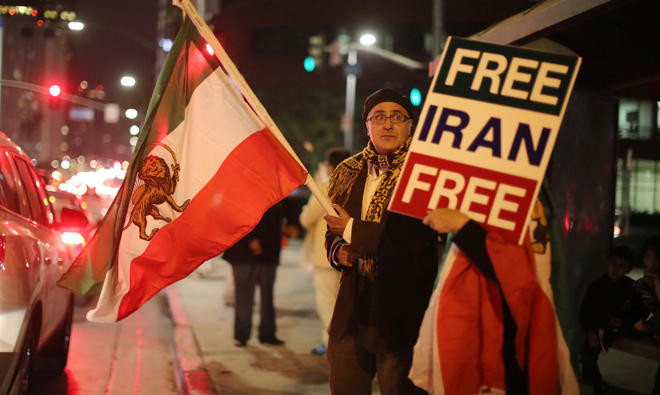
LA's Iranian community cheers anti-regime protests
LA's Iranian community cheers anti-regime protests

Latest updates


© 2026 SAUDI RESEARCH & PUBLISHING COMPANY, All Rights Reserved And subject to Terms of Use Agreement.