18 dead, 260 injured, in South Africa passenger train crash

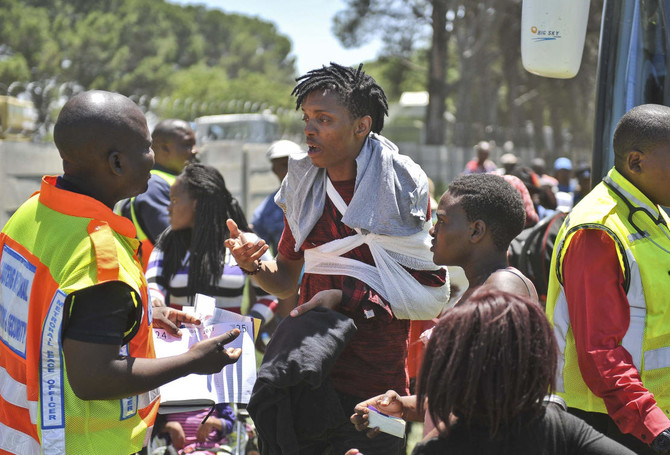
An injured passenger receives attention at the scene of a train accident near Kroonstad, South Africa, Thursday, Jan 4, 2018. South Africa’s transport minister says at least 12 people died and more than 260 were injured in a collision between a truck and a passenger train (AP)
Updated 05 January 2018
Follow

18 dead, 260 injured, in South Africa passenger train crash

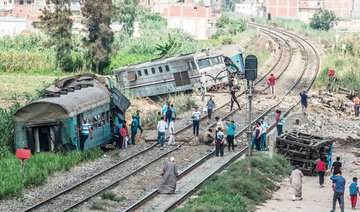
KROONSTAD: A passenger train smashed into a truck at a level crossing in South Africa on Thursday, killing at least 14 people, injuring 190 and throwing several carriages off the rails.
Flames ripped through the twisted wreckage and choking black smoke rose into the air as desperate passengers clambered out of the train to escape the inferno.
Tiaan Esterhuizen, who was traveling on the train as he returned from holiday, attempted to rescue three women who were trapped in a burning passenger wagon.
“I saw around 12 cars on their side and one was already burning. We heard some women screaming when we came closer’ so a few of us climbed over the cars,” he told the Times LIVE news site.
“Two of the women were sort of on top of each other. Another was further back. Her legs were trapped. One of the women was shouting that there was a baby inside also.
“We searched but could not find the child... I am quite sure those women burned to death.”
Rescuers rushed to the scene to search for survivors and treat the injured. Officials warned the toll could rise as operations continued to clear the crash site.
“Police are investigating. The truck driver was taking chances... that cost lots of lives,” Transport Minister Joe Maswanganyi told reporters at the scene.
“The truck driver has been taken to hospital where we are going to do a blood test to verify if he was sober or not, or what was the problem.”

The Shosholoza Meyl rail company, which operates long-distance trains in South Africa, said the train traveling from Port Elizabeth to Johannesburg collided with the truck at about 09:00 am (0700 GMT).
It said the truck had made an “untimely” crossing of the tracks when it was hit by a train at high speed, between the towns of Hennenman and Kroonstad, 200 kilometers (125 miles) southwest of Johannesburg.
One of the derailed carriages was the power generator behind the locomotive car. It caught fire and the flames spread rapidly.
Shosholoza Meyl said there were 429 passengers on board, though Maswanganyi put the number at 730.
“The death toll has increased to 14,” provincial government health spokesman Mondli Mvambi told AFP, adding that at least 190 people had been injured — two of them critically.
“It is feared that they could find more bodies as the search, recovery and rescue work is ongoing,” he said.
The number of injury reports also varied widely in the immediate aftermath of the crash.
“We still have to lift the carriages to see to whether there are any other people that are still trapped there or not. We still don’t know what is underneath,” said one railway official at the accident site, promising a full investigation.
Some victims were treated on a strip of grass beside the railway line while others were taken to hospital. Uninjured passengers waited on a nearby road, some of them carrying their luggage.
The New Year is a busy period for transport in South Africa, with railways and roads carrying passengers returning to work after the holidays.
In 2015, 15 people were killed in eastern South Africa when a mini-bus taxi fell from a bridge onto railway tracks and was hit by a train.

Deadly militant offensive sweeps northern and eastern Burkina Faso

Updated 6 sec ago
Follow

Deadly militant offensive sweeps northern and eastern Burkina Faso

  • Burkina Faso, ruled by a military junta since September 2022, has faced more than 10 years of raids by groups linked to Al-Qaeda and the Daesh
ABIDJAN: Al-Qaeda-affiliated JNIM has in recent days claimed to have inflicted heavy losses in Burkina Faso as a surge in deadly militant attacks sweeps across the Sahelian state.
Burkina Faso, ruled by a military junta since September 2022, has faced more than 10 years of raids by groups linked to Al-Qaeda and the Daesh, including the Group for the Support of Islam and Muslims (JNIM).
A February UN Security Council report noted that the “pace of JNIM attacks” had slowed in September as fighters were diverted to Mali to back an attempted fuel blockade.
“The group’s efforts in Mali have been the primary focus since early September last year,” said Heni Nsaibia, analyst at conflict monitor ACLED.
But attacks never fully stopped, and JNIM has launched a string of large-scale assaults in northern and eastern Burkina Faso since mid-February, killing dozens, including civilians.
“Since February 14, JNIM has claimed responsibility for 10 attacks across different regions of Burkina Faso,” said Hasret Kargin, an Africa studies researcher at intelligence firm Mintel World.
Deadly assaults
The deadliest incidents targeted Titao’s military base on February 15 in the northwest, where the group says it killed dozens of soldiers.
A separate ambush on the same day left around 50 forestry officers dead in Tandjari in the east.
Around 10 civilians were also killed in Titao, including seven Ghanaian traders.
“This latest round demonstrated a high degree of coordination, given the number of large-scale attacks that occurred between 12 and 22 February,” Nsaibia said.
“Over 130 people” — Burkinabe soldiers, civilian auxiliaries and JNIM fighters — “were killed in this series of battles.”
Kargin noted that JNIM has issued no formal statement explaining the recent uptick after several months of reduced activity.
But militant groups often strike “right before and during” the Muslim holy month of Ramadan, he said, adding current dry-season conditions had helped them on the ground.
‘Smuggling zones’
Recent attacks have gripped the country’s north and east, areas seen as financial hubs for Al-Qaeda’s Sahel branch.
“These are zones with numerous gold sites and key routes that fuel the group’s smuggling activities,” a Burkinabe security analyst said, requesting anonymity.
The north “acts as a bridge” to JNIM’s “main central command” in Mali, Kargin said, while he east — home to a vast nature reserve straddling Niger, Benin and Burkina Faso — allows the group to push into neighboring countries.
The forests, he added, both shield fighters from airstrikes and generate income through illegal timber sales and control of artisanal gold mining.
The Tandjari attack near regional capital Fada N’Gourma highlights JNIM’s growing freedom of movement after having “gained a lot of ground in recent years,” Nsaibia said.
“The question is not the frequency of attacks — they never stopped — but how these groups are able to inflict such heavy losses” when the army claims to be better equipped and better organized, said a Burkinabe political scientist.
The army, which rarely comments on attacks, said in mid-February it now controls 74 percent of national territory, with some “600 villages retaken.”
According to the UN report, JNIM recently appointed a senior leader in eastern Burkina Faso tasked with expanding into Benin, Ivory Coast, Ghana, Niger and Togo.