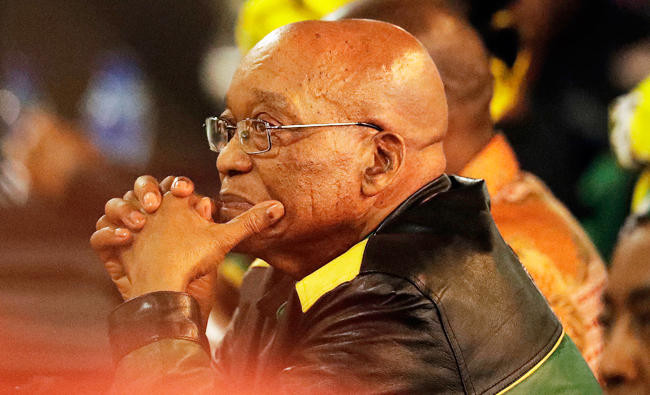
JOHANNESBURG: South Africa’s top court on Friday ruled that Parliament failed to hold President Jacob Zuma to account in a scandal over multi-million-dollar upgrades to his private home, in a decision that fueled opposition calls for the president to be impeached.
The Constitutional Court’s ruling followed its conclusion last year that Zuma violated the constitution when he benefited inappropriately from state funding for his Nkandla home. It was one of a series of presidential scandals that have tarnished the reputation of the ruling African National Congress (ANC), the main anti-apartheid movement that has led South Africa since the first all-race elections in 1994.
Zuma has survived opposition efforts to oust him in votes of no confidence in Parliament, where the ANC party has a majority. Frustrated by setbacks in the National Assembly, the opposition went to court as part of their campaign to impeach Zuma, who has lost support among ruling party loyalists.
Zuma was replaced as party leader this month by Deputy President Cyril Ramaphosa, a critic of the corruption that has undermined South Africa’s economy.
“We conclude that the assembly did not hold the president to account,” said Chris Jafta, a Constitutional Court judge who read out the ruling.
He called for Parliament to institute rules that would provide for a president’s removal. Parliament said in a statement that it would comply with the instruction.
The Democratic Alliance, South Africa’s main opposition party, said its motion to impeach Zuma should be debated in Parliament “as soon as reasonably possible.”
The court ruling cited a constitutional provision that says Parliament “may remove” a president from office by a two-thirds majority for a “serious violation” of the law, as well as a separate requirement that constitutional obligations must be “performed diligently and without delay.”
Chief Justice Mogoeng Mogoeng disagreed with the majority ruling, describing it as judicial overreach.
The ruling party said it will study the ruling and discuss it at a high-level meeting on Jan. 10.

South African president suffers another legal setback
Trump says Iran ‘want to negotiate’ after reports of hundreds killed in protests
- US President Donald Trump said Sunday that Iran’s leadership had called him seeking “to negotiate” after he repeatedly threatened to intervene militarily if Tehran killed protesters
WASHINGTON: US President Donald Trump said Sunday that Iran’s leadership had called him seeking “to negotiate” after he repeatedly threatened to intervene militarily if Tehran killed protesters.
For two weeks, Iran has been rocked by a protest movement that has swelled in spite of a crackdown rights groups warn has become a “massacre.”
Initially sparked by anger over the rising cost of living, the demonstrations have evolved into a serious challenge of the theocratic system in place since the 1979 revolution.
Information has continued to trickle out of Iran despite a days-long Internet shutdown, with videos filtering out of capital Tehran and other cities over the past three nights showing large demonstrations.
As reports emerge of a growing protest death toll, and images show bodies piled outside a morgue, Trump said Tehran indicated its willingness to talk.
“The leaders of Iran called” yesterday, Trump told reporters aboard Air Force One, adding that “a meeting is being set up... They want to negotiate.”
He added, however, that “we may have to act before a meeting.”
The US-based Center for Human Rights in Iran (CHRI) said it had received “eyewitness accounts and credible reports indicating that hundreds of protesters have been killed across Iran during the current Internet shutdown.”
“A massacre is unfolding,” it said.
The Norway-based NGO Iran Human Rights (IHR) said it confirmed the killing of at least 192 protesters but that the actual toll could be much higher.
“Unverified reports indicate that at least several hundreds, and according to some sources, more than 2,000 people may have been killed,” said IHR.
More than 2,600 protesters have been arrested, IHR estimates.
A video circulating on Sunday showed dozens of bodies accumulating outside a morgue south of Tehran.
The footage, geolocated by AFP to Kahrizak, showed bodies wrapped in black bags, with what appeared to be grieving relatives searching for loved ones.
- Near paralysis -
In Tehran, an AFP journalist described a city in a state of near paralysis.
The price of meat has nearly doubled since the start of the protests, and many shops are closed. Those that do open must close at around 4:00 or 5:00 pm, when security forces deploy en masse.
There were fewer videos showing protests on social media Sunday, but it was not clear to what extent that was due to the Internet shutdown.
One widely shared video showed protesters again gathering in the Pounak district of Tehran shouting slogans in favor of the ousted monarchy.
The protests have become one of the biggest challenges to the rule of supreme leader Ayatollah Ali Khamenei, 86, coming in the wake of Israel’s 12-day war against the Islamic republic in June, which was backed by the United States.
State TV has aired images of burning buildings, including a mosque, as well as funeral processions for security personnel.
But after three days of mass actions, state outlets were at pains to present a picture of calm returning, broadcasting images of smooth-flowing traffic on Sunday. Tehran Governor Mohammad-Sadegh Motamedian insisted in televised comments that “the number of protests is decreasing.”
The Iranian government on Sunday declared three days of national mourning for “martyrs” including members of the security forces killed.
President Masoud Pezeshkian also urged Iranians to join a “national resistance march” Monday to denounce the violence.
In response to Trump’s repeated threats to intervene, Iran’s parliament speaker Mohammad Bagher Ghalibaf said Iran would hit back, calling US military and shipping “legitimate targets” in comments broadcast by state TV.
- ‘Stand with the people’ -
Reza Pahlavi, the US-based son of Iran’s ousted shah, who has emerged as an anti-government figurehead, said he was prepared to return to the country and lead a democratic transition.
“I’m already planning on that,” he told Fox News on Sunday.
He later urged Iran’s security forces and government workers to join the demonstrators.
“Employees of state institutions, as well as members of the armed and security forces, have a choice: stand with the people and become allies of the nation, or choose complicity with the murderers of the people,” he said in a social media post.
He also urged protesters to replace the flags outside of Iranian embassies.
“The time has come for them to be adorned with Iran’s national flag,” he said.
The ceremonial, pre-revolution flag has become an emblem of the global rallies that have mushroomed in support of Iran’s demonstrators.
In London, protesters managed over the weekend to swap out the Iranian embassy flag, hoisting in its place the tri-colored banner used under the last shah.
For two weeks, Iran has been rocked by a protest movement that has swelled in spite of a crackdown rights groups warn has become a “massacre.”
Initially sparked by anger over the rising cost of living, the demonstrations have evolved into a serious challenge of the theocratic system in place since the 1979 revolution.
Information has continued to trickle out of Iran despite a days-long Internet shutdown, with videos filtering out of capital Tehran and other cities over the past three nights showing large demonstrations.
As reports emerge of a growing protest death toll, and images show bodies piled outside a morgue, Trump said Tehran indicated its willingness to talk.
“The leaders of Iran called” yesterday, Trump told reporters aboard Air Force One, adding that “a meeting is being set up... They want to negotiate.”
He added, however, that “we may have to act before a meeting.”
The US-based Center for Human Rights in Iran (CHRI) said it had received “eyewitness accounts and credible reports indicating that hundreds of protesters have been killed across Iran during the current Internet shutdown.”
“A massacre is unfolding,” it said.
The Norway-based NGO Iran Human Rights (IHR) said it confirmed the killing of at least 192 protesters but that the actual toll could be much higher.
“Unverified reports indicate that at least several hundreds, and according to some sources, more than 2,000 people may have been killed,” said IHR.
More than 2,600 protesters have been arrested, IHR estimates.
A video circulating on Sunday showed dozens of bodies accumulating outside a morgue south of Tehran.
The footage, geolocated by AFP to Kahrizak, showed bodies wrapped in black bags, with what appeared to be grieving relatives searching for loved ones.
- Near paralysis -
In Tehran, an AFP journalist described a city in a state of near paralysis.
The price of meat has nearly doubled since the start of the protests, and many shops are closed. Those that do open must close at around 4:00 or 5:00 pm, when security forces deploy en masse.
There were fewer videos showing protests on social media Sunday, but it was not clear to what extent that was due to the Internet shutdown.
One widely shared video showed protesters again gathering in the Pounak district of Tehran shouting slogans in favor of the ousted monarchy.
The protests have become one of the biggest challenges to the rule of supreme leader Ayatollah Ali Khamenei, 86, coming in the wake of Israel’s 12-day war against the Islamic republic in June, which was backed by the United States.
State TV has aired images of burning buildings, including a mosque, as well as funeral processions for security personnel.
But after three days of mass actions, state outlets were at pains to present a picture of calm returning, broadcasting images of smooth-flowing traffic on Sunday. Tehran Governor Mohammad-Sadegh Motamedian insisted in televised comments that “the number of protests is decreasing.”
The Iranian government on Sunday declared three days of national mourning for “martyrs” including members of the security forces killed.
President Masoud Pezeshkian also urged Iranians to join a “national resistance march” Monday to denounce the violence.
In response to Trump’s repeated threats to intervene, Iran’s parliament speaker Mohammad Bagher Ghalibaf said Iran would hit back, calling US military and shipping “legitimate targets” in comments broadcast by state TV.
- ‘Stand with the people’ -
Reza Pahlavi, the US-based son of Iran’s ousted shah, who has emerged as an anti-government figurehead, said he was prepared to return to the country and lead a democratic transition.
“I’m already planning on that,” he told Fox News on Sunday.
He later urged Iran’s security forces and government workers to join the demonstrators.
“Employees of state institutions, as well as members of the armed and security forces, have a choice: stand with the people and become allies of the nation, or choose complicity with the murderers of the people,” he said in a social media post.
He also urged protesters to replace the flags outside of Iranian embassies.
“The time has come for them to be adorned with Iran’s national flag,” he said.
The ceremonial, pre-revolution flag has become an emblem of the global rallies that have mushroomed in support of Iran’s demonstrators.
In London, protesters managed over the weekend to swap out the Iranian embassy flag, hoisting in its place the tri-colored banner used under the last shah.
© 2026 SAUDI RESEARCH & PUBLISHING COMPANY, All Rights Reserved And subject to Terms of Use Agreement.