ANKARA: Turkey’s religious affairs state agency came under heavy criticism on Thursday from the main opposition party after it reportedly said girls as young as nine could marry under Islamic law.
The Diyanet religious affairs directorate said on Tuesday the minimum age for girls to marry was nine, while for boys it was 12, according to Turkish media including Hurriyet daily quoting the agency’s official website.
The post, which took the form of an explanatory statement on Islamic law, has since been taken down, after a backlash from the opposition and women’s rights groups.
The head of the High Commission of Religious Affairs Ekrem Keles on Thursday told Hurriyet that the earliest age for a girl to marry is 17 and 18 for a boy.
“Forget a nine or a 10 year old child marrying, a child at 15 should not marry and should not be married,” he said.
The legal age to get married in Turkey is 18.
But Turkish law says that in an extraordinary circumstance, a judge can give permission for a male and female aged 16 to marry.
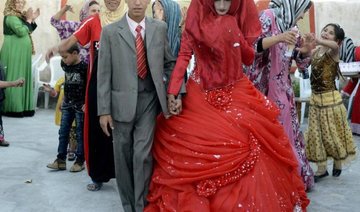
The controversy touched a nerve in Turkey, where child marriages are not uncommon and the fight continues to raise girls’ level of education.
Main opposition Republican People’s Party (CHP) lawmaker Gaye Usluer accused the government of being “more interested in how to marry children at a young age when there needs to be talk on children’s education, health.”
Meanwhile CHP lawmaker Murat Bakan on Twitter said child marriages “violates children’s rights, women’s rights and human rights,” adding that the party had called for a parliamentary investigation into child marriages.
Women’s rights groups also criticized the agency, which is similar to a religious affairs ministry, accusing it of trying to legitimize child abuse and urging Diyanet to “get their hands off our children.”
The ministry said it had “never and will never approve early marriages” in a statement, saying it was only defining Islamic law.
“Forcing girls to marry before psychological and biological maturity, and before they obtain the responsibility to become a mother and form a family is not compatible with Islam which says will and consent are conditions for marriage,” it added.
Women’s groups as well as Usluer raised concern over Diyanet’s move coming after Turkish President Recep Tayyip Erdogan approved a controversial law in November allowing state-approved clerics to conduct marriage ceremonies.
“When we said ‘if you give muftis (clerics employed by Diyanet) the power to conduct marriages, the issue of child brides will increase’, this is what we meant,” she said, according to CHP’s website.
Opponents often claim that Erdogan and his Islamic-rooted Justice and Development Party are attacking the republic’s secular foundations, claims dismissed by the government.
In 2016, the government was forced to throw out a bill that could have pardoned men convicted of child-sex assault after a public outcry.


Outrage in Turkey over ‘child marriage green light’

Outrage in Turkey over ‘child marriage green light’
Related




Jordanian king and Indonesian president to cooperate in stability efforts in Gaza
- Indonesian President Prabowo Subianto emphasized his country’s commitment to establishing an independent Palestinian state
- King Abdullah stressed the importance of dialogue to reduce tensions related to Iran and to support stability in Syria and Lebanon
LONDON: King Abdullah II and Indonesian President Prabowo Subianto discussed cooperation in an effort to restore stability in the Palestinian coastal enclave of Gaza.
The meeting on Wednesday at Basman Palace in Amman focused on regional issues, particularly the support for achieving peace based on the two-state solution, and the commitment to protecting Palestinians in Gaza, according to Petra news agency.
King Abdullah praised Indonesia’s political position and highlighted its investments in regional projects as essential to enhancing collaboration.
Subianto emphasized his country’s commitment to establishing an independent Palestinian state, achieving lasting peace in the region, and ending the conflict in Gaza.
The talks highlighted the ties between Jordan and Indonesia, spanning over 75 years, and the commitment to enhancing cooperation in politics, economics, defense, business, energy, science, technology, and health.
King Abdullah stressed the importance of dialogue to reduce tensions related to Iran and support the Syrian Arab Republic and Lebanon in maintaining their security, sovereignty, and stability, Petra added.
Several Jordanian officials attended the talk, including Crown Prince Hussein, Deputy Prime Minister and Foreign Minister Ayman Safadi, Chairman of the Joint Chiefs of Staff Maj. Gen. Yousef Huneiti, Director of the Office of His Majesty Alaa Batayneh, and Minister of Industry, Trade, and Supply, and Escort of Honour Yarub Qudah.


