SINGAPORE: Singapore banned a documentary featuring a Palestinian teenager charged with assaulting Israeli security forces from being screened at a festival Thursday, warning the “inflammatory” work could stir hatred.
The city-state’s media regulator said the film, “Radiance of Resistance,” had a “skewed narrative” and could cause divisions among its ethnically diverse population.
Most of Singapore’s 5.6 million inhabitants are ethnic Chinese but it is also home to substantial Muslim Malay and Indian minorities, as well as many expatriates. It has strict laws against anything seen as provoking disharmony.
The film was due to be shown Thursday at the Singapore Palestinian Film Festival, which showcases works by Palestinian filmmakers and artists and has been running since 2016.
Four other films will still be screened at the festival, according to its website.
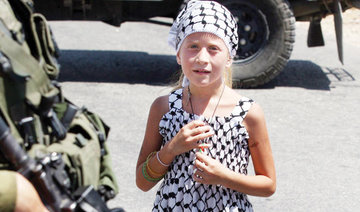
The banned work looked at the lives of two young girls presented as the new faces of Palestinian resistance to the Israeli military occupation.
One of the girls, 16-year-old Ahed Tamimi, has been hailed as a hero by Palestinians who see her as bravely standing up to Israel’s occupation but Israelis accuse her family of using her as a pawn in staged provocations.
She was charged in an Israeli military court Monday with several offenses, including assault, after a video of her kicking and slapping two Israeli soldiers in the West Bank went viral.
The charges relate to the events in the video but also five other incidents.
“In holding up the girls as role models to be emulated in an ongoing conflict, the film incites activists to continue their resistance against the alleged oppressors,” Singapore’s Infocomm Media Development Authority said on its website.
“The skewed narrative of the film is inflammatory and has the potential to cause disharmony among the different races and religions in Singapore.”
Film festival organizer Adela Foo told AFP she respected the decision and would not appeal.
“Naturally, I am a little sad and disappointed,” said Foo, a 23-year-old student. A film was also banned at the 2016 edition of the festival, she said.
Singapore and Israel have a friendly relationship, unlike some of the city-state’s Muslim-majority neighbors who have no diplomatic ties with the country.


Singapore bans ‘inflammatory’ Palestinian film

Singapore bans ‘inflammatory’ Palestinian film



Trending: BBC report suggests sexual abuse and torture in UAE-run Yemeni prisons
- The investigation was produced by British-Yemeni BBC journalist Nawal Al-Maghafi
LONDON: A recent BBC video report diving into what it says was UAE-run prison in Yemen has drawn widespread attention online and raised fresh questions about the role of the emirates in the war-torn country.
The report, published earlier this month and recently subtitled in Arabic and shared on social media, alleged that the prison — located inside a former UAE military base — was used to detain and torture detainees during interrogations, including using sexual abuse as a method.
The investigation was produced by British-Yemeni BBC journalist Nawal Al-Maghafi, who toured the site, looking into cells and what appear to be interrogation rooms.
Al-Maghafi said the Yemeni government invited the BBC team to document the facilities for the first time.
A former detainee, speaking anonymously, described severe abuse by UAE soldiers: “When we were interrogated, it was the worst. They even sexually abused us and say they will bring in the doctor. The ‘so-called’ doctor was an Emirati soldier. He beat us and ordered the soldiers to beat us too. I tried to kill myself multiple times to make it end.”
Yemeni information minister, Moammar al Eryani also appears in the report, clarifying that his government was unable to verify what occurred within sites that were under Emirati control.
“We weren’t able to access locations that were under UAE control until now,” he said, adding that “When we liberated it (Southern Yemen), we discovered these prisons, even though we were told by many victims that these prisons exist, but we didn't believe it was true.”
زارت بي بي سي مواقع داخل قواعد سابقة لدولة الإمارات العربية المتحدة في اليمن، حيث يقول محتجزون إنهم تعرضوا لسوء المعاملة. pic.twitter.com/BfS5GRxULp
— BBC News عربي (@BBCArabic) January 23, 2026
The BBC says it approached the UAE government for comment, however Abu Dhabi did not respond to its inquiries.
Allegations of secret detention sites in southern Yemen are not new. The BBC report echoes earlier reporting by the Associated Press (AP), which cited hundreds of men detained during counterterrorism operations that disappeared into a network of secret prisons where abuse was routine and torture severe.
In a 2017 investigation, the AP documented at least 18 alleged clandestine detention sites — inside military bases, ports, an airport, private villas and even a nightclub — either run by the UAE or Yemeni forces trained and backed by Abu Dhabi.
The report cited accounts from former detainees, relatives, civil rights lawyers and Yemeni military officials.
Following the investigation, Yemen’s then-interior minister called on the UAE to shut down the facilities or hand them over, and said that detainees were freed in the weeks following the allegations.
The renewed attention comes amid online speculation about strains between Saudi Arabia and the UAE over Yemen.


