Palestinian teen in ‘slap video’ back at center of propaganda war

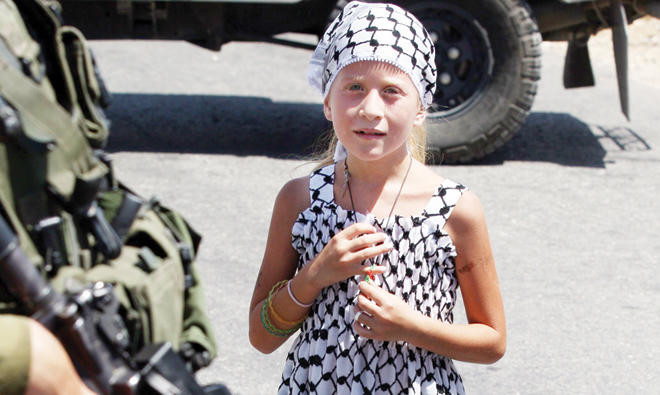
Palestinian Ahed Tamimi wearing a dress made of the traditional Palestinian cloth during a protest against the expropriation of Palestinian land to expand the Jewish settlement of Halmish in the occupied West Bank in this Aug. 6, 2010 photo. (AFP)
Updated 28 December 2017
Follow

Palestinian teen in ‘slap video’ back at center of propaganda war

JERUSALEM: Ahed Tamimi is only a teenager, but has repeatedly been at the center of the seemingly endless propaganda war between Israelis and Palestinians, with a video of her slapping soldiers the latest example.
Tamimi, 16 and recognizable by her shock of blonde hair, has been held up by Palestinians and other supporters as a brave opponent of Israel’s occupation of the West Bank.
A years-old photograph of her raising her fist at a soldier was widely published and led to her being received by then Turkish Prime Minister Recep Tayyip Erdogan in 2012.
She was also photographed while wearing a Tweety Bird shirt and biting the hand of an Israeli soldier in 2015 to try to stop the arrest of a brother.
But for Israeli officials, she is being made to star in staged provocations by her family, prominent activists who have been at the forefront of protests in their village of Nabi Saleh near Ramallah.
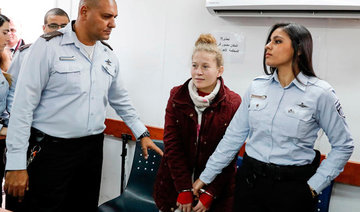
The latest incident led to her arrest on Dec. 19 along with that of her mother and cousin. She has been detained since and is due to appear in military court again later Thursday.
The three appeared in a video that went viral after it was recorded on Dec. 15 in Nabi Saleh.
It showed Tamimi and her cousin approaching two Israeli soldiers before shoving, kicking and slapping them.
The heavily armed soldiers do not respond in the face of what appears to be an attempt to provoke rather than seriously harm them.
They then move backward after Tamimi’s mother Nariman becomes involved.
Tamimi’s father argues that her blonde hair and Western dress have contributed to the attention she has received.
“If she was veiled and dark-skinned, would she have got the same attention?” Bassem Tamimi told AFP.
“The Zionist propaganda machine always depicts the Palestinian as dark-skinned and ugly, attacking the blonde victim, but now she is blonde.”
Michael Oren, a former Israeli ambassador to the US and currently a deputy minister for diplomacy, accused the Tamimis of using children as pawns, however.
“The Tamimi family — which may not be a real family — dresses up kids in American clothes and pays them to provoke (Israeli) troops on camera,” he wrote on Twitter.
“This cynical and cruel use of children constitutes abuse. Human rights organizations must investigate!”
Since her arrest early on Dec. 19, responses from either side could not be further apart.
Palestinian President Mahmoud Abbas has called her father and commended the family’s resistance against Israel’s occupation, official news agency WAFA reported.
Supporters have accused Israeli authorities of arresting a teenager who was only standing up for the rights of her fellow Palestinians.
The incident occurred during a day of clashes across the West Bank against US President Donald Trump’s controversial recognition of Jerusalem as Israel’s capital.
Violence since Trump’s decision has left 12 Palestinians dead, with most killed in clashes with Israeli forces.
The Tamimi family says a relative was shot in the head with a rubber bullet during protests on Dec. 15.
Israelis were divided over the viral video, with some praising the soldiers’ restraint and others saying it showed weakness and merited a tougher response.
Bassem Tamimi describes his daughter as “shy,” but “someone who is mature enough to reject the occupation responsibly.”
She had in the past wanted to become a professional football player, but has since decided to study law to defend her family and village against an Israeli occupation that has lasted more than 50 years, he said.
Regarding criticism of his family, Bassem Tamimi said “we don’t have to respond or defend ourselves,” calling it an attempt to distract from their cause.
But he said he fears his daughter will be imprisoned over the latest incident, particularly because it has become “a case of public opinion” in Israel.


Palestinians wait at border between Gaza and Egypt as uncertainty clouds reopening of Rafah crossing

Updated 04 February 2026
Follow

Palestinians wait at border between Gaza and Egypt as uncertainty clouds reopening of Rafah crossing

  • At that pace, long waits are facing most of the roughly 20,000 sick and wounded people who Gaza’s Health Ministry has said need treatment abroad
  • Reopening the crossing is considered key as the ceasefire agreement moves into a complicated second phase
  • The bus with about 40 Palestinians that entered Gaza via Rafah on Tuesday arrived at Nasser hospital in Khan Younis early Wednesday morning, where their families welcomed them after spending the entire day waiting

KHAN YOUNIS, Gaza Strip: Palestinians gathered on both sides of Gaza’s border with Egypt on Tuesday hoping to pass through the Rafah crossing, after its reopening the previous day was marred by delays, interrogations and uncertainty over who would be allowed to cross.
On the Egyptian side were Palestinians who fled Gaza earlier in the Israel-Hamas war to seek medical treatment, according to Egypt’s state-run Al-Qahera News television. On the Gaza side, Palestinians in need of medical care that is unavailable in Gaza gathered at a hospital before ambulances moved toward Rafah, hoping for word that they would be allowed to cross the other way.
The office of the North Sinai governor confirmed Tuesday that an unknown number of patients and their companions had crossed from Gaza into Egypt.
The bus with about 40 Palestinians that entered Gaza via Rafah on Tuesday arrived at Nasser hospital in Khan Younis early Wednesday morning, where their families welcomed them after spending the entire day waiting.
Though hailed as a step forward for the fragile ceasefire struck in October, it took more than 10 hours for only about a dozen returnees and a small group of medical evacuees to cross in each direction on the first day Rafah reopened.
Three women who crossed into Gaza on Monday told The Associated Press on Tuesday that Israeli troops blindfolded and handcuffed them, then interrogated and threatened them, holding them for several hours before they were released.
The numbers permitted to cross on Monday fell well short of the 50 people that officials had said would be allowed each way and barely began to address the needs of tens of thousands of Palestinians who are hoping to be evacuated for treatment or to return home.
The import of humanitarian aid or goods through Rafah remains prohibited.
’Not a solution to the crisis’
Evacuation efforts on Tuesday morning converged around a Red Crescent hospital in Khan Younis, where a World Health Organization team arrived and a vehicle carrying patients and their relatives rolled in from another hospital. Then the group of WHO vehicles and Palestinian ambulances headed toward Rafah to await crossing.
As the sick, wounded and displaced waited to cross in both directions, health officials said the small number allowed to exit so far paled beside Gaza’s tremendous needs. Two years of fighting destroyed much of its medical infrastructure and left hospitals struggling to treat trauma injuries, amputations and chronic conditions like cancer.
In Gaza City, Shifa Hospital director Mohamed Abu Selmiya called the pace “crisis management, not a solution to the crisis,” imploring Israel to permit the importing of medical supplies and equipment. He wrote on Facebook: “Denying the evacuation of patients and preventing the entry of medicines is a death sentence for them.”
UN and WHO officials said the trickle of patients allowed out and restrictions on bringing in desperately needed supplies are prolonging a disastrous situation in Gaza.
“Rafah must function as a real humanitarian corridor so we can have a surge in aid deliveries,” said Tom Fletcher, the UN’s top relief official.
Palestinian Red Crescent spokesperson Raed Al-Nims told AP that only 16 patients with chronic conditions or war wounds, accompanied by 40 relatives, were brought from Khan Younis to the Gaza side of Rafah on Tuesday — less than the 45 patients and wounded the Red Crescent was told would be allowed.
After days of anticipation over the reopening, hope lingered that it might mark a meaningful first step. In Khan Younis, Iman Rashwan waited for hours until her mother and sister returned from Egypt, hoping others would soon see their loved ones again.
Waiting on both sides
Officials say the number of crossings could gradually increase if the system works, with Israel and Egypt vetting those allowed in and out. But security concerns and bureaucratic snags quickly tempered expectations raised by officials who for weeks had cast reopening as a major step in the ceasefire deal.
There were delays on Monday over disagreements about luggage allowances. Returnees were carrying more than anticipated with them, requiring additional negotiations, a person familiar with the situation told the AP, speaking on condition of anonymity to discuss the diplomatic matter.
“They didn’t let us cross with anything,” Rotana Al-Regeb said as she returned around midnight Monday to Khan Younis. “They emptied everything before letting us through. We were only allowed to take the clothes on our backs and one bag per person.”
The initial number of Palestinians allowed to cross is mostly symbolic. Israeli and Egyptian officials have said that 50 medical evacuees would depart — along with two caregiver escorts — and 50 Palestinians who left during the war would return.
At that pace, long waits are facing most of the roughly 20,000 sick and wounded people who Gaza’s Health Ministry has said need treatment abroad. About 150 hospitals across Egypt are ready to receive patients, authorities said.
Who and what would be allowed through Rafah was a central concern for both Israel and Egypt.
Israeli Prime Minister Benjamin Netanyahu has said that anyone who wants to leave will eventually be permitted to do so, but Egypt has repeatedly said the Rafah crossing must open in both directions, fearing Israel could use it to push Palestinians out of Gaza.
Reopening the crossing is considered key as the ceasefire agreement moves into a complicated second phase. That calls for installing a new Palestinian committee to govern Gaza, deploying an international security force, disarming Hamas and taking steps to begin rebuilding.
In a meeting Tuesday with US special envoy Steve Witkoff in Jerusalem, Netayanhu repeated Israel’s “uncompromising demand” that Hamas be disarmed before any reconstruction begins, the prime minister’s office said.
A 19-year-old killed in southern Gaza
Nasser Hospital in Khan Younis said Ahmed Abdel-Al, 19, was shot and killed by Israeli troops on Tuesday morning in a part of the southern Gaza City, some distance away from the area under the Israeli military’s control.
Israel’s military said it was not immediately aware of any shootings in the area.
Abdel-Al was the latest of the 529 Palestinians killed by Israeli fire since the Oct. 10 start of the ceasefire, according to Gaza’s Health Ministry. They are among more than 71,800 Palestinians killed since the start of the war, according to the ministry, which does not distinguish between fighters and civilians.
The ministry, part of Gaza’s Hamas-led government, keeps detailed casualty records that are seen as generally reliable by UN agencies and independent experts.